

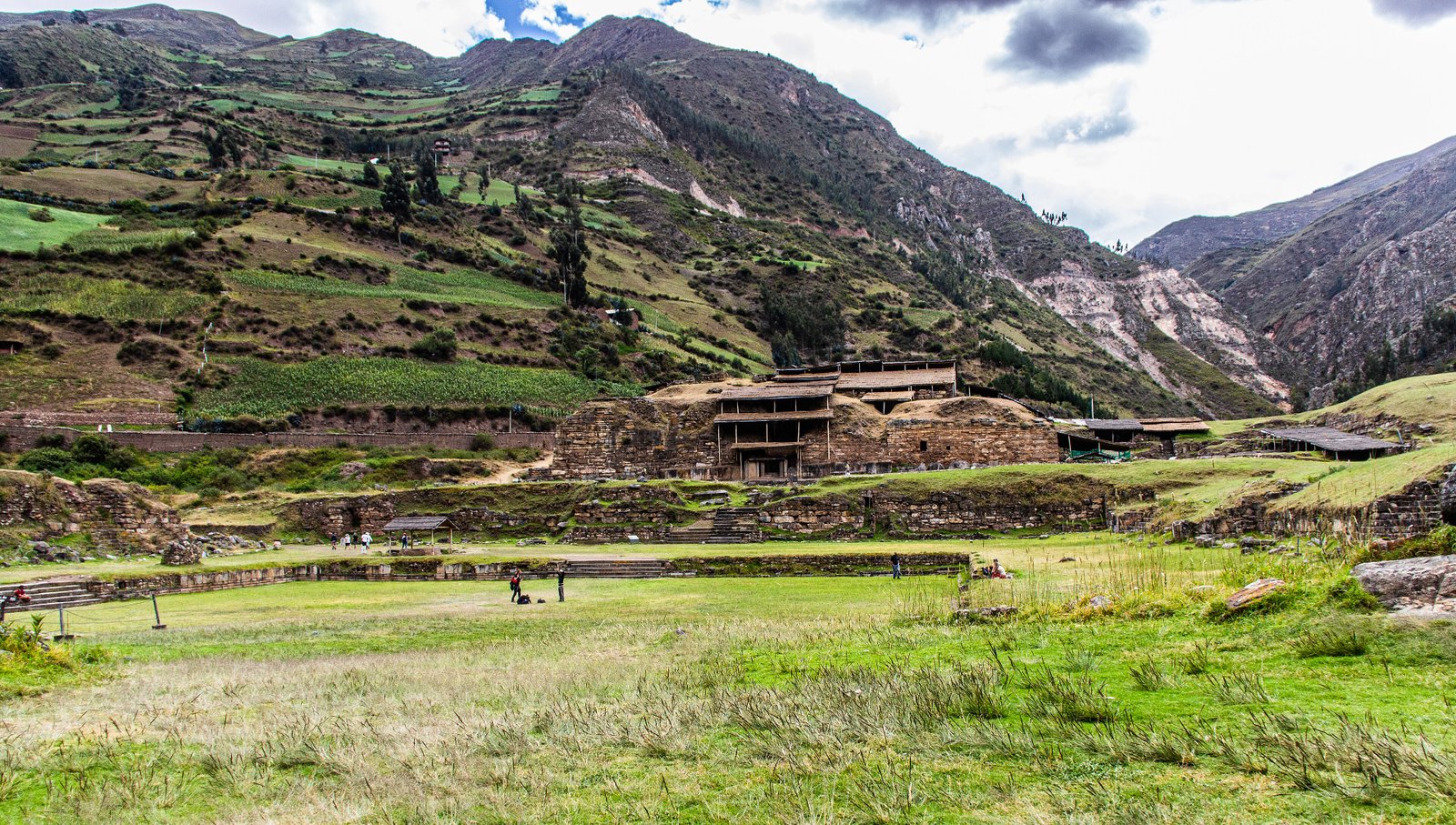
The Oracle at 3,180 Metres
Stand at the entrance to Chavín de Huántar’s underground galleries in near-total darkness, and you hear two things: running water channelled through stone conduits designed 3,000 years ago, and a deep resonant sound — part hum, part roar — that the acoustic architecture of the galleries amplifies and distorts into something unrecognisable, something that bypasses rational cognition and reaches a more primitive register. This was intentional. Chavín’s builders understood acoustics and used them: the gallery system was designed to disorient, to overwhelm, to produce the conditions in which a priest speaking from a hidden chamber would sound like a god.
Chavín de Huántar was the most important ceremonial centre in the ancient Andes between approximately 1200 and 400 BC — the spiritual and political axis of a world that stretched from the Ecuadorian border to the Atacama. It predates Tiwanaku by a thousand years, Wari by 1,500 years, and the Inca Empire by 1,700 years. The civilisation that built it is called Chavín culture (or the Chavín Horizon), and its iconography — the fanged deity, the jaguar, the raptor, the Staff God — spread across the Andes as a unifying visual language that outlasted Chavín’s own influence by centuries.
Site and Setting
The site sits at 3,180 metres in the Callejón de Conchucos, a high valley on the eastern slope of the Cordillera Blanca in the Ancash region of Peru. The location is not accidental: Chavín was built at the confluence of the Mosna and Huachecsa rivers, and the rivers were incorporated into the monument itself. A drainage system of stone-lined canals and conduits channels water beneath and through the platform structures, creating a hydraulic soundscape inside the galleries — the sound of moving water amplified into the acoustic features that made the galleries function as oracle chambers.
The valley setting also created a pilgrimage geography: arriving at Chavín from the lowland jungle to the east or the Pacific coast to the west required crossing the high Andes — an act of physical ordeal that would have prepared pilgrims psychologically for the ritual encounter with the site. Finds of exotic marine shells (Spondylus from Ecuador), obsidian, and tropical bird feathers confirm that Chavín attracted visitors from across the Andean world.
The Galleries and the Lanzón
The underground gallery system beneath Chavín’s main platform has been mapped to approximately 10 kilometres of stone-lined passages — a labyrinthine network at multiple levels with ventilation shafts, water channels, and chambers of varying size. In total darkness, with water sounds and temperature changes and the disorienting weight of several hundred thousand tonnes of stone overhead, the galleries were a calculated assault on consciousness.
At the heart of the oldest gallery — the Lanzon Gallery, which dates to the site’s earliest phase around 1200 BC — stands the Lanzón: a 4.5-metre granite monolith carved with one of the most complex iconographic programmes in Andean art. The figure is a composite deity: humanoid torso, clawed hands and feet, serpent hair, a fanged mouth that terminates in twin upward curving fangs above the head. The Lanzón stands in a cruciform chamber at the intersection of four galleries. It has never been moved. The stone is too large to pass through any of the gallery openings — which means the gallery was built around the Lanzón, not the Lanzón placed inside the gallery. It has occupied this exact position for three millennia.
Chavín Iconography and the Andean Visual Language
The visual language developed at Chavín — what art historians call the Chavín art style — spread across the central Andes between approximately 900 and 200 BC. Its characteristics include: fanged mouths (representing the caiman or the jaguar), serpent appendages sprouting from figures, raptor iconography (particularly the harpy eagle), and a technique of “kenning” where one element of a body contains hidden secondary figures. The same visual vocabulary appears on ceramics in Paracas (south coast of Peru), textiles in the highlands, and carved stone at sites hundreds of kilometres from Chavín.
The spread is not understood as military conquest but as religious diffusion: Chavín appears to have been a pilgrimage centre whose prestige was sufficient to export its iconography, its ritual practices, and possibly its priesthood across the Andes. The Tello Obelisk — a 2.5-metre carved granite shaft now housed in Lima’s National Museum of Anthropology — depicts the caiman deity with an agricultural iconographic programme: it is one of the densest and most complex single objects in Andean art. Julio C. Tello, the Peruvian archaeologist who excavated Chavín from 1919 onward and is considered the father of Peruvian archaeology, brought the obelisk to Lima for preservation.
San Pedro Cactus and Ritual Pharmacology
Among the finds at Chavín are carved stone vessels and bone snuff tubes associated with the ritual use of psychoactive substances — specifically, San Pedro cactus (Echinopsis pachanoi), which contains mescaline. Representations of the cactus appear in the Chavín iconographic programme, and the cactus grows natively in the Andean elevations around the site. The oracle experience at Chavín — darkness, acoustic disorientation, pharmacological preparation — appears to have been a multi-sensory initiation designed to produce states of altered consciousness in which the fanged deity and the voice from the gallery would be experienced as genuinely supernatural.
Julio C. Tello and the Recognition of Chavín’s Importance
Chavín de Huántar was known to colonial Spanish chroniclers, but its significance was not grasped until Julio C. Tello began systematic excavation in 1919. Tello — the first major indigenous Andean archaeologist, born in a village near Chavín — argued that Chavín represented the origin of Andean civilisation rather than a late development, and that it was connected to Amazonian tropical origins rather than coastal influences. His “Chavín Hypothesis” — that all Andean civilisations derived ultimately from Chavín — has been substantially revised, but his identification of Chavín as a primary horizon site was correct.
UNESCO Status, Earthquake Damage, and Ongoing Excavation
Chavín de Huántar was inscribed as a UNESCO World Heritage Site in 1985, one of the earliest Andean sites to receive the designation. The 1970 Ancash earthquake (7.9 magnitude, the deadliest natural disaster in Peruvian history) caused significant structural damage and buried portions of the gallery system under debris. UNESCO-funded restoration work, conducted in partnership with Stanford University’s Chavín de Huántar Archaeological Project from 2008 onward, has cleared and re-opened many galleries. Ongoing excavation — as of 2024, the project continues — regularly produces new finds; a 2022 season revealed previously unmapped gallery sections and additional stone heads that once decorated the exterior walls.
Visiting Chavín de Huántar
Chavín de Huántar is 4 hours by road from Huaraz, the main tourist base in the Ancash region, accessible via a winding mountain route that crosses the Cordillera Blanca through the Cahuish tunnel at 4,516 metres. Acclimatisation at Huaraz for at least one day is recommended before visiting — altitude sickness at 3,180 metres is a real consideration. Tours from Huaraz run daily in season; independent travel by bus is possible but requires an overnight or early start. The site museum (Museo Nacional Chavín) adjacent to the archaeological zone holds the Tello Obelisk replica and other key finds. The Lanzón remains in situ in the gallery — the primary reason to make the journey.
Essential Facts
- Period
- c. 1200–400 BC (Chavín culture / Chavín Horizon)
- Altitude
- 3,180 metres (Callejón de Conchucos, Ancash, Peru)
- Key feature
- 10km underground gallery system; the Lanzón (4.5m fanged granite monolith, in situ)
- Key excavator
- Julio C. Tello, from 1919
- Location
- Chavín de Huántar, Ancash, Peru
- GPS
- 9.5942°S, 77.1780°W
- UNESCO WHS
- 1985
- Access
- 4 hours from Huaraz by road; daily tours in season; acclimatise first
Find it on the map
See this place and what’s around it →📷 Become a Cultural Heritage Online photographer
Share your photos of places: they stay published under your name as the author. The more they're seen, the more you get noticed — and soon a contest will reward the most appreciated photos.
Log in or sign up free to add a photo