
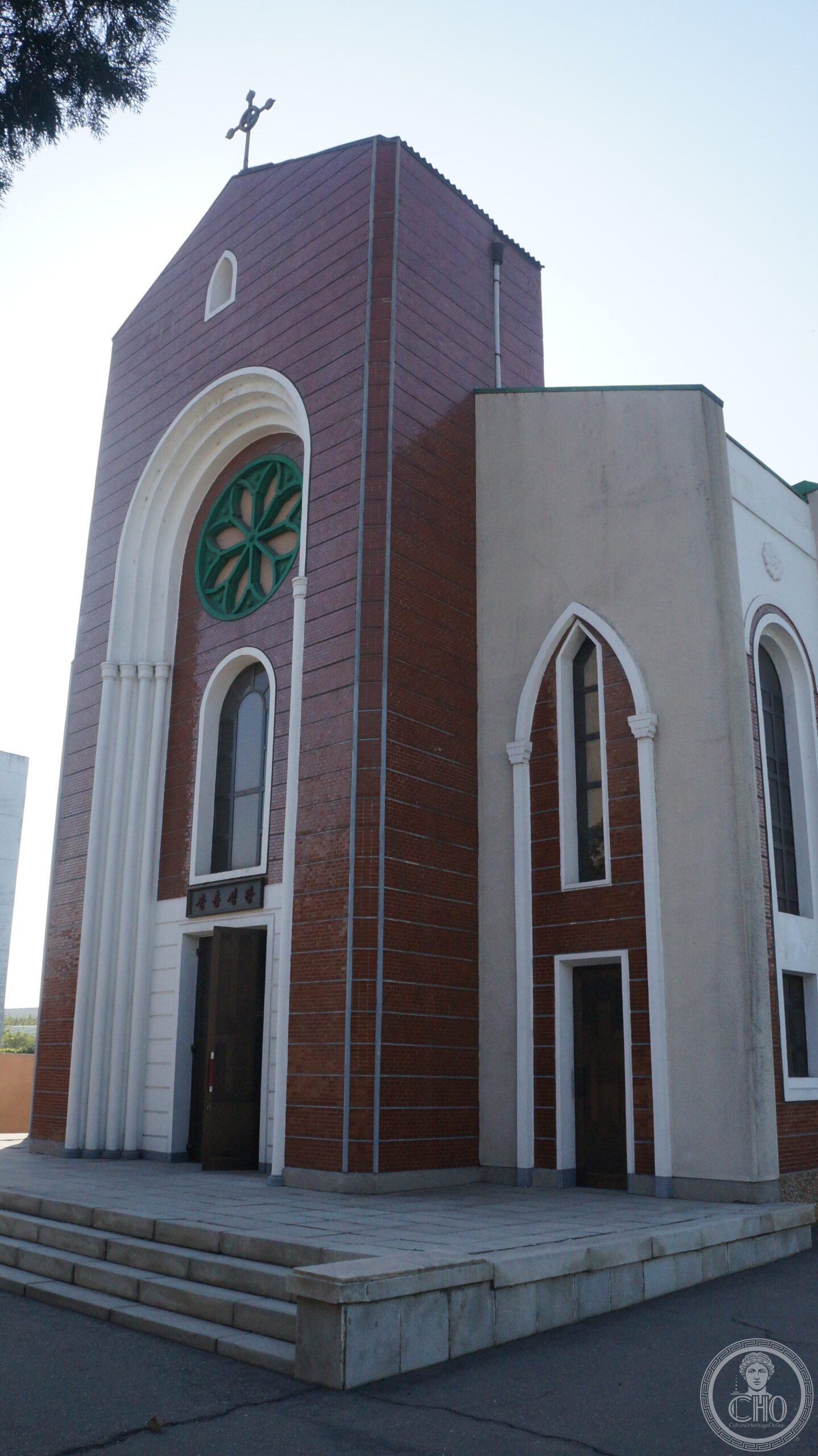
In the Changchung neighbourhood, Songyo district, in Pyongyang, the cathedral of the Sacred Heart is the only Catholic church of North Korea. It replaces an earlier red brick cathedral of the nineteenth century destroyed during the Korean War. Construction, begun in March 1988 and completed on 9 October of the same year, came a few months before the thirteenth World Festival of Youth and Students, held in Pyongyang in July 1989. In the same window, on 30 June 1988, the Korean Catholic Association (KCA) was founded, a state body not recognised by the Holy See, in what several independent sources describe as a deliberate effort by the regime to project an image of religious tolerance before the wave of visitors, journalists and figures from the Eastern bloc expected for the event. The name of an architect is not documented, and the descriptions of the interior differ markedly among the few sources available, with capacity estimates ranging between two hundred and fifty and two thousand people. The cathedral of the apostolic vicariate of Pyongyang, erected in 1927 under the Maryknoll missionaries, has been vacant since 1949, when Bishop Francis Hong Yong-ho was arrested by the North Korean regime and never seen again. The Holy See formally recognised his death only in June 2013, without being able to establish its date, place or circumstances. In the same period about eighty religious of the Benedictine territorial abbey of Tokwon were arrested, among them Abbot Boniface Sauer, who died in a Pyongyang prison on 1 February 1950. According to the sources of the congregation, fourteen monks and two nuns were executed and another seventeen monks and two nuns died of hunger, illness or forced labour, with only forty-two survivors repatriated to Germany in January 1954. To this day, as stated by Cardinal Lazarus You Heung-sik on 3 July 2026, no bishop, priest or religious sister recognised by the Vatican lives in North Korea, and the Holy See holds no diplomatic relations with Pyongyang. Bodies such as the United Nations Commission of Inquiry of 2014 and the United States Commission on International Religious Freedom describe this cathedral, together with a few other churches in Pyongyang, as places of worship run by the State mainly for propaganda purposes abroad, while independent religious practice remains criminalised and clandestine in the rest of the country. An eyewitness account by a journalist of La Croix International, dated 3 November 2017, describes a Sunday service of about forty minutes led not by a priest but by a layman, the president of the state Catholic association, before a hundred and fifty to two hundred faithful, all over sixty. From 1995 until his death in 2015, Father Park Chang-deuk, a Korean-American Augustinian priest, celebrated Mass in this cathedral every year. In December 2015 a delegation of the Korean bishops’ conference reached an agreement with the state Catholic association to allow South Korean priests to celebrate Mass here on the main feast days, beginning with Easter 2016.
About the Cathedral
Changchung Cathedral, in Pyongyang’s Songyo district, is North Korea’s only Catholic church, built in 1988 to replace a 19th-century predecessor destroyed during the Korean War. It has no resident priest and is widely described by outside observers as a state-managed showcase institution.
Key facts
- March–October 1988: cathedral built ahead of the 1989 World Festival of Youth and Students.
- 1949–1950: Bishop Francis Hong Yong-ho and roughly 80 Tokwon Abbey monks and sisters arrested; most killed or died in custody.
- 2013: the Holy See formally acknowledges Bishop Hong’s death, unable to confirm the date, place, or circumstances.
- No Vatican-recognized priest, monk, or nun has resided anywhere in North Korea since the late 1940s.
- 2015–2016: South Korean bishops secure an agreement for occasional visiting-priest Masses on major feast days.
- Sunday services are otherwise led by a lay official of the state-run Korean Catholic Association, not an ordained priest.
History
Built in 1988 in the run-up to a major international youth festival, Changchung Cathedral stands in for a Catholic community effectively destroyed by the North Korean state decades earlier — its bishop disappeared into custody in 1949, its nearest monastic community devastated by execution and forced labor, and no ordained Catholic clergy permitted to live in the country since. UN and religious-freedom investigators have concluded that Pyongyang’s handful of state-sanctioned churches, including this one, function primarily to demonstrate religious tolerance to foreign visitors, while genuine religious practice elsewhere in North Korea remains criminalized. Occasional visits by South Korean priests, most recently under a 2015 agreement, remain the closest thing to regular sacramental life the cathedral receives.
What you see
A red-brick facade with a rooftop cross and Korean-language signage above the entrance opens onto a vaulted interior with Marian and Sacred Heart paintings and a rear choir loft beneath a rose window; descriptions of the interior’s exact scale and finish vary considerably among the few outside accounts available.
Practical information
- Access: visits are only possible through government-approved tours; independent travel is not permitted in North Korea.
- Address: Changchung-dong, Songyo district, Pyongyang, North Korea.
Getting there
The cathedral stands in the Changchung neighborhood of Pyongyang’s Songyo district. GPS: 39.0069°N, 125.7778°E.
Nearby
- Bongsu and Chilgol churches — Pyongyang’s state-sanctioned Protestant churches, part of the same small group of officially permitted places of worship.
Sources
- Wikipedia — “Changchung Cathedral,” “Apostolic Vicariate of Pyongyang,” “Territorial Abbacy of Tokwon”
- Encyclopedia of Korean Culture (Academy of Korean Studies).
- US State Department — International Religious Freedom Report, North Korea, 2023.
- UN Commission of Inquiry on Human Rights in the DPRK (2014); USCIRF 2025 Annual Report.
- La Croix International — eyewitness account of a Sunday service at the cathedral, 3 November 2017.
- Korea Times, Radio Free Asia — coverage of visiting South Korean clergy and Cardinal Lazarus You Heung-sik’s 2026 statement.
Find it on the map
See this place and what’s around it →📷 Become a Cultural Heritage Online photographer
Share your photos of places: they stay published under your name as the author. The more they're seen, the more you get noticed — and soon a contest will reward the most appreciated photos.
Log in or sign up free to add a photo