
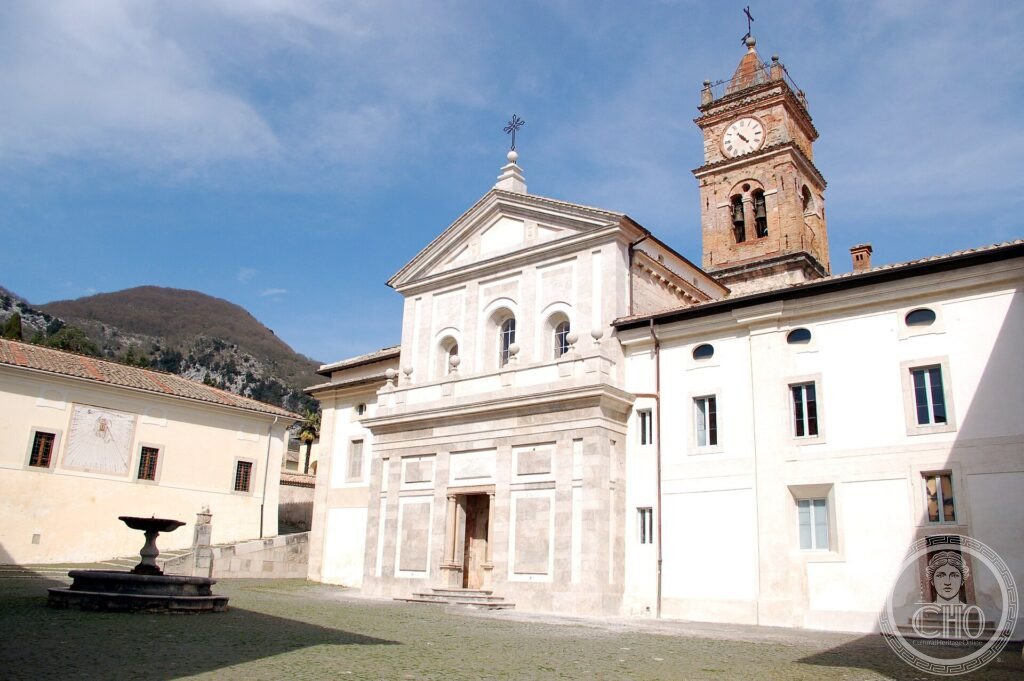
At 820 metres, after ten kilometres of beech wood, a charterhouse opens that looks like a small walled village. Inside, a monastic pharmacy where the walls are painted with deceptions — false doors, false shelves, even a joking portrait of the apothecary friar — and a garden of medicinal herbs cultivated for eight centuries.
At a glance
The Charterhouse of Trisulti stands in the Monti Ernici, at 820 m, in the municipality of Collepardo near Alatri, in the province of Frosinone. Pope Innocent III had it built in 1204 on an accessible mountain shelf and entrusted it to the Carthusians, the strictest of the western monastic orders — hence the name certosa. The Carthusians, who lived in silence in individual cells each with its own small garden, held Trisulti until 1947, when they were replaced by Cistercian monks. Since 2014 the complex has been run by the Italian state. Its Baroque church, its celebrated frescoed pharmacy and its eight-hundred-year-old herb garden make it one of the most complete and atmospheric monastic sites in Lazio.
Key facts
- Founded: 1204 by Pope Innocent III and entrusted to the Carthusians from 1208; the name Certosa records this long Carthusian tenure
- Orders: Carthusian until 1947, then Cistercian monks of the Casamari congregation
- State-run since 2014: managed by the Ministry of Culture (Polo museale del Lazio, then Direzione regionale Musei Lazio from 2019)
- Pharmacy: 17th–18th-century monastic pharmacy, famous for its mid-19th-century (c. 1857) trompe-l’oeil frescoes — attributed to Filippo Balbi with Giacomo Manco — including a witty portrait of the pharmacist friar Benedetto Ricciardi
- Herb garden: a medicinal-plant garden cultivated continuously for centuries; the monks still produce herbal liqueurs and remedies
- Setting: the beech and oak forests of the Monti Ernici, with hiking trails
History
An earlier Benedictine monastery dedicated to St Bartholomew had existed higher in these mountains since around the year 1000. In 1204 Pope Innocent III replaced it with a new foundation on a more accessible site and gave it to the Carthusians, who took possession in 1208. They built most of what survives in the Carthusian manner — a great cloister ringed by individual cells, each a small hermitage with its own walled garden, where monks lived in near-total silence and met only for certain offices.
The Carthusians remained for more than seven centuries, until 1947, when they were replaced by Cistercian monks. The monastery had meanwhile been suppressed under Napoleon and again by the Italian state in the 19th century, and since December 2014 it has been managed by the Ministry of Culture as a state monument. The pharmacy received its famous decoration in the mid-19th century, around 1857, when the walls were covered with realistic trompe-l’oeil scenes — a tradition attributing them to Filippo Balbi with the Neapolitan painter Giacomo Manco — among them the celebrated portrait of Fra Benedetto Ricciardi, the pharmacy’s director, who appears as if caught in the room.
What you see
The road to Trisulti climbs ten kilometres through beech forest from Collepardo before the monastery appears on its mountain shelf. Through the gate, a cobbled courtyard opens with the church on one side and the monastic ranges on the other. The church interior is Baroque — gilded altars, marble floors, carved choir stalls — a deliberate richness set against the austerity of the forest outside.
The highlight is the pharmacy: a sequence of small rooms whose walls and ceilings are painted with botanical and allegorical trompe-l’oeil, the shelves still lined with the original ceramic jars labelled in Latin. The effect is of a room frozen in the 19th century, the quintessence of the monastic pharmacy that once cared for an entire mountain district. Beyond, the great cloister with its Carthusian cells and the herb garden complete the visit.
Practical information
- Visiting: open to visitors as a state monument; the guided visit of the pharmacy is the highlight — check current days and hours with the Direzione regionale Musei Lazio
- Shop: herbal liqueurs, honey and pharmacy products made on site
- Footwear: the approach and grounds are at altitude; comfortable shoes
- Time needed: 1.5–2 hours
Getting there
By car from Frosinone (about 35 km): via Alatri, then up to Collepardo and the mountain road to Trisulti. From Rome (about 100 km) via the A1, exit Anagni, then Alatri. There is no public transport to the monastery. GPS: 41.7667° N, 13.4167° E.
Nearby
- Alatri — the pre-Roman acropolis with its colossal cyclopean walls, one of the great megalithic sites of Italy
- Grotte di Collepardo — the caves and the vast sinkhole of the Pozzo d’Antullo nearby
- Abbazia di Casamari — the great Cistercian abbey to the south, whose congregation now serves Trisulti
Sources
- MiC — “Certosa di Trisulti” (cultura.gov.it) and Catalogo generale dei beni culturali
- Direzione regionale Musei Lazio
- Ciociaria Turismo (Provincia di Frosinone) — Certosa di Trisulti
- Società Romana di Storia Patria — Archivio della Certosa di Trisulti
Find it on the map
See this place and what’s around it →📷 Become a Cultural Heritage Online photographer
Share your photos of places: they stay published under your name as the author. The more they're seen, the more you get noticed — and soon a contest will reward the most appreciated photos.
Log in or sign up free to add a photoIs this page about you?
This page is read by travellers and heritage enthusiasts who find it on Google. Tell us how you are connected to this place and we will take it from there.