
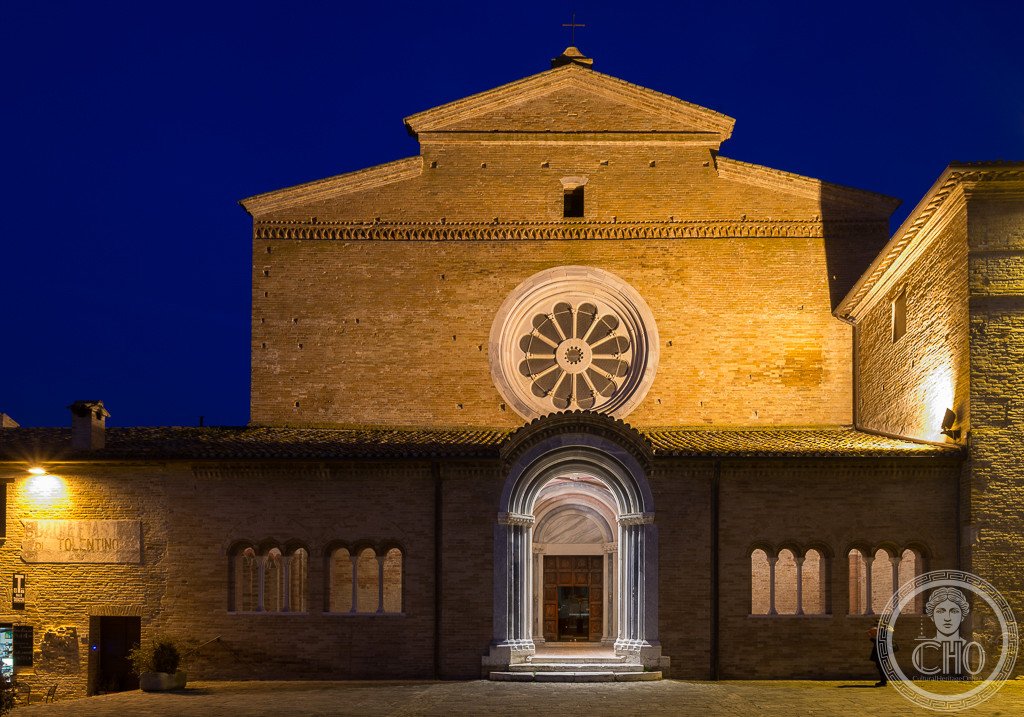
In a valley the monks found wooded and marshy, and which they drained, one of the best-preserved Cistercian abbeys in Italy rose in 1142. To build it the monks went to fetch the stones of the ancient Roman city of Urbs Salvia, levelled by the Visigoths seven hundred years earlier: so the capitals of the cloister are imperial marble reworked by monastic hands.
At a glance
Chiaravalle della Fiastra stands in the broad valley of the Fiastra river, between the communes of Tolentino and Urbisaglia in the province of Macerata, Marche. It was founded in 1142, when Guarnieri II, Duke of Spoleto, gave the land between the Chienti and the Fiastra to Cistercian monks from Chiaravalle Milanese, led by Abbot Bruno — making Fiastra a daughter-house of the great Milanese abbey, and so a granddaughter of Clairvaux itself. The valley was then forest and marsh; the monks drained and farmed it, and quarried the ruins of the nearby Roman city of Urbs Salvia for their stone. The church, cloister, chapter house and refectory survive almost intact, and the whole estate is now protected as the Abbadia di Fiastra nature reserve.
Key facts
- Founded: 1142, on land granted by Guarnieri II, Duke of Spoleto, to Cistercians from Chiaravalle Milanese under Abbot Bruno
- Roman spolia: the church and cloister were built with material from the ruined Roman city of Urbs Salvia (Urbisaglia), sacked by Alaric’s Visigoths in 408–409; the monks recut the capitals from this stone
- 13th-century apex: about 200 monks, the abbey controlling up to 33 churches and monasteries across the Marche
- Architecture: three-aisle Romanesque-Cistercian church with pointed vaults; cloister, chapter house and refectory of the 12th–13th century, almost entirely preserved
- Later history: passed to the Jesuits in the 16th century; after 1773 to the Giustiniani-Bandini family
- Nature reserve: the Riserva Naturale Abbadia di Fiastra (1,825 ha), established 1984 by the Giustiniani-Bandini Foundation with the Marche Region, under WWF Italia protection since 1987
History
The foundation of 1142 was part of the explosive Cistercian expansion of the 12th century. Rather than coming directly from Clairvaux, the founding monks were sent from Chiaravalle Milanese — the Milanese abbey that Bernard of Clairvaux had himself founded in 1135 — led by Abbot Bruno, on land in the Fiastra valley donated by the Duke of Spoleto. They built in the severe manner the order required: no figurative sculpture, no painted ornament, only proportion, stone and light. For their material they turned to Urbs Salvia, the Roman municipium a few kilometres away that the Visigoths had destroyed early in the 5th century; the carved capitals of the church are Roman marble, reworked by the monks themselves.
By the 13th century the abbey was at its height, home to around two hundred monks and controlling a network of up to thirty-three dependent churches and monasteries across the Marche. Decline followed: in the 16th century the abbey passed to the Jesuits, and after the suppression of their order in 1773 the estate came to the Giustiniani-Bandini family. When Duke Sigismondo Giustiniani-Bandini died in 1918 the property passed to the family foundation, which in 1984 — with the Marche Region — turned the estate into the Abbadia di Fiastra nature reserve, recognised by the State in 1985 and placed under WWF Italia in 1987. A Cistercian community lives at the abbey once more.
What you see
The approach through the Fiastra valley is one of the quietest of any Italian abbey: no village, no development, only the river road and the wooded hills the monks once reclaimed. The complex is entered through a gatehouse into a wide courtyard, the church on one side and the cloister behind. The church has three aisles, a tall central nave on cruciform piers, pointed vaults and the flat eastern wall typical of Cistercian plans — Romanesque turning to Gothic within a single building. Look closely at the capitals: their stone is Roman, carried from Urbs Salvia and recut without figures, in the plain leaf forms the order allowed.
Off the church opens the cloister, with pointed arches on slender paired columns, and the chapter house, its ribbed vault carried on two columns — one of the finest Cistercian chapter houses in the Marche. The refectory survives on the south walk. Beyond the walls, the nature reserve protects the Fiastra woods and wetlands, with trails through what was once the abbey’s farmland.
Practical information
- Visiting: the abbey church and cloister are open to visitors; the nature reserve is open year-round — check current hours with the Riserva Abbadia di Fiastra
- Reserve: walking trails, birdwatching and the Fiastra woods; small parking charge
- Shop: the monastic community sells wine, honey and herbal products
- Time needed: 1–2 hours for the abbey, half a day with a nature walk
Getting there
By car from Macerata (about 20 km north) or from Tolentino (8 km north-west) via the SP361; the abbey sits between Tolentino and Urbisaglia. There is no public transport to the site. GPS: 43.3286° N, 13.3567° E.
Nearby
- Urbs Salvia (Urbisaglia) — the archaeological park of the Roman city whose stones built the abbey, with one of the best-preserved Roman theatres of the Marche
- Tolentino — the basilica of San Nicola da Tolentino, with its great frescoed chapel; the medieval bridge
- Macerata — university city and the open-air Sferisterio opera arena
Sources
- Cistercensi.info — “Chiaravalle di Fiastra” (official Cistercian abbeys database)
- FAI — “Abbazia Santa Maria di Chiaravalle di Fiastra” (I Luoghi del Cuore)
- Riserva Naturale Abbadia di Fiastra / Fondazione Giustiniani-Bandini
- Turismo Marche (letsmarche.it) — Abbazia di Chiaravalle di Fiastra
Find it on the map
See this place and what’s around it →📷 Become a Cultural Heritage Online photographer
Share your photos of places: they stay published under your name as the author. The more they're seen, the more you get noticed — and soon a contest will reward the most appreciated photos.
Log in or sign up free to add a photoIs this page about you?
This page is read by travellers and heritage enthusiasts who find it on Google. Tell us how you are connected to this place and we will take it from there.