
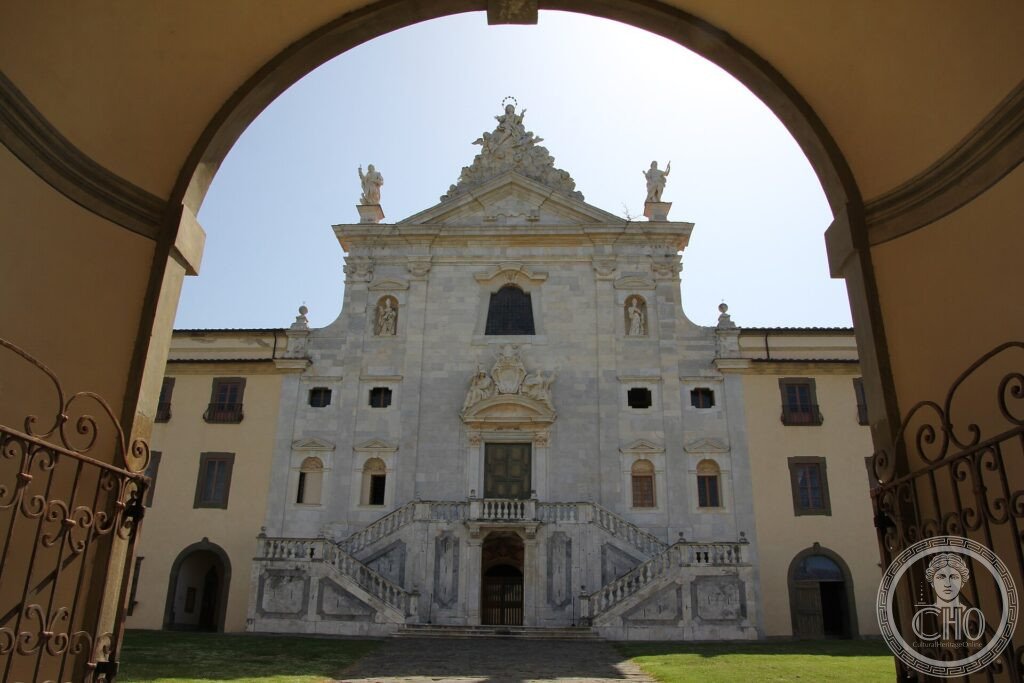
Founded in 1366 on the hills above Pisa, the Certosa di Calci is the largest monastery in Tuscany by area. Its corridors and church are covered with Baroque frescoes of the seventeenth and eighteenth centuries; the former Carthusian cells today house the startling Natural History Museum of the University of Pisa, with life-size whale skeletons hung from the vaults.
At a glance
The Charterhouse (Certosa) of Calci, also known as the Certosa di Pisa, is situated 12 km east of Pisa in the village of Calci, at the foot of the Monte Pisano range. It was founded in 1366 by a bequest of the Pisan merchant Pietro Gambacorti and is the largest monastic complex in Tuscany: the buildings cover more than 50,000 square metres and include three cloisters, a church, a chapter house, dozens of monks' cells (each a self-contained house with garden, in the Carthusian tradition), the prior's apartment, a pharmacy, and a guest wing. The Carthusians lived here until the Napoleonic suppression (1808); after briefly reverting to religious use, the monastery was transferred to the University of Pisa in 1979, which installed its Natural History Museum in the former monastic rooms. The museum's collections include minerals, fossils, zoological specimens, and most remarkably — a large hall of whale and dolphin skeletons, some of them hanging from the ceiling at full scale. The church and Baroque corridors are accessible daily by guided tour.
Key facts
- Founded: 1366 by bequest of the Pisan merchant Pietro Gambacorti; a major Carthusian foundation in Tuscany; active until the Napoleonic suppression (1808)
- Scale: largest monastery in Tuscany; over 50,000 m² of buildings; three cloisters; 24 monks' cells (each a two-storey house with private garden)
- Baroque decoration: church interior and corridors decorated with frescoes by Alessandro Gherardini, Ranieri del Pace, and other 17th–18th c. Florentine and Pisan painters; the quantity and quality of the fresco cycles is extraordinary
- Natural History Museum: transferred to the University of Pisa 1979; collections include the Cetacean Hall (whale and dolphin skeletons, some full-size), mineral collection, fossil collection, zoological specimens; one of the most unusual museum settings in Italy
- Pharmacy: the 17th-century monastic pharmacy, with original furnishings and ceramic jars, is part of the tour
History
The Certosa di Calci was established in 1366 through the generosity of Pietro Gambacorti, a wealthy Pisan merchant, who donated the land and the initial endowment. The Carthusians, who had been founded in 1084 by Bruno of Cologne and practiced the strictest solitude of any western order, found the isolated wooded slopes of Monte Pisano perfectly suited to their life: each monk lived alone in his cell, met his brothers only for liturgical offices, and communicated with the outside world only through a rotating cupboard (the tournette) set into his cell wall. The community grew throughout the 15th century and undertook major building campaigns in the 16th–17th centuries, when the church, the great cloister, and the corridors received their spectacular Baroque decoration. The frescoes, commissioned from leading Florentine and Pisan painters, depict the life of the Virgin, the life of St Bruno, scenes from Carthusian history, and allegories of the monastic virtues; they cover virtually every ceiling and wall in the public areas.
After the Napoleonic suppression the buildings were used variously as a prison, a granary, and a military storehouse, suffering considerable damage. The Carthusians briefly returned (1866), were again expelled in 1880, and did not return. The University of Pisa acquired the complex in 1979 and undertook an extensive restoration; the Natural History Museum was installed in the former cells and the church was reopened to the public. The combination of Baroque splendour and zoological curiosity — a whale skeleton in a vaulted Baroque room, a fossil mastodon in an 18th-century pharmacy — is unique in Italy.
What you see
Guided tours enter through the great gateway into the outer courtyard, then through the church facade (17th century, with characteristic Baroque curves) into the church interior: three aisles with frescoed vaults, marble altars, and the monks' choir with carved stalls behind the altar screen (the Carthusians did not allow laity into the choir, even after death of the order). The corridors leading to the cloisters are frescoed on both walls and ceiling with scenes from Carthusian life — the sheer quantity of imagery is overwhelming. The great cloister, with the monks' cells around three sides, gives access to one or two preserved cells (each shown as it would have appeared in use). The Natural History Museum rooms contain the famous Cetacean Hall.
Practical information
- Opening hours: Tue–Sun 08:30–19:00 (museum and guided tour); closed Monday
- Admission: combined ticket (museum + church + cloisters); moderate fee
- Guided tour: mandatory for church and cloisters; approximately 1 hour
- Time needed: 2–3 hours for museum + guided tour
Getting there
By car from Pisa (12 km east): follow signs to Calci on the SP2 (Strada di Monte Pisano). By bus from Pisa (Piazza Vittorio Emanuele): bus to Calci, approximately 30 min; infrequent service. GPS: 43.7237° N, 10.4876° E.
Nearby
- Pisa — 12 km west; Piazza dei Miracoli (Duomo, Battistero, Torre Pendente); Camposanto; Museo dell'Opera del Duomo; UNESCO World Heritage
- Monte Pisano — the hills between Pisa and Lucca; medieval towers, olive groves, walking paths
- Lucca — 20 km north-west; intact Renaissance city walls; Puccini's birthplace; Romanesque cathedral; one of the best-preserved medieval cities in Italy
Sources
- Wikipedia — “Charterhouse of Calci” (en.wikipedia.org/wiki/Charterhouse_of_Calci)
- Museo di Storia Naturale, Università di Pisa — msn.unipi.it
- Archivio di Stato di Pisa — documentary sources on the foundation (1366)
Find it on the map
See this place and what’s around it →📷 Become a Cultural Heritage Online photographer
Share your photos of places: they stay published under your name as the author. The more they're seen, the more you get noticed — and soon a contest will reward the most appreciated photos.
Log in or sign up free to add a photoIs this page about you?
This page is read by travellers and heritage enthusiasts who find it on Google. Tell us how you are connected to this place and we will take it from there.