

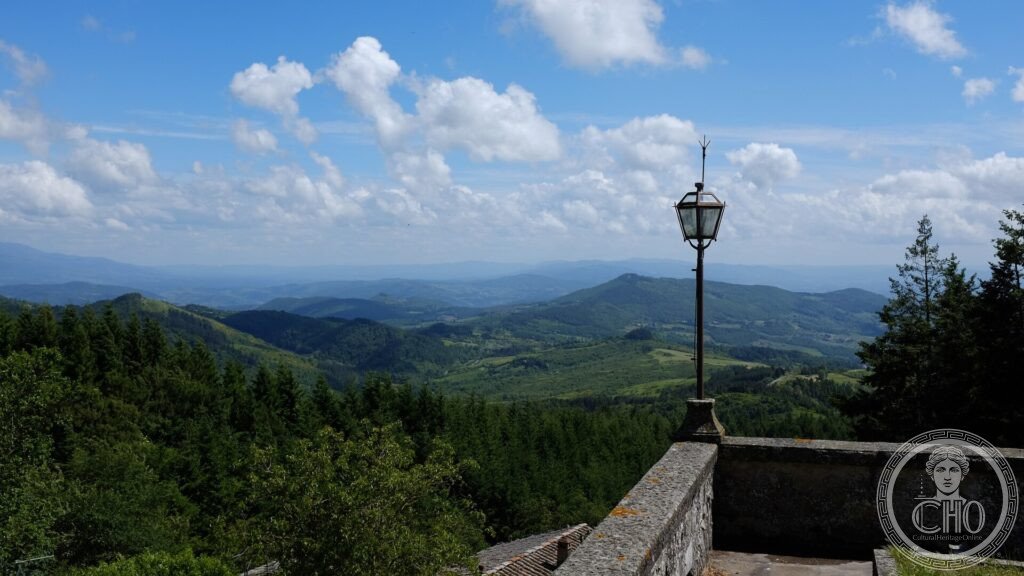
Seven wealthy Florentine merchants left their businesses in 1233 to withdraw and pray on this hill in the Mugello, in cells cut into the living rock. From that act was born a religious order that is still alive — the Servants of Mary — and Monte Senario has remained their mother house, with a view that on clear days reaches the towers of Florence.
At a glance
Monte Senario (about 815 m) is a forested promontory in the Mugello hills, some 25 km north of Florence. Here, on 8 September 1233, seven Florentine merchants withdrew from the world to live as hermits; from their community grew the Order of the Servants of Mary (Servites, OSM), recognised by Pope Alexander IV in 1256 and now spread worldwide. The seven were canonised together as the Seven Holy Founders in 1888, one of the very few collective canonisations in the history of the Church. The convent that crowns the hill is their spiritual mother-house: a complex of church, oratory, fifteenth-century cloister, hermit caves, a monumental ice house and a distillery, set in oak and chestnut forest with a 360-degree view over the Mugello and the Apennines.
Key facts
- The Seven Holy Founders: seven Florentine merchants who withdrew here on 8 September 1233; canonised together in 1888 by Leo XIII
- Birth of the Servites: the Order of the Servants of Mary (OSM), recognised by Alexander IV in 1256 — one of the mendicant orders of the 13th century
- From hermitage to convent: the founders first lived in cells cut into the living rock; in 1241 they received the ruins of the hilltop castle and built the first convent
- Hermit caves: the rock-cut grottoes of the founders survive below the convent and remain a place of pilgrimage
- The ice house (ghiacciaia): a striking 19th-century structure, considered the largest of its kind in Italy
- The distillery: the friars still distil liqueurs, among them the fir-bud Gemma d’Abeto
History
The seven founders were laymen of the Florentine merchant class, different in age and background, who on the feast of the Nativity of Mary in 1233 left the city to do penance on Monte Senario. For several years they lived in cells carved into the rock; in 1241 the bishop gave them the ruins of the hilltop castle, and they built their first convent. They took the Rule of St Augustine and a black habit — mourning for the Sorrows of the Virgin — and within a generation had houses in Florence, Siena and beyond.
Monte Senario remained the order’s spiritual heart even as its administrative centre moved to the Santissima Annunziata in Florence. Renaissance and Baroque campaigns gave the convent its present form; the refectory preserves a Last Supper frescoed by Matteo Rosselli in 1634. The collective canonisation of the Seven Founders in 1888 brought a new wave of pilgrimage that continues today.
What you see
The road climbs through forest from Bivigliano to the convent gate, the hill’s profile recognisable from across the Mugello. Inside, a frescoed atrium leads to the church and the Chapel of the Seven Saints, which holds the relics of the founders; the fifteenth-century cloister, the sacristy and the refectory with Rosselli’s Last Supper complete the monastic core. A path descends to the hermit caves — rough hollows in the hillside with simple stone altars — that still convey the founders’ withdrawal from the world.
Two features set Monte Senario apart from other Tuscan convents: the great 19th-century ice house, an architectural curiosity reckoned the largest in Italy, and the working distillery, where the community makes herbal liqueurs including the celebrated Gemma d’Abeto from fir buds. The panoramic terrace looks north over the Mugello and south toward Florence.
Practical information
- Visiting: the sanctuary church is open daily; the small museum opens mainly at weekends — check current hours
- Shop: the friars’ liqueurs (including Gemma d’Abeto), honey and herbal products
- On site: a panoramic bar/restaurant; the walk to the hermit caves needs sensible shoes
- Time needed: 1–1.5 hours, more with the caves and the view
Getting there
By car from Florence (about 25 km): the SS65 (Via Bolognese) to Pratolino, then the local road to Bivigliano and up to Monte Senario; the convent is in the comune of Vaglia. GPS: 43.9367° N, 11.3025° E.
Nearby
- Villa Demidoff / Pratolino — the Medici park with Giambologna’s colossal stone Appennino (1579)
- Bivigliano — a quiet Mugello village with trattorie below the convent
- Santissima Annunziata, Florence — the Servite mother-church in the city, with its early-Renaissance cloister
Sources
- Comune di Vaglia — “Convento di Montesenario”
- Visit Tuscany (Regione Toscana) — Montesenario Sanctuary
- Eremo di Monte Senario / Ordine dei Servi di Maria (montesenario.it, servidimaria.net)
- FeelFlorence (Città Metropolitana di Firenze) — Monte Senario
Find it on the map
See this place and what’s around it →📷 Become a Cultural Heritage Online photographer
Share your photos of places: they stay published under your name as the author. The more they're seen, the more you get noticed — and soon a contest will reward the most appreciated photos.
Log in or sign up free to add a photoIs this page about you?
This page is read by travellers and heritage enthusiasts who find it on Google. Tell us how you are connected to this place and we will take it from there.