
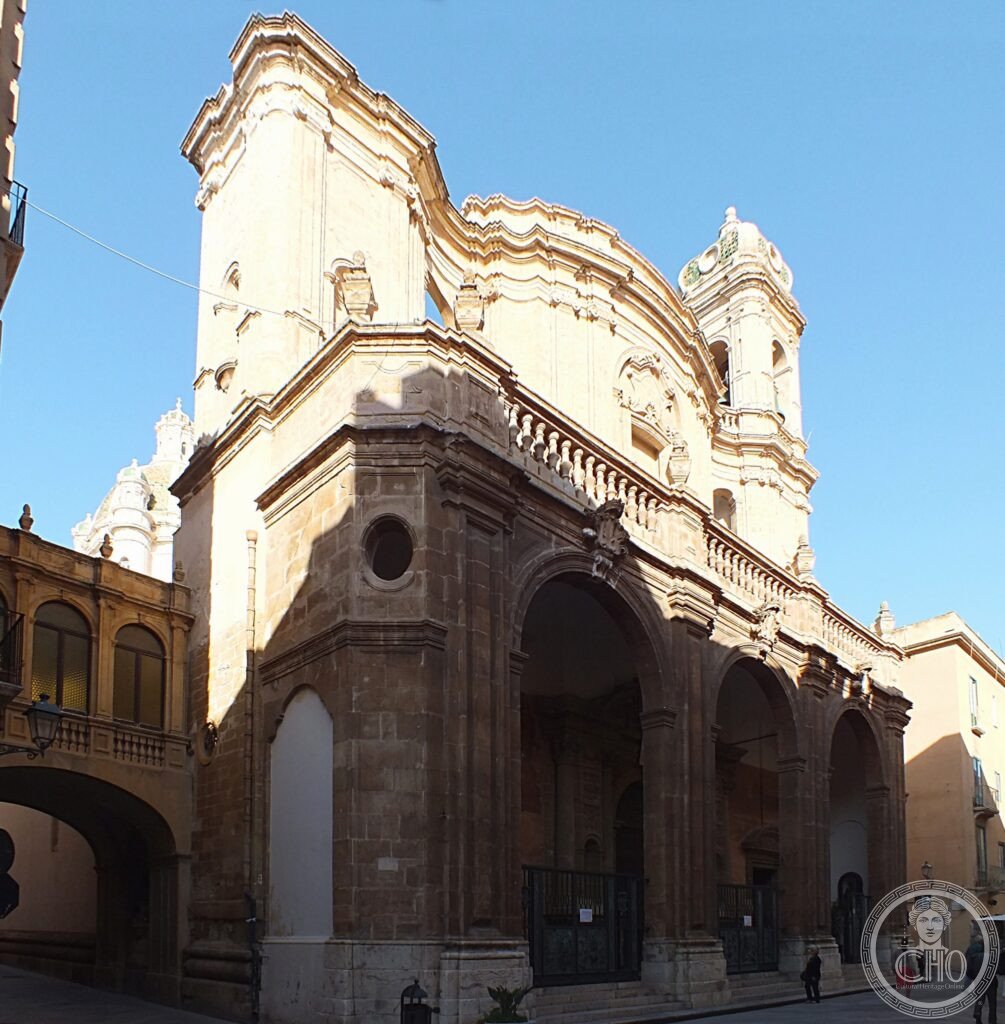
In the heart of the main street of Trapani, an eighteenth-century facade with three arcades holds a Crucifix attributed to Anthony van Dyck: the story of a medieval chapel that became a cathedral only in 1844.
At a glance
Trapani Cathedral, dedicated to Saint Lawrence the Martyr, stands on Corso Vittorio Emanuele in the historic centre of Trapani, western Sicily. Its origins go back to a chapel documented from 1102, later reorganised as the San Lorenzo quarter under James II of Aragon in 1280 and raised to parish status in 1434. The building was substantially restructured after a threatened structural collapse in 1602-1603 under the architect Bonaventura Certo, then given its present Baroque appearance between roughly 1705 and 1740 by the Trapanese architect Giovanni Biagio Amico, who added the dome, bell towers, balustraded facade and triple-arched portico. San Lorenzo only became a cathedral in 1844, when Pope Gregory XVI established the Diocese of Trapani, ending a long-standing rivalry with two other churches in the city for that rank. It was declared a national monument in 1940.
Key facts
- Origins: documented from 1102 as the Cappella di San Giorgio; parish status granted in 1434 under Alfonso the Magnanimous
- Architect of the current form: Giovanni Biagio Amico, who around 1740 added the dome, smaller cupolas, bell towers, balustraded facade and lateral chapels
- Cathedral status: granted only in 1844, when Pope Gregory XVI created the Diocese of Trapani
- Facade: Baroque, with a three-arch pronao at street level and an upper section with Ionic pilasters; bronze and wrought-iron gates by Ennio Tesei installed in 1990
- Notable artwork: a Crucifix attributed to Antoon van Dyck (around 1640), painted during the Flemish master’s stay in Sicily, in a chapel of the right transept
- Interior decoration: Neoclassical stuccoes by Girolamo Rizzo and Onofrio Noto, with ceiling frescoes by Vincenzo Manno added in 1794
- National monument: declared by royal decree in 1940; restored by the Sicilian Superintendency of Cultural Heritage between 1975 and 1997
History
The building’s earliest documented form was a small chapel dedicated to Saint George, recorded from 1102 in what was then Trapani’s Genoese quarter. The urban layout around it changed in 1280, when James II of Aragon reorganised the area into the San Lorenzo neighbourhood; by 1421 the church appears in records as a chaplaincy, and in 1434 Alfonso the Magnanimous elevated it to parish status. Structural problems in the early seventeenth century forced an urgent rebuilding: between 1602 and 1603 the Conventual Franciscan architect Bonaventura Certo gave the church its first basilica-plan layout, a significant break from whatever earlier form the building had.
The church’s present appearance is largely the work of the eighteenth century. Bishop Bartolomeo Castelli solemnly consecrated it on 2 July 1705, and it was raised to collegiate status in 1736. The decisive transformation came around 1740 under Giovanni Biagio Amico, one of the leading Sicilian architects of the period, who added the dome, a set of smaller cupolas, the balustraded facade, the tripartite portico with flanking bell towers, and new lateral chapels. A permanent “Cathedral Works” body was set up in 1788 to manage ongoing maintenance, and in 1794 the interior gained further Neoclassical stuccoes and Vincenzo Manno’s ceiling frescoes of Old Testament patriarchs and prophets.
San Lorenzo did not become a cathedral until 1844, when Pope Gregory XVI created the Diocese of Trapani and resolved a long dispute over precedence with the churches of San Pietro Apostolo and San Nicolò. The building was declared a national monument by royal decree in 1940 and underwent a lengthy restoration by the Sicilian Superintendency of Cultural Heritage between 1975 and 1997, following war damage and general deterioration.
What you see
The Baroque facade unfolds in two registers: at street level a deep pronao of three round arches opens directly onto Corso Vittorio Emanuele, while the upper section is framed by Ionic pilasters beneath a curved, balustraded profile. The bell towers on either side carry polychrome majolica caps, a detail typical of western Sicilian Baroque, and the bronze and wrought-iron entrance gates by the sculptor Ennio Tesei were installed as recently as 1990. Inside, the plan is a Latin cross with three naves divided by Tuscan columns, six to a side, the central nave covered by a barrel vault and the lateral aisles by groin vaults; Amico’s dome combines a circular interior drum with a square exterior tambour, surrounded by four smaller cupolas.
The cathedral’s best-known artwork is a Crucifix attributed to Antoon van Dyck, painted during the Flemish artist’s documented stay in Sicily around 1624-1625 and dated by most sources to about 1640, displayed in a chapel of the right transept. Other notable paintings include a 1631 Adoration of the Shepherds by Geronimo Gerardi and a Flemish-school Deposition of 1634-1636 clearly indebted to Rubens, alongside a marble and alabaster Entombed Christ by the Trapanese sculptor Giacomo Tartaglia from the early eighteenth century. The cathedral holds two organs: a 1967 instrument by Fratelli Ruffatti with electric transmission, and a mechanical organ built in 2008 by Fratelli Cimino in the left transept.
Practical information
- Opening hours: open daily around Mass times; confirm current hours via the parish’s own site, cattedraletrapani.it, before visiting
- Mass schedule: weekdays and Saturday at 18:15, Sunday at 11:00 and 18:15 (autumn-winter timetable, Diocese of Trapani)
- Tickets: free entry as an active parish church
- Time needed: about 30 minutes; the interior is wheelchair accessible
Getting there
Trapani is served by Vincenzo Florio Airport (Trapani-Birgi), about 15 km south of the city, and by rail connections to Palermo (roughly 1.5-2 hours). The cathedral sits directly on Corso Vittorio Emanuele in the pedestrian historic centre, a short walk from the main train station and from the ferry port. By car, Trapani is reached via the A29 motorway from Palermo. GPS: 38.01603° N, 12.50788° E.
Nearby
- Santuario dell’Annunziata (Madonna di Trapani) — a 14th-century Carmelite sanctuary a short walk away, holding the marble Madonna and Child attributed to Nino Pisano and later decorated by the same architect, Giovanni Biagio Amico
- Torre di Ligny — a 1671 watchtower at the tip of the Trapani peninsula, now a civic museum, marking the point where the Tyrrhenian and Mediterranean seas meet
- Saline di Trapani e Paceco — historic salt pans and windmills just outside the city, a protected WWF wetland reserve
Sources
- Wikipedia — “Cattedrale di San Lorenzo (Trapani)” and “Trapani Cathedral” (it.wikipedia.org, en.wikipedia.org)
- Parrocchia Cattedrale San Lorenzo Martire, Trapani — official parish site (cattedraletrapani.it)
- Diocesi di Trapani — mass schedule, autumn-winter 2025-2026 (diocesi.trapani.it)
- Comune di Trapani — tourism portal, Santuario dell’Annunziata (comune.trapani.it)
Find it on the map
See this place and what’s around it →📷 Become a Cultural Heritage Online photographer
Share your photos of places: they stay published under your name as the author. The more they're seen, the more you get noticed — and soon a contest will reward the most appreciated photos.
Log in or sign up free to add a photoIs this page about you?
This page is read by travellers and heritage enthusiasts who find it on Google. Tell us how you are connected to this place and we will take it from there.