
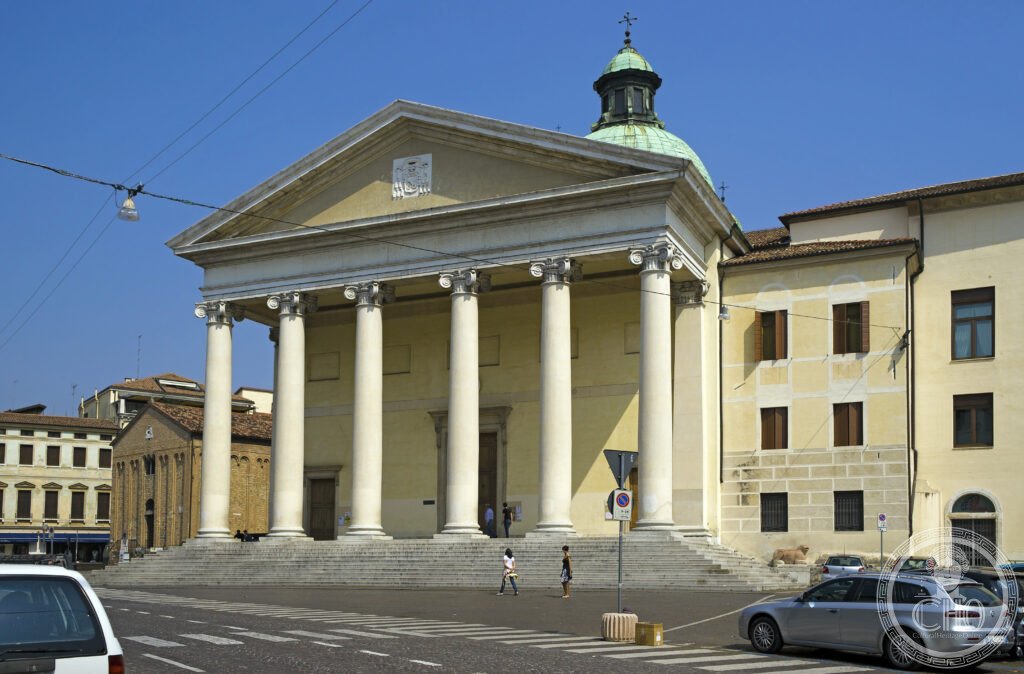
Raised on a Roman temple and remade in Neoclassical style, the cathedral holds in the Malchiostro chapel an altarpiece by Titian and frescoes by Pordenone, above a Romanesque crypt with the tombs of the bishops.
At a glance
The Cathedral of San Pietro Apostolo — known simply as the Duomo — is the seat of the Diocese of Treviso and the city’s principal place of worship. Its origins go back to the paleochristian period, but the building visible today is the result of a long neoclassical reconstruction begun in 1759 and completed with the current facade in 1836. Seven domes rise over the nave and transept chapels, an unusual silhouette among Italian cathedrals. Inside, the Malchiostro Chapel holds one of the Veneto’s finest Renaissance ensembles: an altarpiece by Titian paired with frescoes by Il Pordenone. Beneath the church, a Romanesque crypt preserves the tombs of past bishops and the relics of Treviso’s patron saint, Liberalis.
Key facts
- Dedication: Saint Peter the Apostle (San Pietro Apostolo); seat of the Diocese of Treviso.
- Origins: paleochristian church, 6th century, raised over the remains of a Roman-era complex in the city centre.
- Romanesque phase: 11th-12th centuries under Bishop Rotario, who gave the area its current layout; the crypt dates from this period.
- Neoclassical rebuilding: begun in 1759 by Giordano Riccati, halted in 1782, resumed from 1790 under Giannantonio Selva.
- Facade: designed by Francesco Bomben with engineer Gaspare Petrovich, completed in 1836.
- Domes: seven in total — five over the central nave, two closing the transept chapels.
- Malchiostro Chapel: Titian’s Annunciation (1520) and fresco cycle by Il Pordenone, in a chapel attributed to Tullio and Antonio Lombardo.
History
The Duomo stands on ground that has been used for public buildings since Roman times: archaeological traces beneath and around the cathedral point to a temple and a theatre on the same site. The first Christian basilica here is dated to the 6th century, part of the paleochristian wave of church-building in the Veneto after the fall of the Western Empire. Little of that first building survives above ground today.
The cathedral took on its medieval character between the 11th and 12th centuries, when Bishop Rotario reorganised the surrounding area and had the church rebuilt in Romanesque style. The crypt beneath the present sanctuary belongs to this phase and is the oldest substantial structure still visible inside the building. Three Lombard apsidal chapels from this era were later preserved even as the rest of the church was transformed.
The building seen today is largely the product of an 18th-century campaign. Starting in 1759, the Treviso-born scholar and architect Giordano Riccati directed a neoclassical reconstruction that replaced most of the Romanesque fabric while keeping the old apses. Work stopped in 1782 and picked up again in 1790 under Giannantonio Selva, one of the leading Neoclassical architects working in the Veneto at the time. The project reached its final form only in 1836, when Francesco Bomben and engineer Gaspare Petrovich completed the monumental staircase and Ionic-columned pronaos that now front the cathedral on Piazza Duomo. The building suffered damage during an Allied bombing raid on Good Friday, 7 April 1944, which also destroyed part of an adjoining library.
What you see
From the piazza, the cathedral presents a broad flight of steps rising to a six-column Ionic pronaos, a composition that deliberately recalls a classical temple front rather than a conventional church facade. Behind it, seven shallow domes break the roofline — five along the nave, two more over the transept chapels — giving the exterior a rhythm closer to a Byzantine or Palladian domed hall than to the single-dome model typical of most Italian cathedrals. The bell tower beside the church was never finished to its full planned height; local tradition holds that the Venetian government of the day capped its construction so it would not rise above the campanile of St Mark’s in Venice.
Inside, three broad aisles lead to lateral chapels and three apses inherited from the Romanesque church. The most important is the Malchiostro Chapel, entered from the right aisle beside the sacristy through a raised vestibule. Its dome and walls were frescoed by Il Pordenone with scenes including the Adoration of the Magi, while the altar holds Titian’s Annunciation, painted around 1520 for the chapel’s patron, canon Broccardo Malchiostro. Works by Paris Bordone and Lorenzo Bregno appear elsewhere in the church. Below the sanctuary, the Romanesque crypt — supported on reused columns — holds the tombs of former bishops and the reliquary of Saint Liberalis, Treviso’s patron saint.
Practical information
- Opening hours: weekdays approx. 7:15-12:00 and 15:30-18:30; Sundays and holidays approx. 8:00-13:00 and 15:30-20:00 (mass times take precedence; check locally before visiting).
- Admission: free entry to the church; a small contribution may be requested for guided visits or access to specific areas such as the crypt.
- Address: Piazza Duomo 2 / Via Canoniche 2/A, 31100 Treviso.
- Time needed: 30-45 minutes for the church and Malchiostro Chapel; add time for the adjoining Diocesan Museum if open.
Getting there
The Duomo sits in the historic centre of Treviso, about a 15-20 minute walk from Treviso Centrale railway station, which has frequent regional trains to and from Venice (roughly 30 minutes). Treviso Antonio Canova Airport, used by low-cost carriers, is about 5 km from the centre and reachable by taxi or the ACTT airport bus. Venice Marco Polo Airport is roughly 40 minutes away by car via the A27 and A4 motorways. Drivers should aim for the historic centre’s limited-traffic zone around Piazza Duomo and use one of the paid car parks just outside it. GPS: 45.6663746, 12.2432244.
Nearby
- Piazza dei Signori — Treviso’s medieval civic square, a five-minute walk away, framed by the Palazzo dei Trecento and the Palazzo del Podestà.
- Museo Nazionale Collezione Salce — a national collection of historic Italian poster art, housed a short walk from the cathedral.
- Gallerie delle Prigioni — a former prison building in the city centre now used as an exhibition space.
Sources
- Diocesi di Treviso, official parish record — Cattedrale S. Pietro Apostolo (diocesitv.it)
- Wikipedia (Italian) — Duomo di Treviso
- Wikipedia (English) — Treviso Cathedral
- OpenStreetMap / Nominatim, geographic coordinates verification
Find it on the map
See this place and what’s around it →📷 Become a Cultural Heritage Online photographer
Share your photos of places: they stay published under your name as the author. The more they're seen, the more you get noticed — and soon a contest will reward the most appreciated photos.
Log in or sign up free to add a photoIs this page about you?
This page is read by travellers and heritage enthusiasts who find it on Google. Tell us how you are connected to this place and we will take it from there.