
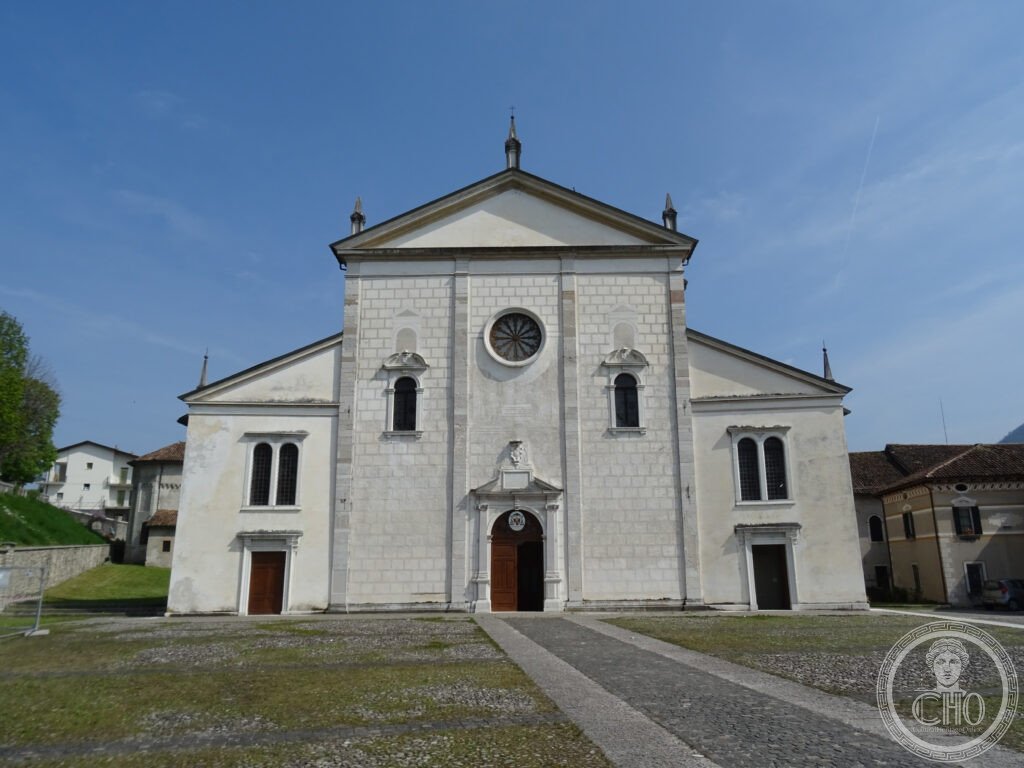
Above a Romanesque crypt built on Roman columns, Feltre Cathedral still carries the marks of a fire of 1510 and of a facade that leans, like the head of Christ on the cross.
At a glance
The Concattedrale di San Pietro Apostolo, known locally as the Duomo di Feltre, stands on the site of a paleochristian place of worship, with foundations tracing back to Roman-era Feltre. Gutted by fire in 1510 during the War of the League of Cambrai, the building was rebuilt in Renaissance forms between 1514 and 1585 while its Gothic apse survived intact. Today it serves as co-cathedral of the Diocese of Belluno-Feltre, a title it has held since the two historic sees were formally merged in 1986. Behind a restrained, slightly concave facade lies a three-nave interior with ten lateral altars, and beneath the raised presbytery an 11th-century crypt built directly over Roman column fragments, rediscovered and excavated in the early twentieth century.
Key facts
- Dedication: Saint Peter the Apostle (San Pietro Apostolo)
- Status: co-cathedral of the Diocese of Belluno-Feltre since 30 September 1986; sole cathedral of Feltre until the sees were united in 1818
- Bell tower: erected in 1392, partially remodeled in 1690
- Crypt: three-nave structure dating to the second half of the 11th century, resting on reused Roman capitals and column drums
- 1510 fire: the cathedral was destroyed when troops of Maximilian of Habsburg set fire to Feltre during the War of the League of Cambrai; it was rebuilt between 1514 and 1585
- Facade crucifix (1516-1518): carved by Vittore Scienza, painted by Lorenzo Luzzo, who also created the facade graffito
- Organ: built in 1767 by the noted Venetian organ-maker Gaetano Callido
History
Archaeological soundings beneath the cathedral and its courtyard have uncovered traces of a paleochristian place of worship and a circular baptistery, evidence that a Christian building stood on this hill well before the Romanesque church took shape in the second half of the 11th century. That medieval cathedral had a single nave with a central lantern, lateral buttresses and ten symmetrical chapels. Between 1472 and 1502 Bishop Angelo Fasolo commissioned a Gothic polygonal presbytery with six windows and a ribbed vault, and the main altar and lateral chapels were formally consecrated on 8 November and 4 December 1474. This medieval and early-Renaissance fabric did not survive intact for long: in 1510, during the War of the League of Cambrai, troops loyal to Maximilian of Habsburg set fire to Feltre, gutting the cathedral. Only the apse, structurally separate from the nave, resisted destruction.
Reconstruction in Renaissance forms proceeded slowly between 1514 and 1585. In 1543 the upper part of the rebuilt facade suddenly collapsed, and Vittore Scienza was appointed proto (master builder) to oversee the repairs; it was in this period, 1516-1518, that Scienza carved the crucifix later painted by Lorenzo Luzzo, who also executed the graffito decoration still visible on the facade. Work continued under successive bishops: Agostino Gradenigo, from 1610, added the main portal with its broken pediment, a new stone floor and a continuous staircase up to the presbytery, while Bartolomeo Gera, elected bishop in 1664, promoted the definitive vaulting of the nave between 1666 and 1673. The bell tower, originally raised in 1392, was partially remodeled in 1690. Later additions layered onto this Renaissance-Baroque fabric include Gaetano Callido’s organ of 1767 and a reworking of the facade by engineer Giobatta Sanguinazzi in 1894.
The cathedral’s modern phase began after the First World War, when architect Alberto Alpago Novello directed a campaign that built the canonry, recovered the buried crypt and conducted archaeological excavations beneath the church, bringing to light the primitive baptistery and numerous Roman-era artifacts. Monsignor Pietro Tiziani expanded the crypt further in 1937, and in 1947 painter Pietro Cortellazzi added frescoes depicting Saint Peter and the evangelists. The building’s current status dates from 30 September 1986, when the Congregation for Bishops formally united the dioceses of Belluno and Feltre; the Feltre cathedral, having served the diocese since medieval times, became a concattedrale sharing the title with Belluno’s cathedral.
What you see
The facade is slightly concave, a Renaissance solution enlivened by Lorenzo Luzzo’s graffito decoration rather than sculpture. Behind it, the church opens into three vaulted naves reaching a floor of alternating white and pink limestone, with five entrances and ten lateral altars distributed along the flanks. At the far end, the Gothic polygonal apse — the one element to survive the 1510 fire — is deliberately built off-axis, tilted to the left; local tradition reads this asymmetry as a reference to the bowed head of the crucified Christ, a device found in a handful of other Italian Gothic churches. In the presbytery stands the 13th-century episcopal throne attributed to Bishop Adalgerio Villalta, together with a Baroque altar carrying an 18th-century altarpiece, “Madonna Assunta e San Pietro” (1722), by Antonio Lazzarini. The Chapel of the Blessed Sacrament holds a painted cycle by Giovanni Battista Volpato running from the Annunciation to the Visit of the Magi, while a side chapel pairs Pietro Marescalchi’s “Gesù alla Colonna” with Agostino Ridolfi’s nearly seven-metre canvas of Christ’s Passion, known locally as the “Carnaio di San Michele.”
Beneath the raised presbytery, reached by Gradenigo’s 17th-century staircase, the crypt is a three-nave, seven-bay space roofed with cruciform vaults and carried on capitals and column drums salvaged from Roman structures on the same site — physical evidence that the church stands directly over the Roman-era settlement of Feltre. Frescoes by Marco Damello line the walls, and the vaulted ceiling was painted in 1636 by Paolo Dal Pozzo with scenes from the Passion. Left buried and largely forgotten for centuries, the crypt was rediscovered in the early twentieth century and enlarged during Alpago Novello’s post-war campaign, which also exposed the Roman pavement beneath the present stone flooring and the remains of the cathedral’s primitive baptistery.
Practical information
- Opening hours: daily, 8:00 AM to 7:00 PM
- Free guided visits: 18 July to 31 August, daily except Wednesdays, 10:00 AM-1:00 PM and 3:00-5:00 PM
- Admission: free entry; group visits outside regular hours by reservation, donation suggested
- Address: Salita Nicolò Ramponi 7, 32032 Feltre (BL)
- Time needed: 30-45 minutes for the church and crypt
Getting there
Feltre has its own railway station on the Padova-Calalzo line, reached via Padua or Belluno, and the cathedral is a level walk of about ten minutes from the station up into the historic centre. By car, Feltre sits on the SS50 and is linked to the A27 Venice-Belluno motorway (Sedico-Bribano exit, then roughly 15 minutes on regional roads). The nearest airports are Venice Treviso (about 85 km) and Venice Marco Polo (about 100 km). GPS coordinates for the cathedral: 46.01678, 11.90951.
Nearby
- Castello di Alboino — the hilltop castle keep dominating Piazza Maggiore, with an 11th-century core and a single surviving corner tower, a short walk from the cathedral.
- Piazza Maggiore — Feltre’s main square, lined with Lombard fountains, frescoed noble palaces and the church of San Rocco.
- Carlo Rizzarda Modern Art Gallery — housed on Via Paradiso near the old Bishop’s Palace, a short walk from the cathedral.
- Museum of Sacred Art — installed in the Vecchio Vescovado (old Bishop’s Palace), gathering liturgical art from the diocese’s churches.
Sources
- Wikipedia (IT) — “Concattedrale di San Pietro Apostolo (Feltre)”
- Diocesi di Belluno-Feltre, official site — “La Concattedrale di Feltre” (chiesabellunofeltre.it)
- Fondaco per Feltre — “Duomo, Cattedrale di San Pietro” (fondacofeltre.it), opening hours and address
- OpenStreetMap / Nominatim — GPS coordinate verification
Find it on the map
See this place and what’s around it →📷 Become a Cultural Heritage Online photographer
Share your photos of places: they stay published under your name as the author. The more they're seen, the more you get noticed — and soon a contest will reward the most appreciated photos.
Log in or sign up free to add a photoIs this page about you?
This page is read by travellers and heritage enthusiasts who find it on Google. Tell us how you are connected to this place and we will take it from there.