
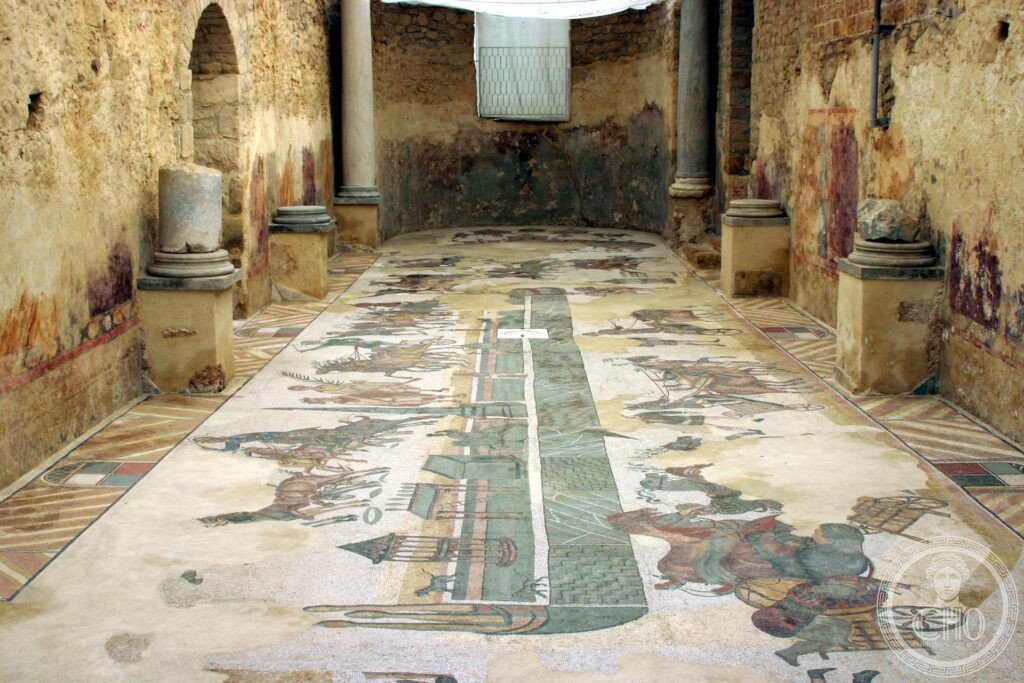
The Villa Romana del Casale — a vast late Roman hunting lodge buried by a medieval landslide and excavated in the 1950s on a wooded hillside near Piazza Armerina in central Sicily — contains the largest surviving Roman floor mosaic programme in the world: 3,500 square metres of polychrome figurative mosaic depicting big-game hunting in Africa, mythological scenes, a chariot race, athletic competitions (including the famous “Bikini Girls” panel — ten female athletes in two-piece swimsuits that look indistinguishable from modern sportswear), and a 65-metre corridor showing the capture and transport of African animals — elephants, lions, rhinoceroses, tigers — to the Circus Maximus in Rome.
At a glance
The Villa Romana del Casale (province of Enna, Sicilia; UNESCO 1997, ref. 832) is a late Roman villa rustica (an agricultural estate serving as a palatial hunting retreat) built in the last decade of the 3rd century CE or the first decade of the 4th century CE; the leading scholarly identification of its patron is the emperor Maximian (Marcus Aurelius Valerius Maximianus, 286-305 CE, co-emperor with Diocletian), based on the scale and quality of the construction and the iconographic programme (the hunt mosaics depict the kind of large-scale animal capture operations that required imperial authorization and infrastructure); the identification remains disputed. The villa covers approximately 3,500 square metres of floor area; its mosaic programme covers approximately the same area in continuous floor surface — an almost complete overlay. The mosaics were produced by North African workshops (the style — “North African school” — is recognizable from parallels in Tunisia and Libya) and represent the highest technical standard of late Roman polychrome floor mosaic surviving anywhere.
Key facts
- Le “Ragazze in Bikini” (Sala delle Palestriti): The “Bikini Girls” mosaic (officially “Sala delle Palestriti” or “Room of the Female Athletes”) is the most-reproduced image from the villa: it shows 10 female athletes in two-piece garments — a bandeau top and shorts reaching the hip — engaged in discus throwing, running, ball games, and weight training; they wear garments that are functionally and visually identical to a modern bikini; the mosaic was completed approximately 1,700 years before the invention of the bikini swimsuit (1946); the room serves as a palestra (exercise hall), and the scene is therefore athletic rather than erotic; the women wear golden crowns, suggesting they are victors in athletic competition
- La Grande Caccia (Corridoio delle Grandi Cacce, 65 m × 5 m): The Great Hunt corridor (the longest surviving Roman floor mosaic in the world, at 65 m × 5 m = 325 m²) depicts the capture and transport of African wildlife (elephants, lions, rhinoceroses, tigers, hippos, cheetahs, antelopes, and ostriches) from the African and Asiatic provinces to Italy for use in the venationes (wild beast hunts) staged in the Circus Maximus and Colosseum; the corridor shows the entire operation: hunters trapping animals in nets in the African forest, animals being loaded onto ships, the sea crossing, and delivery at an Italian port; figures wearing the purple vestment of the emperor or high official appear at the ends of the composition
- Il colonnato e il peristilio: The central peristyle (a colonnaded courtyard, 37 × 29 m) is the organizational centre of the villa; its mosaic floor depicts the four seasons as female figures with seasonal attributes; the columns (granite, with white marble Ionic capitals) were originally covered in opus sectile (coloured marble veneer); 12 of the original 32 columns survive
- UNESCO: 1997, rif. 832
- GPS: 37.3692, 14.3282 — Google Maps (Villa Romana del Casale)
History
The Villa Romana del Casale was built in a single construction phase (c.290-310 CE) on an elevated position (700 m a.s.l.) in the mountainous interior of Sicily, within the latifundium (large agricultural estate) system that dominated Sicilian agriculture in the late Empire; it served as both a working estate headquarters and a luxury hunting lodge for large-scale venatio hunting expeditions in the Sicilian forests. The villa continued in use through the Byzantine period (535-827 CE) and the Arab period (827-1072 CE); it was partially destroyed by the Norman mercenaries of William I (William the Bad) in 1160 CE (the villa shows burn evidence at this date) and was buried by a series of landslides triggered by the deforestation of the surrounding hillsides in the 13th century. A medieval village (Casale) built over the ruins was itself abandoned in the 14th century; the site was covered by approximately 2 metres of earth when the archaeological excavations began in 1929 (limited) and 1950-1960 (systematic, directed by Gino Vinicio Gentili).
What you see
The Villa Romana del Casale is covered by a modern protective structure (designed 1953-1967, currently being replaced with a new intervention — check status before visiting) that allows viewing of the mosaics from elevated walkways. The visit circuit (1.5-2 hours, well-signed in Italian and English) follows a logical path: entrance → Terme (private baths; mosaic programme of athletes and mythological marine scenes) → Peristilio (central courtyard) → Sala delle Terme (Great Hall) → Corridoio della Grande Caccia (65 m hunting corridor — the unmissable centrepiece; follow the action left to right) → Sala delle Palestriti (Bikini Girls room; 3rd from the end of the corridor) → Triclinium (dining room; the Labours of Hercules mosaic, the largest figurative scene in the villa) → Private apartments. The site museum (external building, 5 min walk) holds the finds not on display in situ: pottery, glass, coins, and architectural fragments.
Gallery
Practical information
- Villa Romana del Casale: Contrada Casale, Piazza Armerina (EN), Sicilia; open daily 09:00-19:00 (summer), 09:00-17:00 (winter); admission ~€10 (full), ~€5 (reduced); family ticket available. The walkways inside the protective structure can be crowded at midday in summer (July-August); arrive at 09:00 for the most comfortable experience. Guided tours available (Italian/English, ~€8 supplement, ~90 min); strongly recommended for understanding the iconographic programme of the Great Hunt and the mythological mosaics.
- Photography: Permitted inside without flash (the protective structure is relatively low-light; a smartphone is usually adequate for documentation but a lens with good ISO performance is useful for the more shadowed rooms). Tripods not permitted.
Getting there
Villa Romana del Casale, Contrada Casale, Piazza Armerina (EN), Sicilia. GPS 37.3692, 14.3282. By car (essentially required — no direct public transport): from Catania, A19 Palermo motorway → exit Enna → SP15 to Piazza Armerina (90 km, 1h20); from Palermo, A19 → exit Enna → SP15 (160 km, 1h50); from Agrigento, SS189 → Piazza Armerina (90 km, 1h30). Parking at the villa (free). Public transport: buses from Catania or Enna to Piazza Armerina (daily, 1-2 services; check SAIS Autolinee); local bus from Piazza Armerina town centre to the villa (~5 km, limited service).
Nearby
- Agrigento, Valle dei Templi — 90 km south-west; (UNESCO 1997, ref.831); the most complete surviving Doric temple complex outside Greece (7 temples along the ridge of the “Valley of the Temples”); the Temple of Concordia (450 BCE) is the best-preserved Greek Doric temple in the world after the Hephaisteon in Athens
- Cattedrale di Monreale — 130 km north-west; (CHO card: Monreale UNESCO 2015); the Norman cathedral (1172-1189) with 6,340 m² of Byzantine-style gold mosaic
- Ragusa Ibla — 100 km south-east; the UNESCO-inscribed historic centre of Ragusa (Val di Noto, ref.1024), with the Baroque cathedral of San Giorgio by Rosario Gagliardi (1738-1775) perched above a deep limestone gorge
Sources
- UNESCO: whc.unesco.org/en/list/832
- Wikipedia EN: Villa Romana del Casale
- Parco Archeologico Villa Romana del Casale: villaromanadelcasale.it
Find it on the map
See this place and what’s around it →📷 Become a Cultural Heritage Online photographer
Share your photos of places: they stay published under your name as the author. The more they're seen, the more you get noticed — and soon a contest will reward the most appreciated photos.
Log in or sign up free to add a photo