
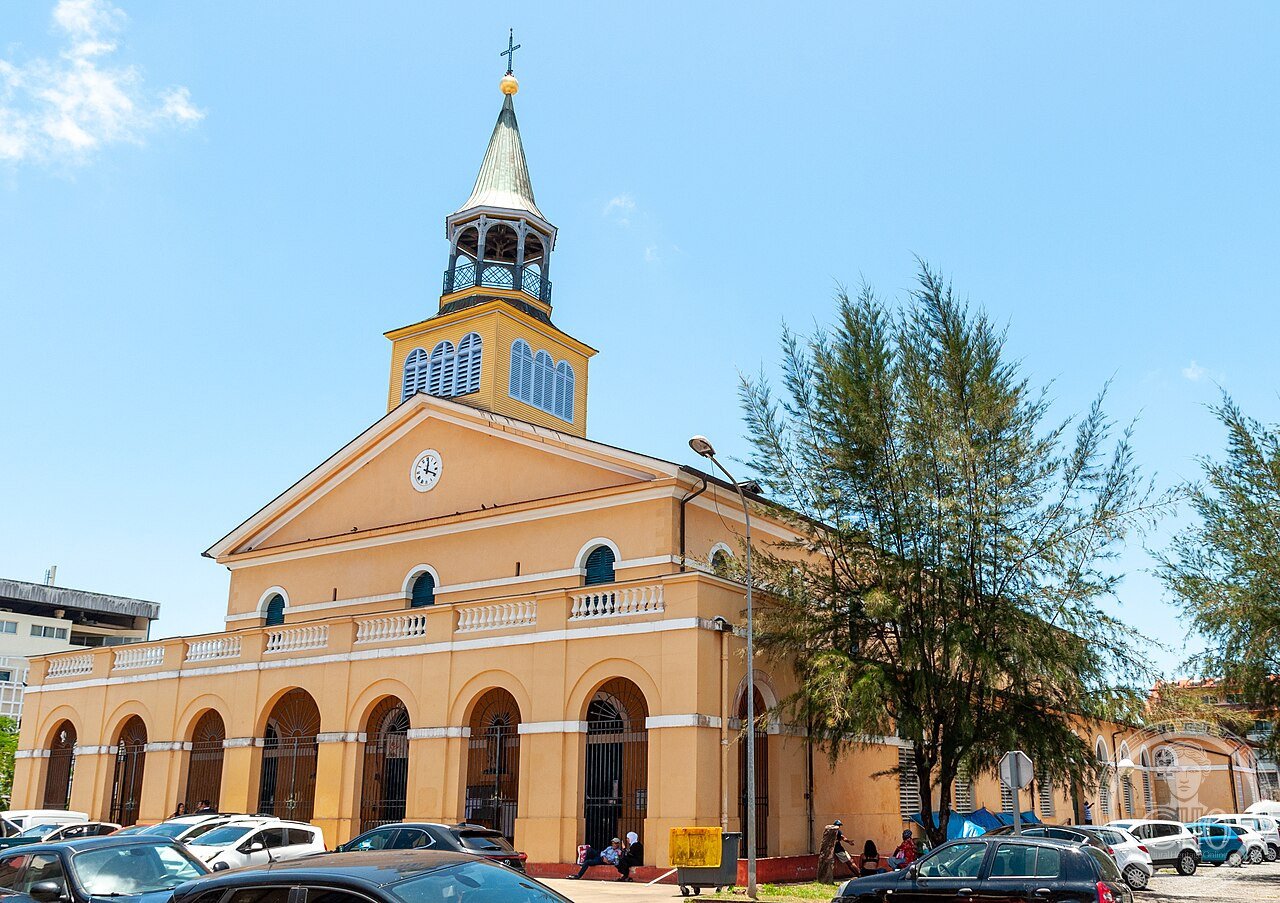
In Cayenne, the capital of French Guiana, the Cathédrale Saint-Sauveur was raised to replace the parish church of Saint-Nicolas, which once stood on today’s Place Léopold-Héder. In 1823 Father Nicolas Guiller and Baron Pierre Bernard Milius, colonial administrator of Guiana, decided to build the new church, with the foundation stone laid on 25 August of that year according to one source. The works ran between 1825 and 1833, with a consecration given by some sources as 6 August 1833, while others, among them the French Wikipedia and the official Mérimée heritage database, give a public inauguration only in 1861. That is a gap of almost thirty years between the two dates which the sources do not explain, and it should be taken as unresolved. The Mérimée database names no particular architect, recording him as unknown. An entry in the English Wikipedia attributes the building instead to the architect Victor Toubi, with a construction dated 1925-1933, a claim that contradicts every other source consulted, according to which Toubi was in fact the engineer of the enlargement of 1952-1954 alone, and it should therefore be taken as a probable error. In neoclassical style, built of stone and brick, with a porticoed façade and a two-storey wooden bell tower, the cathedral has a basilican plan with double side aisles, unusual for the region. No iron structure is documented, a feature that belongs instead to the different cathedral of Fort-de-France, in Martinique, often confused with this one. Described as the largest church in French Guiana, though without a documented figure for its capacity, the interior keeps rose windows, stained glass, a confessional of wacapou, a prized local wood, and statues of Saints Peter and Paul, as well as a polygonal choir in reinforced concrete added in 1952, which lengthened the building by about 13 metres to the east. The digging of that year brought to light a lead capsule holding 21 coins, among them coins of the Napoleonic period, and 20 seals from the time of Charles X. The ecclesiastical circumscription, erected as the apostolic prefecture of French Guiana-Cayenne in 1651, was raised to an apostolic vicariate on 15 January 1933, with Pierre-Marie Gourtay as first apostolic vicar, consecrated bishop on 25 March and installed on 25 September of that same year. The building was formally consecrated as a cathedral on 9 November 1934 by Gourtay himself, while the vicariate became the full diocese of Cayenne on 29 February 1956. No papal visit is documented. Major restorations were carried out between 1952 and 1954, with the enlargement to the east, a new choir, the replacement of stained glass, of the ceilings and of the gallery floors, and new roofing, followed by a further restoration between 2000 and 2005, covering the bell tower in 2000-2001 and the outer walls in 2004-2005. The present bishop is Monsignor Alain Ransay, born on 11 November 1961 at La Trinité, in Martinique, consecrated bishop on 6 February 2022 and installed in the cathedral of Cayenne on 9 February of the same year. The diocese is a suffragan of the ecclesiastical province of Fort-de-France, in Martinique. The building was listed as a historic monument on 9 December 1992, with the bell tower and the portico classified in 1999, the sources differing on the exact day, and the full classification of the building following on 29 October 2012.
About Cathédrale Saint-Sauveur de Cayenne
In Cayenne, the capital of French Guiana, the Cathédrale Saint-Sauveur was built to replace the Saint-Nicolas parish church that once stood on today’s Place Léopold-Héder; in 1823, Father Nicolas Guiller and Baron Pierre Bernard Milius, the colonial administrator of French Guiana, decided to build the new church, with the foundation stone laid on 25 August that year, per one source. Construction ran from 1825 to 1833, with one source reporting consecration on 6 August 1833, while others — including French Wikipedia and the official Mérimée heritage database — cite a public inauguration only in 1861, a nearly 30-year gap that sources leave unexplained.
Key facts
- 1823-1833: the cathedral built to replace the earlier Saint-Nicolas church.
- 15 January 1933: the Vicariate Apostolic of Cayenne created, elevating the church’s status.
- 9 November 1934: the building formally consecrated as a cathedral by Bishop Pierre Gourtay.
- 1952: extended eastward by roughly 13 metres, uncovering a buried capsule of Napoleonic-era coins.
- 29 February 1956: the vicariate elevated to the full Diocese of Cayenne.
- 29 October 2012: the entire building classified as a French historic monument.
History
Built in the 1820s-30s but not formally consecrated as a cathedral until a full century later, in 1934, Cathédrale Saint-Sauveur’s own institutional history lagged well behind its physical construction — a gap mirrored by its disputed 1833/1861 completion dates, which no source fully reconciles. A 1952 extension that literally unearthed Napoleonic-era coins beneath its floor adds a small archaeological footnote to a building whose full legal heritage protection came only in 2012.
What you see
A neoclassical stone-and-brick façade with a porticoed entrance and a two-story wooden bell tower fronts a basilical church with an unusual double side-aisle plan for the region. Inside, a wooden confessional carved from wacapou, a prized Guianese hardwood, sits alongside statues of Saints Peter and Paul and a polygonal reinforced-concrete choir added during the 1952 extension.
Practical information
- Opening hours: generally open daily outside services; check current hours before visiting.
- Address: 16 Bis Rue Lallouette, 97300 Cayenne, French Guiana.
Getting there
The cathedral stands on Rue Lallouette in central Cayenne, easily reached on foot from the city’s historic core. GPS: 4°56′21″N, 52°19′54″W.
Nearby
- Place Léopold-Héder — the square where the cathedral’s predecessor church once stood.
Sources
- French Wikipedia — “Cathédrale Saint-Sauveur de Cayenne” (fr.wikipedia.org).
- Base Mérimée — French Ministry of Culture heritage database (pop.culture.gouv.fr).
- Musée du Patrimoine de France (museedupatrimoine.fr).
- Wikipedia — “Roman Catholic Diocese of Cayenne” (en.wikipedia.org).
Find it on the map
See this place and what’s around it →📷 Become a Cultural Heritage Online photographer
Share your photos of places: they stay published under your name as the author. The more they're seen, the more you get noticed — and soon a contest will reward the most appreciated photos.
Log in or sign up free to add a photo