
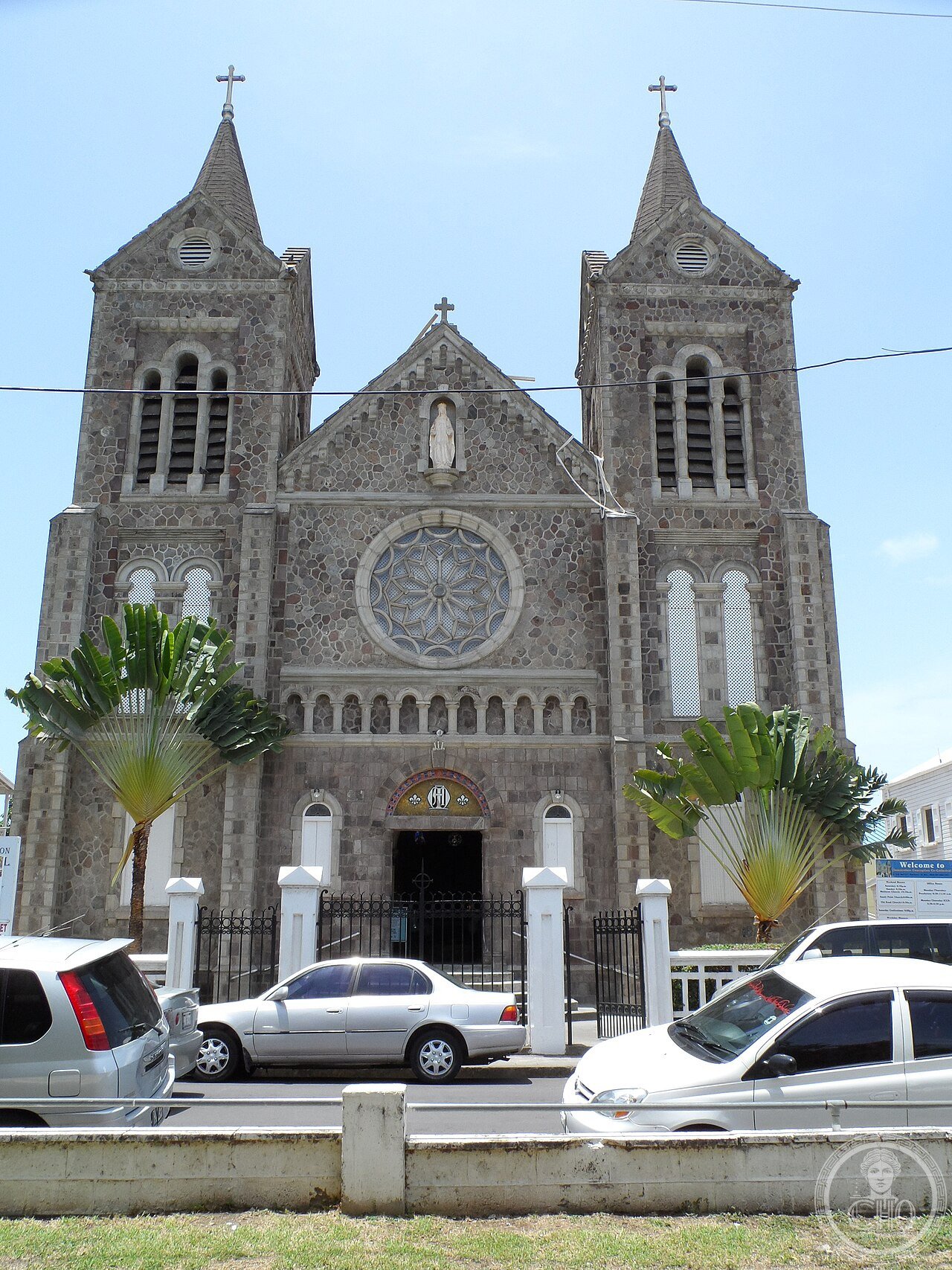
In Basseterre, capital of Saint Kitts and Nevis, French Jesuits built a Catholic church dedicated to Notre Dame in the first years of the colony. It burned in 1706 during an Anglo-French war and was later rebuilt as the Anglican church of Saint George, on a site different from that of the present co-cathedral. From 1713, when the island passed fully under British control, public Catholic worship was banned by law, and some well-off Catholic families built secret cupolas on their houses in order to practise the faith in private. A few of those restrictions were eased by an act of 1829, but the Catholic community reformed in any real way only with the Portuguese immigration from Madeira, from 1835-1846, and with the Irish immigration of the years of the great famine, which settled in the district of Basseterre known as «Irish Town». The first church on the present site was begun under Father John Taaffe, on a date given inconsistently between 1846 and 1852, and then stood still for want of money until Father Philip Lynch, the first resident parish priest on the island, arrived in 1858 and completed it. By 1885 the building was already badly decayed, which pushed Father Peter Smyth to start rebuilding it. The present building was designed in 1925, with the plans shown publicly in 1926. Demolition of the old church began on 1 February 1927 and the new work on 17 March of the same year; the church was finished in less than two years and dedicated on 6 December 1928. The attribution of the design to «Father Claeys», described as «an architect of repute» in several tourist sources, finds no support in an independent biographical source. The church is of grey stone, with two towers topped by crosses, a central rose window and a cross plan. Inside are fourteen stations of the Via Crucis given by the bishop of Roseau, in Dominica, a statue of the Immaculate Conception placed in 1903, a crown of diamonds and a statue of the Madonna given by Bishop Poirier, and an organ brought from a church in Antigua in 1899 and replaced in 1919. The floor tiles of the demolished old church were reused in the new building of 1928. The diocese of Saint John’s-Basseterre, which takes in Antigua and Barbuda, Saint Kitts and Nevis, Montserrat and the British Virgin Islands, was erected as the diocese of Saint John’s on 16 January 1971, with Joseph Oliver Bowers as its first bishop, and renamed diocese of Saint John’s-Basseterre on 21 June 1981, when the church of Basseterre was raised to co-cathedral. One parish source gives 1983 instead, the year of the country’s independence, but the date is probably confused with that anniversary and finds no support in other sources. No damage to the building caused specifically by hurricanes is documented, nor any papal visit; the present bishop is Monsignor Robert Anthony Llanos, installed between the end of 2018 and the beginning of 2019. The co-cathedral stands on the east side of Independence Square, the old Pall Mall Square, renamed on 19 September 1983, and carries no specific formal heritage protection of its own, although it lies inside a recognised historic district of Basseterre.
About the Co-Cathedral of the Immaculate Conception
In Basseterre, the capital of St. Kitts and Nevis, French Jesuits built an early Catholic church dedicated to Notre Dame during the island’s colonial founding, burned in 1706 during an Anglo-French war and later rebuilt as the Anglican Church of St. George, on a different site from today’s co-cathedral. From 1713, when the island passed fully under British control, public Catholic worship was legally banned, with wealthy Catholic families reportedly building secret cupolas atop their homes to worship in private; some restrictions eased under an 1829 act, but the Catholic community only rebuilt substantially with Portuguese immigration from Madeira beginning 1835-1846 and Irish Great Famine-era immigration, settling in Basseterre’s “Irish Town” district.
Key facts
- 1713: public Catholic worship banned under British colonial rule.
- 1846-1858: the first church on the current site built, completed by Father Philip Lynch.
- 1927-1928: the present church built and dedicated on 6 December 1928.
- 21 June 1981: the church elevated to co-cathedral with the renaming of the Diocese of Saint John’s-Basseterre.
- 1899-1919: an organ brought from Antigua, later replaced.
- 2018-2019: Bishop Robert Anthony Llanos installed, the current bishop.
History
Standing on ground where public Catholic worship was illegal for over a century, the Co-Cathedral of the Immaculate Conception traces a path from secretly practiced faith under British colonial law to a formally elevated co-cathedral of an independent Caribbean nation’s diocese. Its 1928 rebuilding, reusing floor tiles salvaged from the demolished 19th-century church it replaced, reflects a Catholic community rebuilt largely by 19th-century Portuguese and Irish immigrants rather than a continuous congregation.
What you see
Twin cross-topped grey stone towers flank a central rose window on a cruciform-plan church completed in 1928, its interior holding Stations of the Cross donated by the Bishop of Roseau, Dominica, and a statue of the Immaculate Conception enshrined in 1903. The pavement tiles underfoot were salvaged from the demolished 19th-century church that stood on the same site before it.
Practical information
- Opening hours: generally open daily outside services; check current hours before visiting.
- Address: Independence Square, Basseterre, St. Kitts and Nevis.
Getting there
The co-cathedral stands on the east side of Independence Square in central Basseterre, easily reached on foot from the city’s main commercial district. GPS: 17°17′47″N, 62°43′18″W.
Nearby
- Independence Square — Basseterre’s historic central square, formerly Pall Mall Square.
Sources
- Wikipedia — “Basseterre Co-Cathedral of Immaculate Conception” (en.wikipedia.org).
- Diocese of Saint John’s-Basseterre — official site (diocesesjb.org).
- Historic St. Kitts — “Co-Cathedral of the Immaculate Conception”
Find it on the map
See this place and what’s around it →📷 Become a Cultural Heritage Online photographer
Share your photos of places: they stay published under your name as the author. The more they're seen, the more you get noticed — and soon a contest will reward the most appreciated photos.
Log in or sign up free to add a photo