
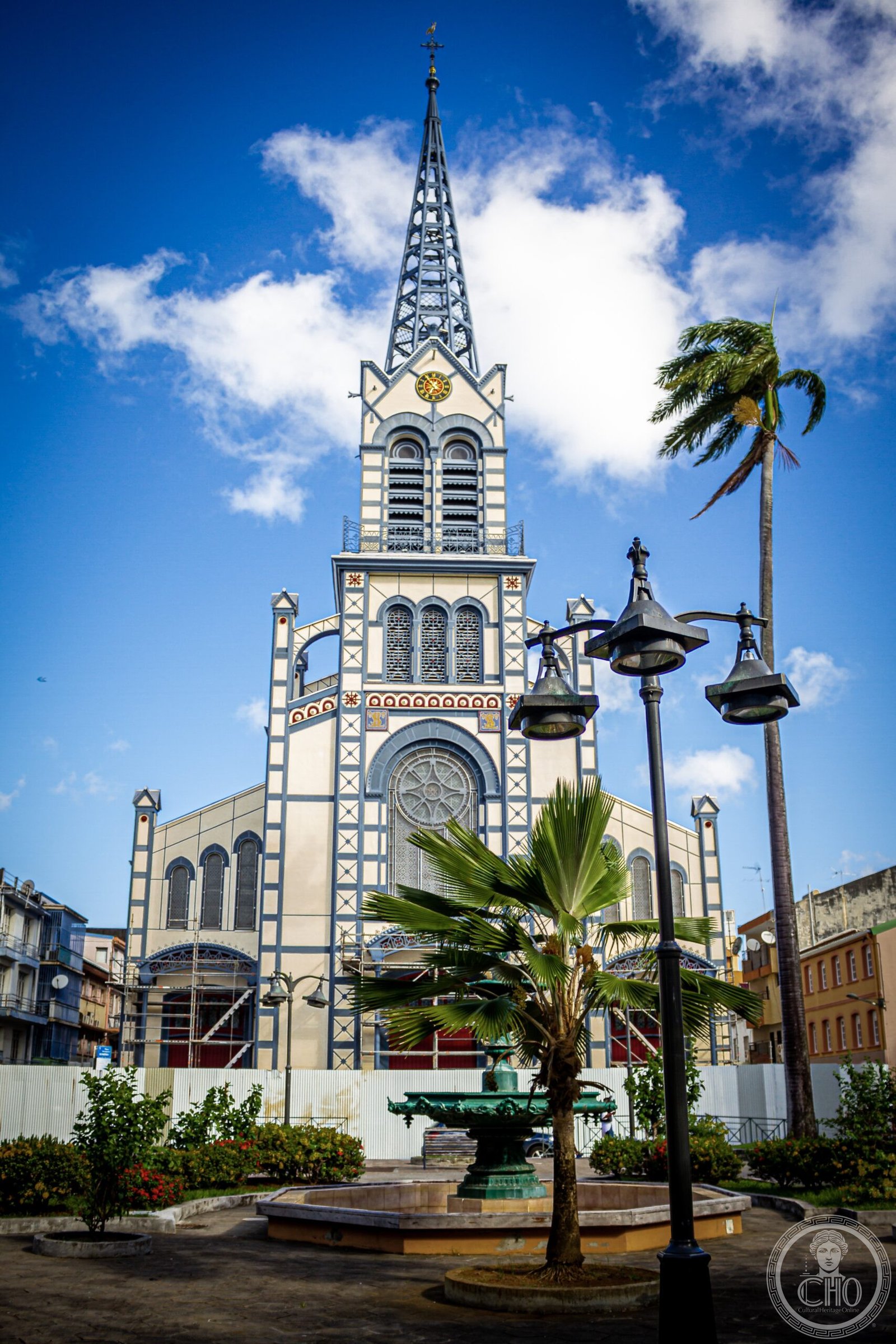
In Fort-de-France, Martinique, the earliest documented place of worship on the site of the present cathedral is dated 1671 by French Wikipedia and 1657 by the English version, an unresolved discrepancy. Dutch forces under Admiral de Ruyter burned it in 1674. A stone church was built between 1678 and 1685 under Governor Charles de Courbon-Blénac, repaired in 1703, damaged by a tidal surge in 1766 and badly struck by an earthquake in 1839, which forced it to close. A new church, designed by the government architect César Jolly, had its foundation stone laid in 1845 and was inaugurated as a cathedral in 1854, after the diocese was created. On 22 June 1890 a fire destroyed that cathedral along with about three quarters of the town, and in 1891 a cyclone swept away what was left of the roof. The present building is often described as the seventh church on the same site, a figure widely repeated but impossible to verify structure by structure from the available sources. It was built between 1891 and 1895 and solemnly inaugurated on 2 July of that year by Bishop Julien-François-Pierre Carméné, on a commission from the municipality of Fort-de-France, which owns it. The design was by the Parisian architect Pierre-Henri Picq (1833-1911), who lived in Martinique for some seven years from the early Nineties of the nineteenth century. He also designed the Bibliothèque Schœlcher, built for the Paris Exhibition of 1878, then dismantled and rebuilt in Fort-de-France, where it opened in 1893. Neo-Gothic outside and Romanesque-Byzantine inside, with round arches and an octagonal dome, the cathedral is 66 metres long and 24 wide, with a bell tower 58.8 metres high. Its most distinctive feature is the load-bearing structure, entirely of metal, beams, capitals and arches alike, conceived to withstand earthquakes and hurricanes after the repeated destruction of the earlier buildings. The prefabricated metal parts were made by the French firm Moisant-Laurent-Savey and assembled on the foundations of the previous cathedral, which earned the building its local nickname, the iron cathedral. Nineteen stained-glass windows by the glass painter Néret decorate the interior, five of them showing the life of Saint Louis in the apse. The seating capacity of the building is not documented. Tourist sources often claim that the cathedral is the work of Gustave Eiffel, but no primary source gives Eiffel any role in its design or construction: the architect of record remains Pierre-Henri Picq, even if the building technique genuinely recalls the metal architecture of the Eiffel era. The eruption of Mount Pelée on 8 May 1902, which destroyed Saint-Pierre and killed more than 30,000 people, did no direct damage to the cathedral, more than 20 kilometres away. It did mark the definitive shift of the economic and administrative centre of the island to Fort-de-France, which confirmed the cathedral as the main religious building of Martinique. The diocese, with origins going back to 1643, was erected as the diocese of Martinique on 27 September 1850 by Pope Pius IX, renamed diocese of Saint-Pierre shortly afterwards, and finally raised to the archdiocese of Fort-de-France and Saint-Pierre on 26 September 1967. No papal visit is documented. A major restoration was carried out in 1976 under the engineer François Lubin, who strengthened and raised the bell tower and added a new spire of 25 metres, taller than the original and clad in about 3,000 bronze-coloured aluminium shingles. A further long restoration campaign, begun in 2002 and continued in phases beyond 2016, has covered the naves and the western block, with the spire replaced in 2015-2016, and is still under way according to the most recent sources consulted. The present archbishop is Monsignor David Macaire, appointed on 7 March 2015. The building has been a French historic monument since 9 October 1990.
About Cathédrale Saint-Louis
In Fort-de-France, Martinique, the earliest documented place of worship on this site dates to 1671 per French Wikipedia, or 1657 per the English version — an unresolved discrepancy — and was burned by Dutch forces under Admiral de Ruyter in 1674; a stone church was built between 1678 and 1685 under Governor Charles de Courbon-Blénac, repaired in 1703, damaged by a tidal surge in 1766, and severely struck by an earthquake in 1839 that forced its closure. A new church, designed by government architect César Jolly, had its foundation stone laid in 1845 and was inaugurated as a cathedral in 1854, following the diocese’s creation. A fire on 22 June 1890 destroyed this cathedral along with roughly three-quarters of the town, and a 1891 cyclone swept away what remained of the roof; the present building, often described as the seventh church on this site, was constructed between 1891 and 1895 and solemnly inaugurated on 2 July that year by Bishop Julien-François-Pierre Carméné.
Key facts
- 1891-1895: the current cathedral built by architect Pierre-Henri Picq.
- An entirely metal structural frame, engineered specifically to resist earthquakes and hurricanes.
- 2 July 1895: solemnly inaugurated by Bishop Julien-François-Pierre Carméné.
- 8 May 1902: the Mount Pelée eruption destroys Saint-Pierre, cementing Fort-de-France’s primacy.
- 26 September 1967: elevated to Archdiocese of Fort-de-France.
- 9 October 1990: classified a French historic monument.
History
Rebuilt on the ashes and rubble of at least six earlier churches destroyed by Dutch raids, earthquakes, a tidal surge, a devastating 1890 fire and a 1891 cyclone, Cathédrale Saint-Louis answered that history of repeated destruction with an entirely metal structural frame — an engineering solution, not merely a stylistic one, that has kept the building standing since 1895. Long popularly but inaccurately credited to Gustave Eiffel, the cathedral’s real architect, Pierre-Henri Picq, worked in the same era of French iron architecture without any documented connection to Eiffel himself.
What you see
A Neogothic exterior encloses a Romano-Byzantine interior of round arches and an octagonal dome, the entire structural frame — beams, capitals, arches — built of prefabricated metal components shipped from France and assembled on the foundations of the previous cathedral, earning it the local nickname “the Iron Cathedral.” Nineteen stained-glass windows by the painter Néret, five depicting the life of Saint Louis in the apse, light an interior whose bell tower and spire have been rebuilt and heightened during restorations in 1976 and again from 2015 to 2016.
Practical information
- Opening hours: generally open daily outside services; check current hours given ongoing restoration work.
- Address: Rue Victor Schœlcher, facing Place Monseigneur Roméro, Fort-de-France, Martinique.
Getting there
The cathedral stands near La Savane park in central Fort-de-France, easily reached on foot from the city center. GPS: 14°36′15″N, 61°04′12″W.
Nearby
- La Savane — Fort-de-France’s central public park, a short walk away.
Sources
- Wikipedia — “St. Louis Cathedral, Fort-de-France” (en.wikipedia.org).
- French Wikipedia — “Cathédrale Saint-Louis de Fort-de-France” and “Pierre-Henri Picq”
- Monumentum — reference PA00105958 (monumentum.fr).
- Ville de Fort-de-France — official site (fortdefrance.fr).
Find it on the map
See this place and what’s around it →📷 Become a Cultural Heritage Online photographer
Share your photos of places: they stay published under your name as the author. The more they're seen, the more you get noticed — and soon a contest will reward the most appreciated photos.
Log in or sign up free to add a photo