
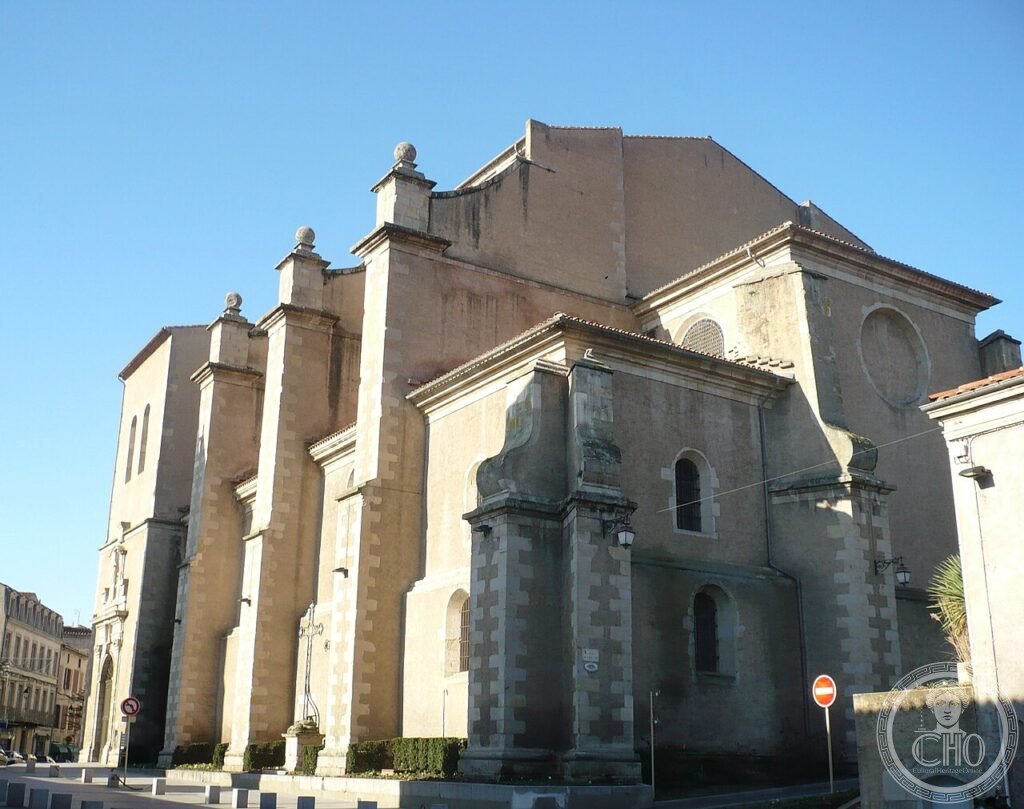
Fondato nell’812 da Benedetto d’Aniane, il grande riformatore monastico dell’epoca carolingia, il priorato di Bellecelle divenne cattedrale nel 1317. Distrutta dagli ugonotti nel Cinquecento, fu progettata per la ricostruzione come la più grande cattedrale di Francia — ma i lavori non furono mai completati: quello che si vede oggi era destinato a essere solo il coro.
At a glance
Castres Cathedral (Cathédrale Saint-Benoît) traces its origins to the Benedictine priory of Bellecelle, founded in 812 at the instigation of Benedict of Aniane — one of the most influential monastic reformers of the Carolingian period, whose reform programme shaped Western monasticism for centuries — on land donated by Ulfarius, a count of the Albigeois, on high ground above the Agout river. The priory began with a prior and twelve monks from the abbey of Aniane and developed rapidly; Benedict of Aniane himself drew up its founding regulations, formally approved by Emperor Louis the Pious on 9 March 819, who took the monastery under his personal protection. The abbey church, elevated to cathedral status in 1317, was originally built in the late 11th century as a Romanesque Latin-cross structure with a semi-circular apse; its bell tower, still standing today though now absorbed into the episcopal palace, rises from around 1100. The cathedral was destroyed by Huguenot forces in the 16th century, and its planned reconstruction was extraordinarily ambitious: the new building was intended to become the largest cathedral in France. That reconstruction was, however, never completed — what stands today corresponds only to what was meant to have been merely the choir of the planned, far larger cathedral.
Key facts
- Foundation: 812, Benedictine priory of Bellecelle, instigated by Benedict of Aniane on land donated by Count Ulfarius of the Albigeois
- Founding charter: regulations drawn up by Benedict of Aniane, approved by Emperor Louis the Pious on 9 March 819, who placed the monastery under his protection
- Cathedral status: conferred 1317; reduced to parish church status in 1801
- Original abbey church: late 11th century, Romanesque, Latin-cross plan with semi-circular apse; bell tower c. 1100, still standing, now incorporated into the episcopal palace
- 16th-century destruction and rebuilding: destroyed by Huguenot forces; planned reconstruction intended to make it the largest cathedral in France, but the project was never completed — the present building represents only the planned choir
History
Benedict of Aniane’s involvement in founding the Bellecelle priory in 812 connects Castres directly to one of the most consequential monastic reform movements of the entire Carolingian period: Benedict, working closely with Emperor Louis the Pious, sought to impose a single, standardised Benedictine observance across Frankish monasteries, replacing the more varied local monastic customs that had developed across different houses, and his personal drafting of Bellecelle’s founding regulations — subsequently formally approved by the emperor himself in 819 — placed the new Castres foundation directly within this ambitious programme of monastic standardisation from its very inception, rather than as a monastery founded independently and only later brought into line with Aniane’s reforms.
The priory’s elevation to cathedral status in 1317 reflected its accumulated regional significance across five centuries of continuous monastic life, but the building’s 16th-century destruction by Huguenot forces during the French Wars of Religion — a period when Castres itself became a significant Protestant stronghold in southern France — dealt the medieval structure a blow serious enough to require essentially complete reconstruction. The extraordinary ambition of the planned rebuilding, intended to produce the largest cathedral in France, reflects the scale of confidence and resources the Catholic Church and local patrons were prepared to commit to reasserting Catholic institutional presence in a region that had experienced serious Protestant challenge; that this ambitious project was ultimately never completed, leaving only what was intended as the cathedral’s choir section standing as the entire building visitors see today, makes Castres a rare and specifically documented case of a French cathedral whose surviving form directly reflects an abandoned, much larger original design rather than either a completed unified structure or a series of successfully finished sequential building campaigns.
What you see
The building’s buttressed exterior gives a direct sense of its status as an intentionally partial structure — what would have been merely the choir of a vastly larger planned cathedral — a scale mismatch between ambition and executed reality that is itself part of the building’s specific historical interest. The Romanesque bell tower, dating from around 1100 and among the few substantial survivals of the original medieval abbey church, now stands incorporated into the adjoining episcopal palace rather than as a freestanding element of the cathedral itself. Inside, the choir and pulpit reflect the building’s later, post-Huguenot-destruction decorative campaigns, executed within the scaled-back reality of the never-completed reconstruction.
Practical information
- Opening hours: generally open daily, check current hours before visiting; free admission
- Address: Rue Saint-Benoît, 81100 Castres
Getting there
Castres is reachable by train from Toulouse (approximately 1.5 hours, via Mazamet or direct regional connections) and has its own regional airport (Castres-Mazamet). By car, Castres sits on the A68/D622 road network from Toulouse. The cathedral stands in the historic centre, near the Agout river. GPS: 43.6042° N, 2.2417° E.
Nearby
- Musée Goya, Castres — in the former episcopal palace adjoining the cathedral; holds the largest collection of Spanish art in France outside the Louvre, including significant Goya works
- Jardin de l’Évêché — adjoining the cathedral and Musée Goya; formal gardens attributed in design to André Le Nôtre’s school
- Église Notre-Dame-de-la-Platé — elsewhere in Castres; a separate Jesuit Baroque church, the oldest in the city, rebuilt 1741-1753 in a style modelled on Rome’s Gesù
Sources
- Diocèse d’Albi — “Castres: cathédrale Saint-Benoît” (albi.catholique.fr)
- Fondation du patrimoine — heritage documentation (fondation-patrimoine.org)
- Structurae — architectural documentation (structurae.net)
- Wikipedia — “Cathédrale Saint-Benoît de Castres” (fr.wikipedia.org)
Find it on the map
See this place and what’s around it →📷 Become a Cultural Heritage Online photographer
Share your photos of places: they stay published under your name as the author. The more they're seen, the more you get noticed — and soon a contest will reward the most appreciated photos.
Log in or sign up free to add a photoIs this page about you?
This page is read by travellers and heritage enthusiasts who find it on Google. Tell us how you are connected to this place and we will take it from there.