
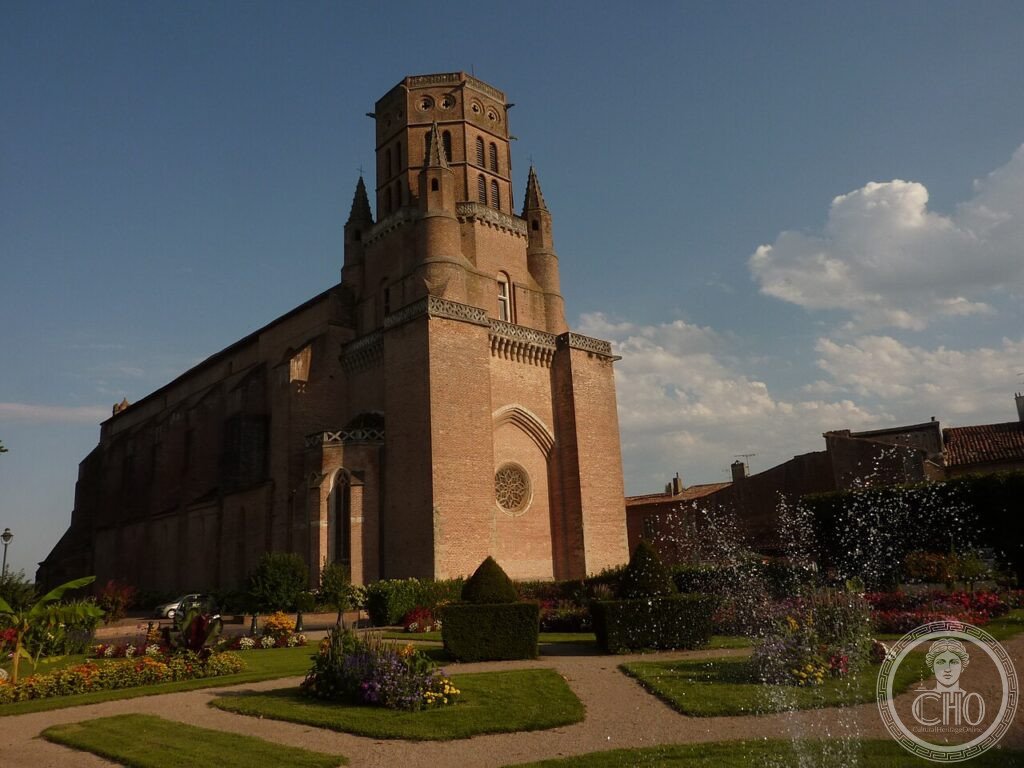
Il monastero benedettino fondato nel VII secolo da Sant’Alano fu quasi interamente distrutto nella primavera del 1211, quando Simone di Montfort conquistò Lavaur durante la crociata contro gli Albigesi, in uno dei massacri più sanguinosi dell’intera crociata. La cattedrale attuale nacque solo a metà Duecento, sulle rovine.
At a glance
Lavaur Cathedral (Cathédrale Saint-Alain) originates from a Benedictine monastery founded around the 7th century by Saint Alain and rebuilt in the 11th century, a building that was almost entirely destroyed in 1211 during the Albigensian Crusade, when Simon de Montfort conquered the city — an episode remembered as one of the crusade’s most brutal, with a documented massacre in spring 1211. The current church was rebuilt beginning around 1255, commissioned by the consuls of Lavaur, and when the building was elevated to cathedral status in 1317, it was further enlarged with a semicircular apse extending eastward, replacing the original square east end. Its most celebrated later artistic feature is its historic organ: in 1523, under Bishop Simon de Beausoleil (1514-1525), a major organ was commissioned, likely from Toulouse workshops, an ensemble presented as a unique surviving testimony to the flowering of Renaissance artistic ideas in southern France; the organ itself is attributed uncertainly to Jehan Torrian, but its surviving case is confidently attributed to the significant Toulouse Renaissance sculptor Nicolas Bachelier. The organ was later replaced by an instrument from the celebrated French organ-building workshop of Aristide Cavaillé-Coll, quoted in 1874 and delivered in 1876.
Key facts
- Origins: Benedictine monastery founded c. 7th century by Saint Alain; rebuilt 11th century
- 1211 Albigensian Crusade: the church was almost entirely destroyed when Simon de Montfort conquered Lavaur, an episode remembered as one of the crusade’s bloodiest, with a documented massacre that spring
- Reconstruction: begun c. 1255, commissioned by the consuls of Lavaur; enlarged with a semicircular apse when elevated to cathedral status in 1317
- 1523 organ: commissioned under Bishop Simon de Beausoleil; organ attributed uncertainly to Jehan Torrian, its surviving case confidently attributed to Toulouse Renaissance sculptor Nicolas Bachelier
- Cavaillé-Coll organ: quoted 1874, delivered and received 28-29 November 1876, a three-keyboard instrument with pedals
History
Lavaur’s role in the Albigensian Crusade (1209-1229) reflects the city’s position as a significant stronghold associated with the Cathar heresy and its noble protectors in the Languedoc region, and Simon de Montfort’s 1211 siege and conquest of the city — undertaken as part of the broader crusade Pope Innocent III had called against Catharism and its aristocratic supporters — culminated in violence severe enough to be specifically remembered among historians of the crusade as one of its most brutal single episodes, with the resulting destruction of the earlier monastery-church leaving Lavaur’s religious community to rebuild almost from nothing over the following decades. The roughly four-decade gap between the 1211 destruction and the reconstruction beginning around 1255 reflects both the severity of the damage and the time required for the city and its consuls (municipal governing officials) to marshal the resources necessary for rebuilding on this scale, a pattern of delayed reconstruction documented at several sites affected by the crusade’s violence across the wider Languedoc region.
The cathedral’s 1523 organ commission, arriving under Bishop Simon de Beausoleil more than three centuries after the Albigensian violence, situates Lavaur within the broader flourishing of Renaissance artistic patronage across southern France during this period, and the surviving organ case’s attribution to Nicolas Bachelier connects the instrument to one of Toulouse’s most historically significant Renaissance sculptors, whose documented body of work across the wider Toulouse region makes this attribution a meaningful marker of the organ case’s artistic quality and regional significance. The subsequent replacement of the instrument with a Cavaillé-Coll organ in 1876 places Lavaur within the broader 19th-century pattern of major French churches upgrading to instruments from the era’s most prestigious and technically advanced organ-building workshop, whose surviving instruments across France remain highly valued today.
What you see
The semicircular apse, added when the building was elevated to cathedral status in 1317, gives the eastern end of the church its distinctive form, replacing what had originally been a simpler square chevet in the mid-13th-century reconstruction. The historic organ case, attributed to Nicolas Bachelier, rewards close attention as a documented survival of Toulouse Renaissance sculptural workshop practice, housing the later Cavaillé-Coll instrument installed in 1876. The building’s overall Southern Gothic character, shaped by its post-1255 reconstruction following the Albigensian Crusade’s destruction, situates Lavaur within the broader regional pattern of churches rebuilt in this period across the Languedoc following the crusade’s widespread devastation.
Practical information
- Opening hours: generally open daily, check current hours before visiting; free admission
- Address: Rue de l’Évêché, 81500 Lavaur
Getting there
Lavaur is reachable by train from Toulouse (approximately 30-40 minutes). By car, Lavaur sits on the D630/D112 road network between Toulouse and Castres. The cathedral stands in the historic centre on high ground above the Agout river. GPS: 43.6992° N, 1.8218° E.
Nearby
- Lavaur historic centre — surrounding the cathedral; well-preserved medieval streets above the Agout river gorge
- Jardin de l’Évêché, Lavaur — adjoining the cathedral; landscaped former episcopal gardens overlooking the river
- Toulouse historic centre — approximately 30-40 minutes by train; a natural onward destination, itself home to the Cathédrale Saint-Étienne and the Basilique Saint-Sernin
Sources
- Ville de Lavaur — “La cathédrale Saint-Alain” (ville-lavaur.fr)
- Musique Orgue Québec — organ documentation, “Ancienne cathédrale Saint-Alain” (musiqueorguequebec.ca)
- Ministère de la Culture — heritage listing, Base Mérimée (culture.gouv.fr)
- Wikipedia — “Cathédrale Saint-Alain de Lavaur” (fr.wikipedia.org)
Find it on the map
See this place and what’s around it →📷 Become a Cultural Heritage Online photographer
Share your photos of places: they stay published under your name as the author. The more they're seen, the more you get noticed — and soon a contest will reward the most appreciated photos.
Log in or sign up free to add a photoIs this page about you?
This page is read by travellers and heritage enthusiasts who find it on Google. Tell us how you are connected to this place and we will take it from there.