
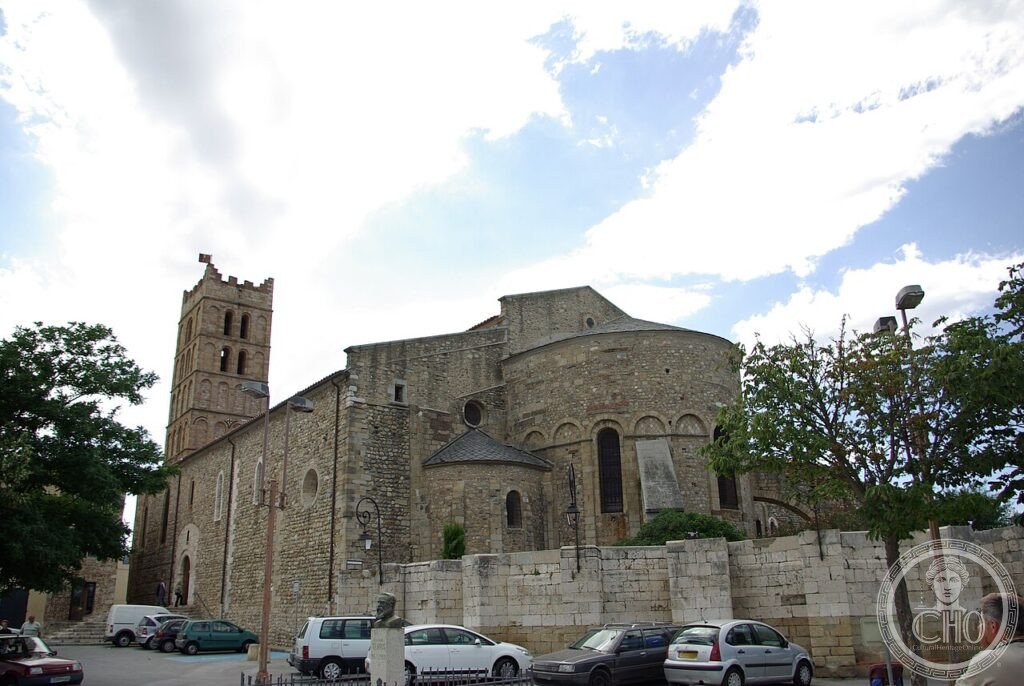
Fondata dai Visigoti nel 571, smembrando l’arcivescovado di Narbona, la sede episcopale di Elne resse fino al 1602, quando fu trasferita a Perpignan. Sugli stipiti del portale romano in marmo blu di Céret, il fuoco lasciato dalle truppe di Filippo III di Francia nel 1285 è ancora visibile.
At a glance
Elne Cathedral (Cathédrale Sainte-Eulalie-et-Sainte-Julie) is the seat of the bishopric of Elne, whose diocese once covered the Catalan comarques of Roussillon, Vallespir, and Conflent, documented from the year 571 as a Visigothic creation — the Visigoths, having succeeded the Romans in the region, dismembered the archbishopric of Narbonne to establish the new Elne diocese. Built across the 11th and 12th centuries, the cathedral is a major monument of Catalan Romanesque art, and it served as the episcopal seat for this northern part of Catalonia continuously from the 6th century until 1602, when the seat was transferred to Perpignan, the region’s larger and increasingly more significant city. Recent excavations (2018-2019) revealed remains of the original 6th-century cathedral beneath the nearby Place des Garaffes, inscribed as a heritage site in 2023. The cathedral’s austere west facade, built of irregular rubble stone and pierced only by a plain Romanesque portal in blue Céret marble devoid of sculptural decoration, gives the building a genuinely fortress-like character — an impression reinforced by fire damage still visible on the portal’s jambs, physical evidence of the 1285 attack by French King Philip III “the Bold” against the town of Elne.
Key facts
- Episcopal origins: documented from 571, a Visigothic creation dismembering the archbishopric of Narbonne to form the new Elne diocese
- Construction: 11th-12th centuries, a major monument of Catalan Romanesque art; episcopal seat continuously from the 6th century until 1602, when transferred to Perpignan
- 2018-2019 excavations: revealed remains of the original 6th-century cathedral beneath the nearby Place des Garaffes, formally inscribed as a heritage site in 2023
- West facade: austere, fortress-like, built of irregular rubble stone with an unadorned Romanesque portal in blue Céret marble; jambs still show fire-scarring from the 1285 attack by King Philip III of France
- Cloister: built between the 12th and 14th centuries, gathering the full evolution of Roussillon medieval sculpture in a single complex, making it one of the most complete cloisters of its kind; built for canons assisting the bishop rather than for monks, unlike most Roussillon cloisters
- Heritage status: cloister listed historic monument since 1840; church since 1875
History
Elne’s status as a Visigothic-era episcopal foundation, carved directly out of the older archbishopric of Narbonne in 571, situates the diocese within the specific post-Roman political reorganisation the Visigothic kingdom imposed on southern Gaul following the collapse of direct Roman administration — a pattern of ecclesiastical restructuring that gave the Catalan-speaking Roussillon region its own distinct religious authority centre well before the medieval period more commonly associated with Catalan cultural and political identity in this area. The cathedral’s continuous function as the region’s episcopal seat for over a millennium, from the 6th century until its 1602 transfer to Perpignan, reflects Elne’s long-standing regional significance, even as the eventual relocation to the larger, more strategically positioned Perpignan (itself already the subject of the previously documented Cathédrale Saint-Jean-Baptiste) mirrored the broader late medieval and early modern pattern of episcopal seats following the practical shift of urban and political weight toward larger centres.
The fire damage still visible on the west portal’s jambs provides direct, physically documented evidence of the 1285 attack by King Philip III of France, part of the wider Aragonese Crusade — Philip’s campaign against the Crown of Aragon, launched partly in response to Aragonese involvement in Sicily following the 1282 Sicilian Vespers uprising — during which French forces moved through Roussillon and inflicted damage on Elne among other targets in the region. This tangible scarring gives the cathedral’s austere, fortress-like facade a documented historical explanation beyond pure stylistic austerity: the building’s plain, undecorated stonework reflects genuine period vulnerability to exactly this kind of military violence, a concern that shaped Romanesque ecclesiastical architecture across contested medieval frontier regions more broadly. The cloister’s unusual 12th-to-14th-century construction span, in a single complex documenting the full stylistic evolution of Roussillon medieval sculpture, and its specific purpose serving canons rather than monks (setting it apart from most other Roussillon cloisters, typically built for monastic communities), together make it one of the region’s most art-historically significant surviving ensembles.
What you see
The west facade’s austere, fortress-like character, built of irregular rubble stone and pierced only by the unadorned blue-marble Romanesque portal, rewards close inspection specifically for the fire damage still visible on its jambs — physical evidence of the 1285 attack, rather than merely wear or weathering. The cloister, the site’s principal artistic destination, presents its full 12th-to-14th-century stylistic range across its four galleries, with the south gallery (12th century) the oldest and the only one fully Romanesque in style, while the later galleries document the transition through to Gothic sculptural forms. The nearby archaeological remains of the original 6th-century cathedral, uncovered beneath Place des Garaffes and formally recognised in 2023, add a further, older layer of documented history to a visit.
Practical information
- Opening hours: seasonal, generally open for guided or self-guided visits; check current hours before visiting, particularly for cloister access
- Address: Rue de l’Église, 66200 Elne
Getting there
Elne has its own railway station on the Perpignan-Latour-de-Carol/Cerbère regional line, approximately 15-20 minutes from Perpignan. By car, Elne sits just off the A9 motorway near Perpignan. The cathedral stands in the historic hilltop centre of Elne. GPS: 42.5991° N, 2.9720° E.
Nearby
- Perpignan — approximately 15-20 minutes by train; the successor episcopal seat since 1602, home to the Cathédrale Saint-Jean-Baptiste
- Collioure — approximately 20 minutes by car; a picturesque Mediterranean fishing port associated with the Fauvist painters
- Château Royal de Collioure — near Collioure; a royal fortress with a long Aragonese and French history
Sources
- Tourisme Pyrénées-Orientales — official visitor information (tourisme-pyreneesorientales.com)
- Pierres Romanes — “Sainte-Julie-et-Sainte-Eulalie d’Elne” (romanes.com)
- Made in Perpignan — “Elne, découvertes archéologiques aux abords de la cathédrale” (madeinperpignan.com)
- Wikipedia — “Cathédrale Sainte-Eulalie-et-Sainte-Julie d’Elne” (fr.wikipedia.org)
Find it on the map
See this place and what’s around it →📷 Become a Cultural Heritage Online photographer
Share your photos of places: they stay published under your name as the author. The more they're seen, the more you get noticed — and soon a contest will reward the most appreciated photos.
Log in or sign up free to add a photoIs this page about you?
This page is read by travellers and heritage enthusiasts who find it on Google. Tell us how you are connected to this place and we will take it from there.