
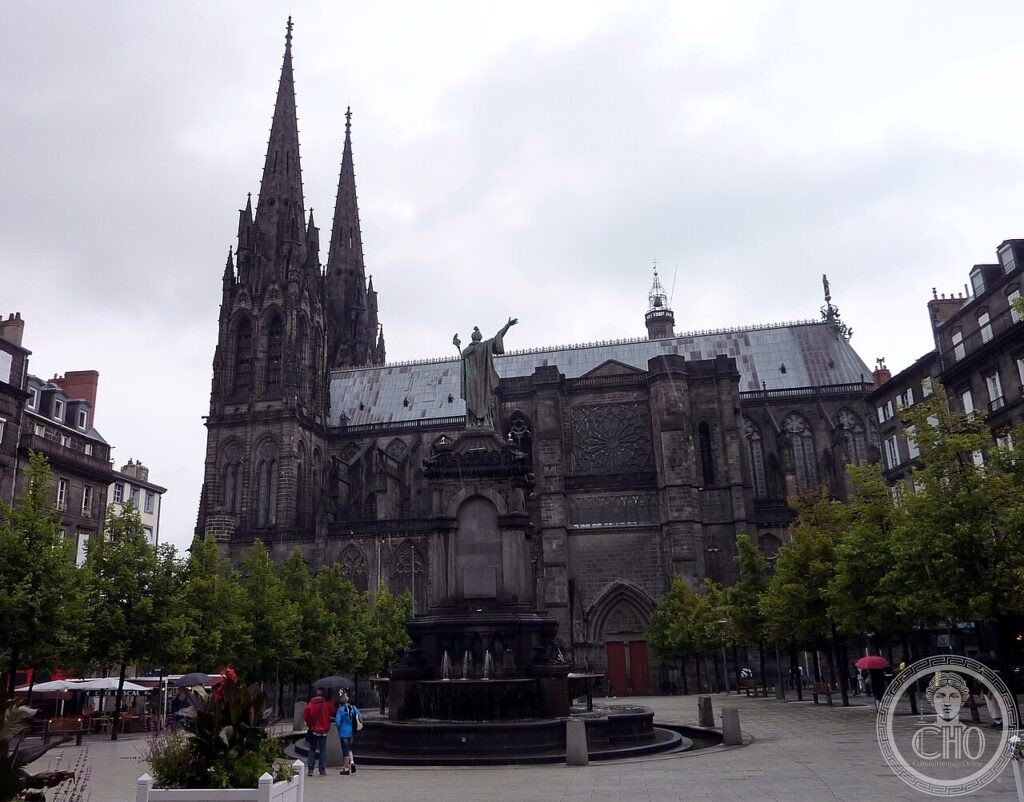
The master builder Jean Deschamps abandoned the traditional arkose and used instead the black lava stone of the Puy de la Nugère flows, quarried at Volvic. It was the first architectural use of this stone. The result is so dark that it earned the nickname “cathedral of the coalmen”, and it is today the tallest lava-stone cathedral in France.
At a glance
Clermont-Ferrand Cathedral (Cathédrale Notre-Dame-de-l’Assomption) was begun in 1248 under the impetus of Bishop Hugues de La Tour. Construction continued in phases across more than six and a half centuries, through to 1902, including major 19th-century restoration and the completion of the west facade by the celebrated architect Eugène Viollet-le-Duc. Its defining architectural distinction is material rather than purely stylistic. The master builder Jean Deschamps chose to abandon the traditional arkose sandstone used elsewhere in French Gothic cathedral-building, in favour of black lava stone quarried from the flows of the Puy de la Nugère at Volvic. That made Clermont-Ferrand the first architectural use of Volvic stone, and produced a cathedral whose colour is unmistakably, dramatically dark. The structural properties of the trachy-andesitic Volvic stone also allowed unusually slender pillars. The striking blackness of the building earned it the nickname “Cathédrale des charbonniers”, the cathedral of the coalmen or charcoal-burners, from the celebrated 19th-century French writers the Goncourt brothers. It stands today as the tallest cathedral built in lava stone in France.
Key facts
- Construction: begun 1248 under Bishop Hugues de La Tour; continued in phases to 1902; west facade and other elements completed in the second half of the 19th century by Eugène Viollet-le-Duc.
- Volvic stone: black trachy-andesitic lava stone from the Puy de la Nugère flows at Volvic, chosen by master builder Jean Deschamps in place of traditional arkose sandstone — the first architectural use of Volvic stone.
- Structural effect: the properties of Volvic stone allowed construction of unusually slender pillars compared to standard Gothic sandstone or limestone construction.
- Nickname: “Cathédrale des charbonniers” (coalmen’s cathedral), given by the Goncourt brothers in reference to the building’s dark, coal-black appearance.
- Superlative: the tallest cathedral built in lava stone in France.
History
Bishop Hugues de La Tour’s 1248 decision to begin an ambitious new Gothic cathedral for Clermont reflected the broader wave of major cathedral-building that swept France during the 13th century. But master builder Jean Deschamps’s choice to source the building’s stone from the volcanic flows at Volvic, rather than the arkose sandstone more typically used for Gothic construction elsewhere in France, was a genuinely distinctive regional adaptation. It made practical sense given Clermont-Ferrand’s location within the volcanic Auvergne region, where lava stone was locally abundant. The stone’s properties permitted the unusually slender Gothic pillars visible throughout the building. And, whether intentionally or not, it gave the cathedral an unmistakable visual identity, setting it apart from virtually every other major French Gothic cathedral built in lighter-coloured stone.
The building’s more-than-six-and-a-half-century construction span, from 1248 through to 1902, meant the project outlasted the medieval period entirely, eventually incorporating substantial 19th-century intervention under Eugène Viollet-le-Duc, the era’s most influential and controversial French Gothic Revival architect, whose completion of the west facade brought his characteristic scholarly-but-interpretive approach to Gothic restoration to a building whose core medieval fabric long predated his involvement. The Goncourt brothers’ “Cathédrale des charbonniers” nickname, while originally likely intended at least partly as a wry or even mildly disparaging comment on the building’s unusual dark colouring relative to the pale stone of most famous French cathedrals, has since become an affectionately used popular epithet reflecting the cathedral’s genuinely singular visual character within French ecclesiastical architecture.
What you see
The overwhelming visual impression of dark, near-black stone across the entire structure is the cathedral’s essential and immediately apparent architectural signature. It distinguishes the building sharply from the pale limestone or sandstone of most other major French Gothic cathedrals, and gives it a genuinely unique silhouette on the Clermont-Ferrand skyline, particularly striking when viewed from a distance against the surrounding Auvergne volcanic landscape from which its stone was quarried. The unusually slender Gothic pillars, made possible by the specific structural properties of Volvic lava stone, give the interior a distinctively light, vertically emphatic quality despite the dark material. Viollet-le-Duc’s 19th-century west facade completion was a later addition to the medieval structure, but it was executed with careful attention to Gothic stylistic coherence, integrating visually with the earlier core of the building.
Practical information
- Opening hours: Monday-Saturday 7:45-12:00 and 14:00-18:00 (19:00 from 15 June to 20 September), visits from 9:00; Sunday and feast days 9:00-12:00 and 15:00-20:00, visits afternoon only.
- Admission: free.
- Time needed: approximately 1 hour for the nave, chapels, and stained glass.
- Address: Place de la Victoire, 63000 Clermont-Ferrand.
Getting there
Clermont-Ferrand has direct TGV rail connections from Paris (approximately 3 hours) and is served by its own airport. The cathedral stands on Place de la Victoire in the historic centre, easily walkable and served by T2C tram line A and numerous bus lines. GPS: 45.7787° N, 3.0858° E.
Nearby
- Basilique Notre-Dame-du-Port — in Clermont-Ferrand, a short distance from the cathedral; a UNESCO World Heritage Romanesque basilica (part of the Routes of Santiago de Compostela in France listing).
- Puy de Dôme — approximately 15 minutes by car; the iconic volcanic peak overlooking the city, source of the cathedral’s own stone from nearby Volvic.
- Vulcania — approximately 30 minutes by car; a volcanology theme park exploring the Auvergne’s volcanic landscape.
Sources
- Puy-de-Dôme Tourisme — official visitor information (puydedome-tourisme.com).
- Cathédrale catholique Notre-Dame de Clermont — parish visitor portal (cathedrale-catholique-clermont.fr).
- Ville de Clermont-Ferrand — heritage information (clermont-fd.com).
- Wikipedia — “Cathédrale Notre-Dame-de-l’Assomption de Clermont” (fr.wikipedia.org).
Find it on the map
See this place and what’s around it →Events here — now on & upcoming
- Anniversary: Pope Urban II Calls the First Crusade — November 27, 109527 Nov 2027See the event →
📷 Become a Cultural Heritage Online photographer
Share your photos of places: they stay published under your name as the author. The more they're seen, the more you get noticed — and soon a contest will reward the most appreciated photos.
Log in or sign up free to add a photoIs this page about you?
This page is read by travellers and heritage enthusiasts who find it on Google. Tell us how you are connected to this place and we will take it from there.