
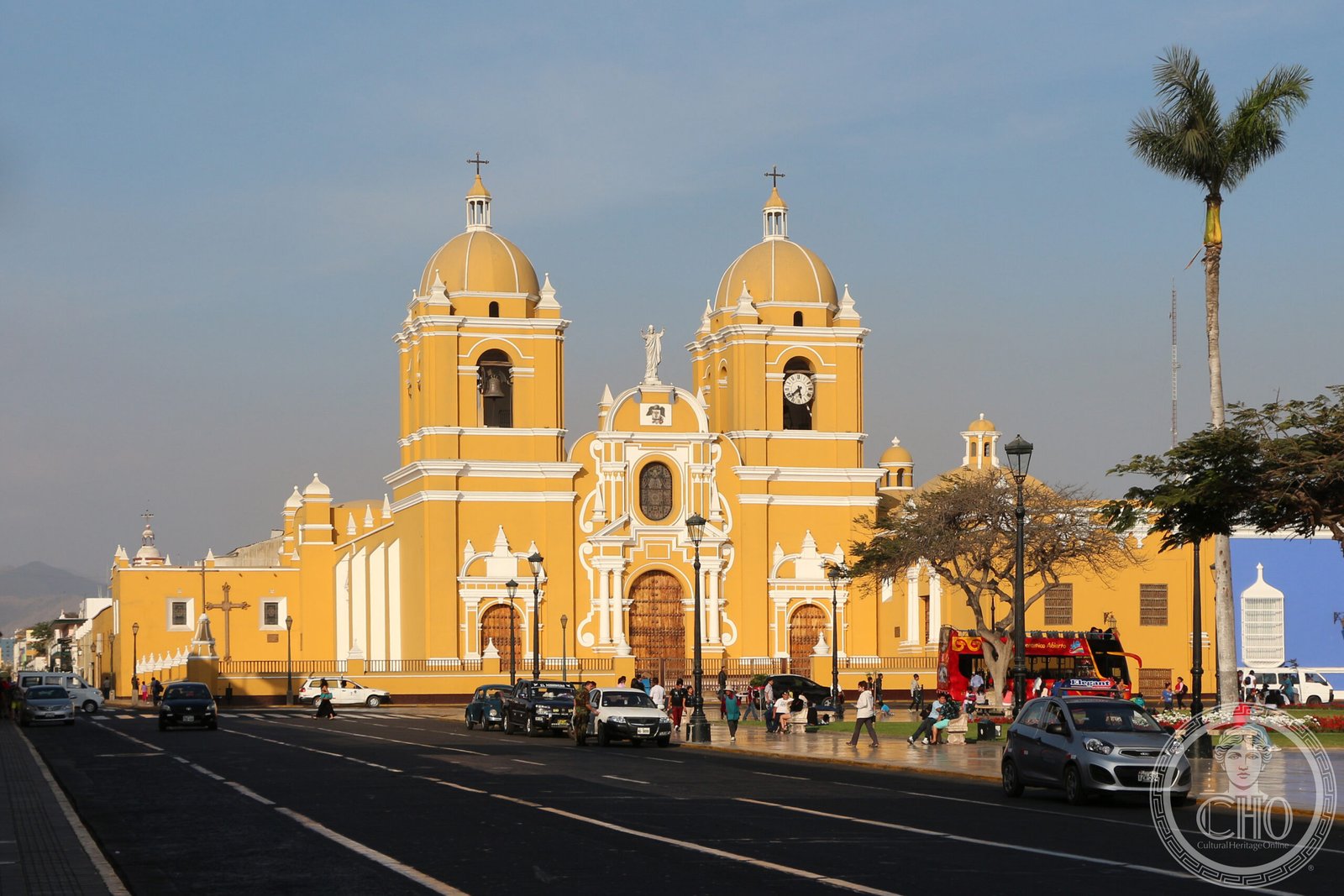
On Trujillo’s Plaza de Armas, on Peru’s northern coast, the Cathedral-Basilica of Santa Maria is the third building to stand on this site.
A first parish church was founded shortly after the city itself was founded, between 1535 and 1540, and was raised to cathedral status by Pope Paul V in 1616. This first building was destroyed by a violent earthquake on 14 February 1619.
Reconstruction was entrusted to the architect Bartolomé de las Cuevas, but the second building too was damaged or destroyed by a further earthquake on 29 February 1635.
The current building was built between 1647 and 1666, begun by the architect Francisco de Soto Ríos and completed by Francisco Balboa.
A further earthquake, in 1970, badly damaged the basilica, destroying the bell tower and the dome; the dome’s collapse in turn brought down the high altarpiece, which had already been altered in earlier periods. The building was fully restored over roughly twenty years.
In 1967, Pope Paul VI had already raised it to the rank of minor basilica.
Inside stands a gilded Churrigueresque Baroque high altar in the “a giorno” style (free-standing, that is, separated from the wall): according to sources, one of only two altars of this kind to survive in Peru, the other being in Cusco Cathedral.
The cathedral also holds white-and-gold Rococo altarpieces, paintings from the colonial schools of Cusco and Quito, and a cathedral museum with liturgical objects in gold and silver, including chalices and a portable silver altar.
The cathedral faces onto the same Plaza de Armas where, on 29 December 1820, the Marquis of Torre Tagle publicly proclaimed Trujillo’s independence from Spain — Trujillo was among the first Peruvian cities to do so. Historical documentation, however, gives the cathedral itself no direct role in those events, which are tied instead to the Seminary of San Carlos and San Marcelo and to the Casa de la Emancipación, other buildings in the city. The connection should therefore be limited to sharing the same square, not to any active role by the religious building.
About the Cathedral
The Cathedral of Trujillo, on the city’s Plaza de Armas in northern Peru, is the third religious building on this site, the current structure built 1647–1666 after two predecessors were destroyed by earthquakes in 1619 and 1635. Raised to minor basilica status in 1967, it was again badly damaged by a 1970 earthquake and fully restored over the following two decades.
Key facts
- 1616: the earlier church on this site elevated to cathedral status by Pope Paul V.
- 14 February 1619: the first cathedral destroyed by earthquake.
- 29 February 1635: its rebuilt successor damaged or destroyed by a further earthquake.
- 1647–1666: current cathedral built, begun by architect Francisco de Soto Ríos, completed by Francisco Balboa.
- 1967: elevated to minor basilica by Pope Paul VI.
- 1970: bell tower and dome destroyed by earthquake; fully restored over roughly two decades.
History
Built between 1647 and 1666 after two earlier cathedrals on this site fell to earthquakes, Trujillo’s cathedral has weathered the seismic instability of Peru’s northern coast for over three centuries, including a further major blow in 1970 that destroyed its bell tower and dome. It stands on the same Plaza de Armas where Trujillo publicly proclaimed independence from Spain in December 1820, though the cathedral itself played no documented role in that specific event.
What you see
An ochre-yellow baroque facade with white pilaster trim and twin golden domed bell towers crowned by a statue of the Risen Christ, its interior holding a gilded Churrigueresque free-standing altarpiece, Rococo side altars, and colonial-era paintings from the Cusco and Quito schools.
Practical information
- Opening hours: generally open daily outside services; check current hours before visiting.
- Address: Plaza de Armas, Trujillo, Peru.
Getting there
The cathedral fronts Trujillo’s Plaza de Armas, alongside the Municipal Palace. GPS: 8.1107°S, 79.0282°W.
Nearby
- Casa de la Emancipación — the historic building where Trujillo’s independence agreement was reached in December 1820.
- Chan Chan — the vast pre-Columbian Chimú adobe city on Trujillo’s outskirts, unrelated to the cathedral’s own history.
Sources
- Wikipedia (English and Spanish) — “Cathedral of Trujillo, Peru,” “Independence of Trujillo,” “Plaza de Armas of Trujillo (Peru)”
- El Comercio — “Trujillo, la imponente Basílica Catedral que sobrevivió a tres terremotos”
- RPP — “El museo catedralicio de Trujillo”
Find it on the map
See this place and what’s around it →📷 Become a Cultural Heritage Online photographer
Share your photos of places: they stay published under your name as the author. The more they're seen, the more you get noticed — and soon a contest will reward the most appreciated photos.
Log in or sign up free to add a photo