
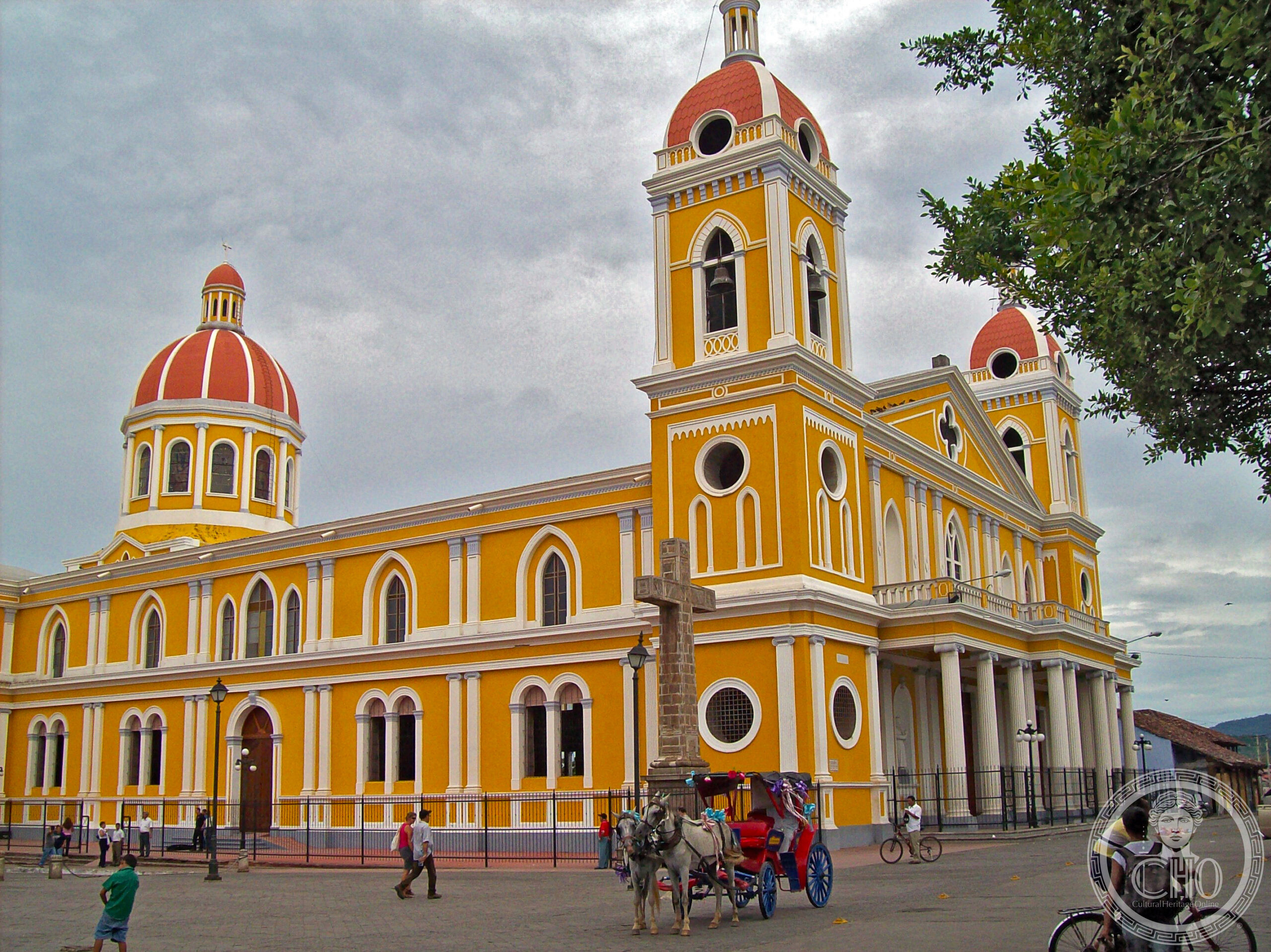
On the east side of Parque Colón, the Parque Central of Granada, in Nicaragua, the cathedral of Our Lady of the Assumption is the third building to stand on this site. A first church, dating from about 1525, had already burned twice by 1578. A second, rebuilt in stone around 1751, was finally destroyed in November 1856, according to one source specifically on 22 November, with an explosive charge set off in one of the towers, by the troops of the US filibuster William Walker. Between 1855 and 1857 Walker had seized power in Nicaragua by exploiting the civil war between the liberals of León and the conservatives of Granada, had himself elected president in a fraudulent vote on 11 June 1856 and took office on 12 July, reintroducing slavery and making English the official language. Forced to retreat by the allied Central American forces, Walker ordered his general Charles Frederick Henningsen to destroy Granada before the evacuation, leaving among the ruins an inscription that became famous, “Aquí fue Granada”, “Here was Granada”, though the sources also report the variant “Aquí estaba Granada”, before finally being forced to surrender on 1 May 1857. The present cathedral was rebuilt in a process that lasted almost a century. The first plans date from 1880, by the Jesuit priest Alejandro Nicolás Cáceres; the foundation stone was laid on 8 December 1888; the design was revised in 1890 by the architect Andrés Zapata, a succession of responsibilities not fully confirmed by sources independent of online encyclopedias. Work was suspended in 1891 for lack of funds, resumed in 1905, and the main structure was completed in 1910. In 1913 the diocese of Granada was established; in 1916 the iron frame of the dome arrived from the United States; as late as 1928 the building had a single bell tower, completed in its final pair only at the end of 1931 thanks to the intervention of the Nicaraguan president José María Moncada Tapia. The interior decoration was considered finished only in 1972. Founded on 21 April 1524 by Francisco Hernández de Córdoba, Granada is often presented as the oldest city in the continental Americas, a claim contested by other colonial cities of earlier or contemporary foundation, such as Panama City (1519). The most defensible version of the claim is that Granada is among the oldest colonial cities on the continent never moved from their original site, unlike, for example, Panama City itself, rebuilt elsewhere after the destruction of 1671. The centuries-old rivalry between conservative Granada and liberal León finally led, in 1857, to the choice of Managua as the country’s neutral capital.
About the Cathedral
The Cathedral of Granada, facing Parque Central in Granada, Nicaragua, is the third religious building on this site, its current form built in stages from 1880 to 1972 after the predecessor cathedral was destroyed by American filibuster William Walker’s forces in November 1856. It remains the seat of the Diocese of Granada, established in 1913.
Key facts
- November 1856: the earlier cathedral destroyed as William Walker’s forces burned Granada before retreating.
- 1 May 1857: Walker surrenders to the US Navy, ending his self-proclaimed Nicaraguan presidency.
- 8 December 1888: cornerstone of the current cathedral laid.
- 1910: main structure completed after a construction pause and resumption.
- Late 1931: the cathedral’s second bell tower finally completed.
- 1972: interior decoration considered finished, closing a rebuilding process of nearly a century.
History
Granada’s cathedral was destroyed in November 1856 when American filibuster William Walker, having briefly seized the Nicaraguan presidency through a fraudulent election, ordered the city burned as his forces retreated, leaving behind ruins and the defiant inscription “Here was Granada.” The rebuilding that followed stretched across nearly a century, from initial 1880s plans to a completed second bell tower only in 1931 and finished interior decoration as late as 1972 — a slow reconstruction mirroring Granada’s long historical rivalry with Nicaragua’s other great colonial city, León, a rivalry that led the two to yield the national capital to a compromise third city, Managua, in 1857.
What you see
A yellow-and-white neoclassical facade with twin bell towers and red-tiled domes rises on the east side of Parque Central, its symmetrical composition anchoring the skyline of a city otherwise defined by low colonial rooftops.
Practical information
- Opening hours: generally open daily outside services; check current hours before visiting.
- Address: east side of Parque Central (Parque Colón), Granada, Nicaragua, next to the Episcopal Palace.
Getting there
The cathedral fronts the east side of Parque Central in Granada’s historic core. GPS: 11.9298°N, 85.9532°W.
Nearby
- Palacio Episcopal — the Episcopal Palace, adjoining the cathedral.
- Parque Central (Parque Colón) — Granada’s main plaza, framed by colonial-era buildings on all sides.
Sources
- Wikipedia (English and Spanish) — “Our Lady of the Assumption Cathedral, Granada,” “Catedral de Nuestra Señora de la Asunción (Granada),” “Granada (Nicaragua),” “Filibuster War”
- Gilder Lehrman Institute of American History — on William Walker’s Nicaraguan campaign.
Find it on the map
See this place and what’s around it →📷 Become a Cultural Heritage Online photographer
Share your photos of places: they stay published under your name as the author. The more they're seen, the more you get noticed — and soon a contest will reward the most appreciated photos.
Log in or sign up free to add a photo