
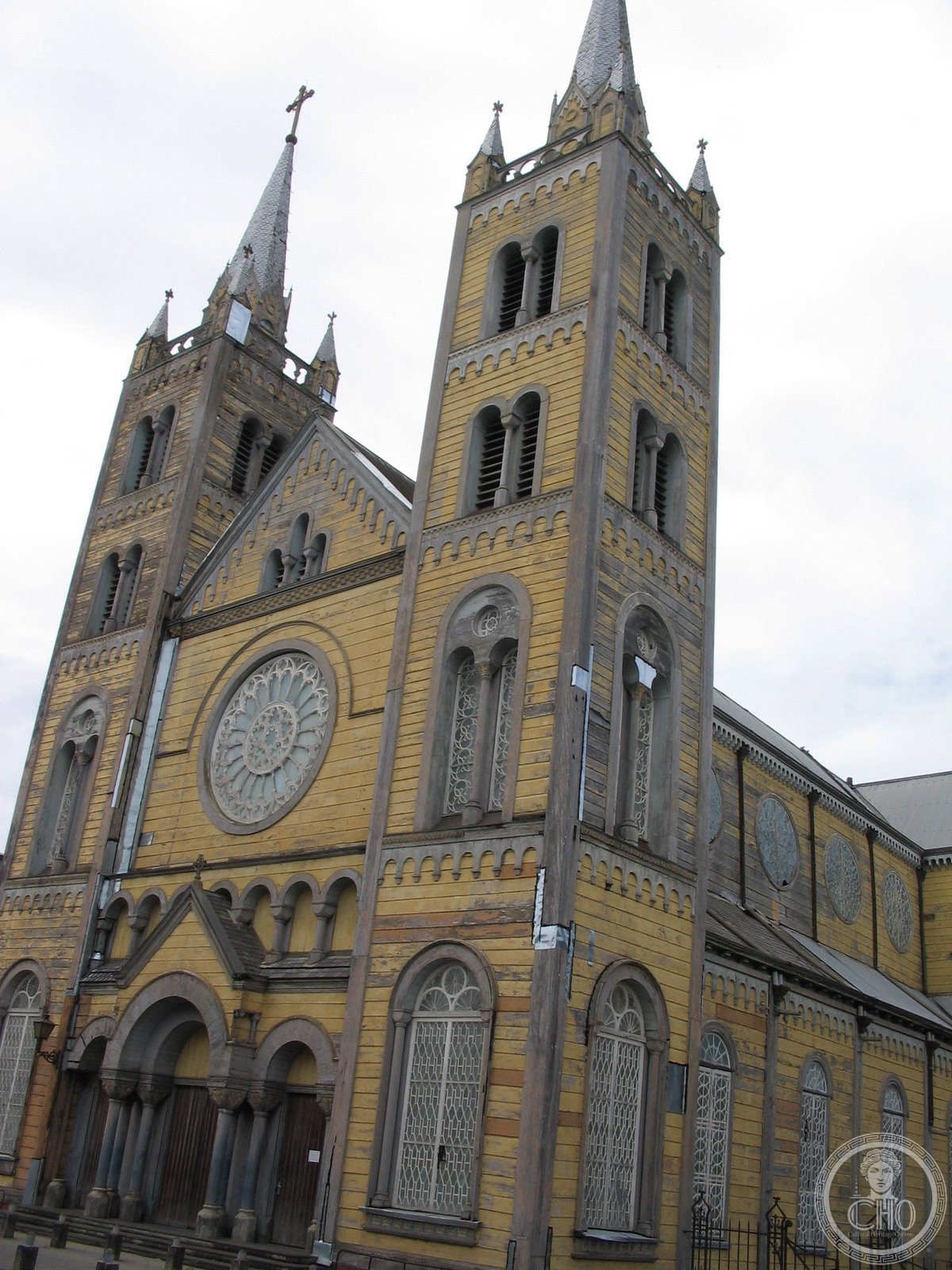
In Paramaribo, the capital of Suriname, the Cathedral-Basilica of Saints Peter and Paul stands on the site of a former theater, “De Verrezene Phoenix” (1809), converted into a Catholic church in 1826. By 1882, the building had become too small and dilapidated for the growing Catholic community, and the diocese decided to build a new cathedral. The foundation stone was laid on 30 January 1883. The building was consecrated on 10 July 1885, with work continuing until 1887, while the two Gothic wooden towers, about 40-44 metres tall to the bronze cross, were completed only around 1901. The architect was Frater Frans Harmes, a Redemptorist priest, who according to some Dutch-language sources was inspired by Redemptorist churches in Roosendaal, in the Netherlands, and in Boston — a detail not confirmed by other independent sources. The cathedral is built almost entirely of wood, with the interior in unpainted Surinamese cedar. According to some tourist sources, not confirmed elsewhere, the facade and pillars would be in “greenheart” wood, a particularly dense and insect-resistant species typical of the Guianas region. It is often described as one of the largest wooden churches in the Americas, a record sometimes shared, according to the most accurate Dutch source consulted, with the Cathedral of St. George in Georgetown, Guyana — the absolute claim of “largest wooden building in the western hemisphere”, repeated by some English-language tourist sources, does not however find a verifiable numerical confirmation. Inside there is a capacity of about 900 seats, three bells (Alphonsus, 222 kg; Rosa, 413 kg; John, 827 kg), and a pipe organ originally with 1,550 pipes, reduced over time due to thefts. A place of particular veneration is the tomb of the blessed Peerke Donders (1809-1887), a Redemptorist priest known for his mission among enslaved people and, later, at the leprosy colony of Batavia. He died on 14 January 1887; his remains were moved to the cathedral cemetery in 1900 and placed in a tomb in the left wing of the church in 1921, while his beatification took place on 23 May 1982 by the hand of Pope John Paul II. A first restoration effort in 1977-1979 proved inadequate, and in 1989 the building was closed due to structural problems and severe termite damage. The real restoration, funded with about 2.8 million euros from the European Development Fund, began concretely in 2007, with the replacement of some structural columns in greenheart wood, and the cathedral was reopened and reconsecrated on 13-14 November 2010, after more than twenty years of closure. Having become the cathedral of the Catholic diocese of Paramaribo at its establishment in 1958, it was raised to the rank of minor basilica on 6 April 2014 by Pope Francis, with the local ceremony presided over by the apostolic nuncio Nicola Girasoli. The cathedral falls within the UNESCO World Heritage site “Historic Inner City of Paramaribo”, inscribed in 2002, as one of its most significant buildings, though without a separate inscription of its own.
About the Cathedral-Basilica of Saints Peter and Paul
In Paramaribo, the capital of Suriname, the Cathedral-Basilica of Saints Peter and Paul stands on the site of a former theater, “De Verrezene Phoenix” (1809), converted into a Catholic church in 1826; by 1882, that building had become too small and dilapidated for the growing Catholic community, and the diocese decided to build a new cathedral. The foundation stone was laid on 30 January 1883, the building was consecrated on 10 July 1885 with work continuing until 1887, and its twin neo-Gothic wooden towers, rising roughly 40-44 metres to the bronze cross, were not completed until around 1901. The architect was Frater Frans Harmes, a Redemptorist priest.
Key facts
- 1883-1887: the cathedral built, consecrated on 10 July 1885.
- ~1901: the twin neo-Gothic wooden towers completed.
- Built almost entirely of wood, with an unpainted Surinamese cedar interior.
- 1989-2010: closed for over two decades due to structural and termite damage.
- 13-14 November 2010: reopened and reconsecrated after EU-funded restoration.
- 6 April 2014: elevated to minor basilica status by Pope Francis.
- 2002: included within the UNESCO-listed Historic Inner City of Paramaribo.
History
Built almost entirely of wood in a tropical climate famously hostile to timber structures, the Cathedral-Basilica of Saints Peter and Paul’s greatest historical test came not from fire or storm but from termites, which forced its closure for more than two decades before a European Union-funded restoration brought it back into use in 2010. Its association with the beatified missionary Peerke Donders, whose tomb draws its own devotion, and its 2014 elevation to minor basilica status, have kept it central to Surinamese Catholic life across more than a century.
What you see
Twin neo-Gothic wooden spires rise to roughly 40-44 metres above a nave built almost entirely of Surinamese cedar, seating around 900 worshippers beneath a pipe organ originally built with 1,550 pipes. Inside, the tomb of the beated missionary Peerke Donders draws visitors alongside the church’s three named bells, while the building’s very structure — replaced in places with insect-resistant greenheart timber during its 2007-2010 restoration — remains a permanent study in building in wood within a tropical climate.
Practical information
- Opening hours: generally open daily outside services; check current hours before visiting.
- Address: Henck Arronstraat 22-24, Paramaribo, Suriname.
Getting there
The cathedral stands in central Paramaribo, within the UNESCO-listed historic inner city and easily reached on foot from the city’s colonial-era core. GPS: 5°49′43″N, 55°09′15″W.
Nearby
- Historic Inner City of Paramaribo — the surrounding UNESCO World Heritage historic center, including Fort Zeelandia.
Sources
- Wikipedia — “Saint Peter and Paul Cathedral, Paramaribo” (en.wikipedia.org).
- Dutch Wikipedia — “Sint-Petrus-en-Pauluskathedraal (Paramaribo)”
- Wikipedia — “Peerke Donders” (en.wikipedia.org).
- UNESCO World Heritage Centre — “Historic Inner City of Paramaribo” (whc.unesco.org).
Find it on the map
See this place and what’s around it →📷 Become a Cultural Heritage Online photographer
Share your photos of places: they stay published under your name as the author. The more they're seen, the more you get noticed — and soon a contest will reward the most appreciated photos.
Log in or sign up free to add a photo