
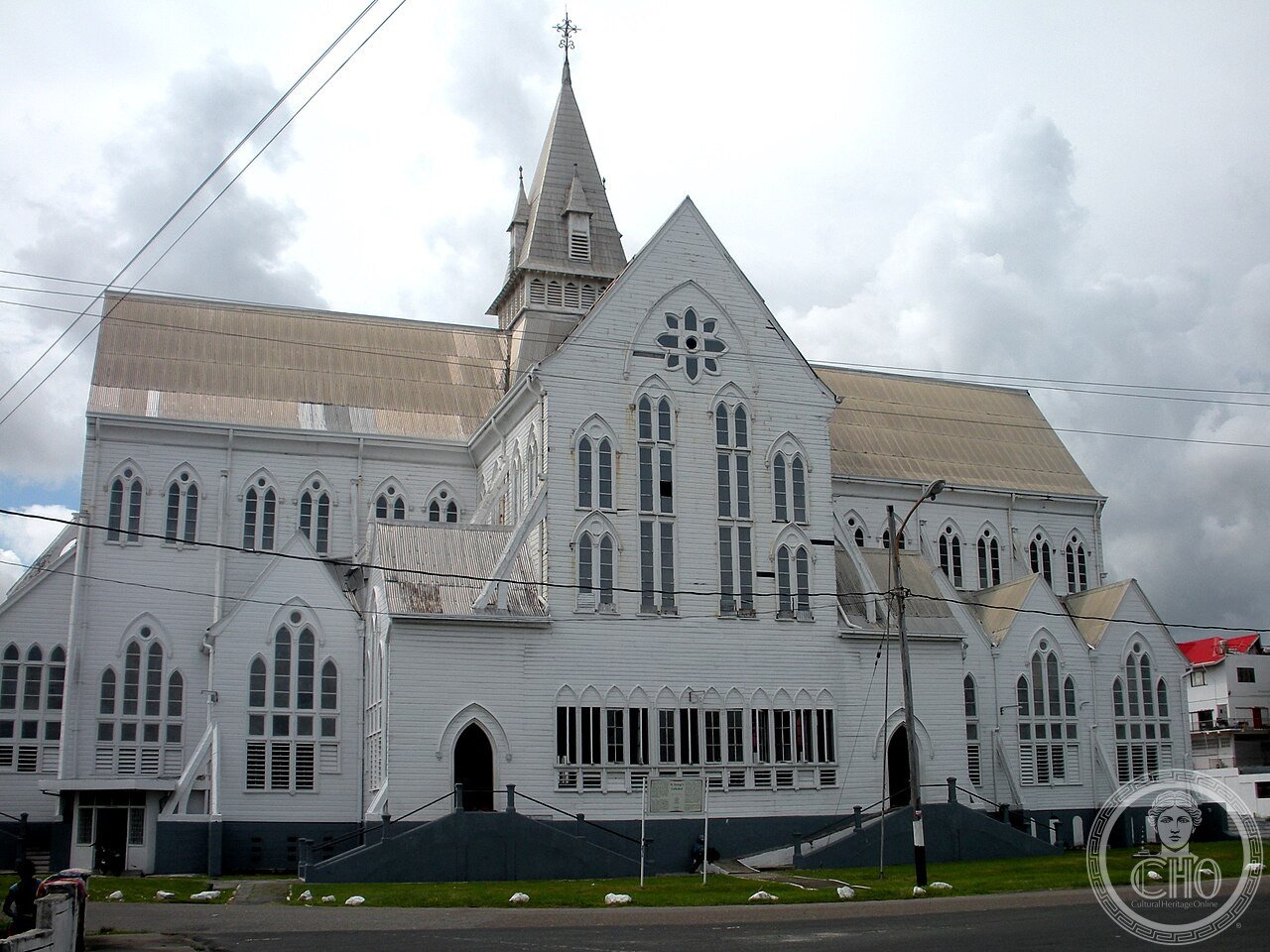
In Georgetown, Guyana, the present St. George’s Cathedral is the latest in a series of Anglican buildings on the same site, whose earliest history is reported inconsistently by the available sources. According to some, the first chapel dates from 1805, when the Anglican congregation outgrew the Court of Policy hall where it met; according to others, a first building of 1810 was put up by the Dutch Reformed Church and handed to the Church of England in 1812. A second cathedral, its foundation stone laid by Governor Henry Light in September 1838, was completed in 1842 and demolished after about 33 years for structural failure, followed by a temporary pro-cathedral from 1877. The present building, designed by the British architect Sir Arthur Blomfield, saw work begin in 1888-1889, opened for worship on 24 August 1892 and was consecrated on 8 November 1894. The original design called for stone, with a central tower and two western towers, but it was rejected as too heavy and costly for the ground, and the committee decided to build “with the woods of the country and no other”: hence the choice of greenheart, a hardwood typical of the Guianas, resistant to insects and rot and almost fireproof. The tower and spire reach a height of about 43.5 metres (143 feet). The claim, recurrent in tourist sources, that the cathedral was the tallest wooden church in the world until 2003, when it was supposedly overtaken by the monastery of Săpânța-Peri in Romania, finds no support in the Wikipedia sources consulted, which date that building to 2013 with no direct link to Georgetown, so the claim should be treated as unverified. In Gothic Revival style, with a Latin-cross plan, clustered columns, pointed arches and polychrome stained glass, the cathedral holds, according to some tourist sources not cross-checked against primary ones, a bishop’s throne, a brass eagle lectern donated by the diocese of Barbados, an iron pulpit donated by the Howell-Jones family and a silver cross donated by Queen Victoria in 1897. A major restoration was carried out between 2017 and 2020 on the stained glass, wooden cladding and roof. Seat of the bishop of Guyana and of the Anglican diocese of Guyana, part of the Church in the Province of the West Indies, the cathedral has been declared a national monument of Guyana (according to one source, in April 2001) and appears on the UNESCO Tentative List, without however being inscribed as a full World Heritage site.
About St. George’s Cathedral
In Georgetown, Guyana, the present St. George’s Cathedral is the latest in a series of Anglican buildings on the same site, whose earliest history sources report inconsistently: some cite a first chapel from 1805, once the Anglican congregation outgrew the Court of Policy hall it had met in; others describe an 1810 building erected by the Dutch Reformed Church and handed to the Church of England in 1812. A second cathedral, its foundation stone laid by Governor Henry Light in September 1838, was completed in 1842 and demolished after roughly 33 years due to structural failure, followed by a temporary pro-cathedral from 1877. The current building, designed by British architect Sir Arthur Blomfield, saw construction begin in 1888-1889, opened for worship on 24 August 1892, and was consecrated on 8 November 1894.
Key facts
- 1888-1894: the current cathedral built, designed by Sir Arthur Blomfield.
- Built almost entirely of local greenheart wood, chosen after a stone design proved too heavy for the site.
- Roughly 43.5 metres (143 ft) tall at the tower and spire.
- 2017-2020: a major restoration of the stained glass, timber cladding and roof.
- Reportedly gazetted as a national monument of Guyana in 2001.
- On the UNESCO Tentative List, though not inscribed as a full World Heritage Site.
History
The fourth (or possibly third, depending on the source) Anglican building on this Georgetown site, St. George’s Cathedral represents a deliberate 19th-century engineering choice — abandoning a heavier stone design in favor of the Guianas’ own greenheart timber — that produced one of the tallest wooden church buildings anywhere, without needing an unverified world-record claim to make the point. Its continued role as the seat of the Bishop of Guyana, alongside national-monument status and a place on the UNESCO Tentative List, keeps it central to Georgetown’s historic streetscape.
What you see
A wooden Gothic Revival cathedral built almost entirely of greenheart, with a cruciform plan, clustered columns, pointed arches and stained glass rising toward a tower and spire roughly 43.5 metres tall. Reportedly among its furnishings are an episcopal throne, a brass eagle lectern given by the Diocese of Barbados, an iron pulpit donated by the Howell-Jones family, and a silver cross said to be a gift from Queen Victoria in 1897.
Practical information
- Opening hours: generally open daily outside services; check current hours before visiting.
- Address: Church Street at North Road, Lacytown, Georgetown, Guyana.
Getting there
The cathedral stands on a roundabout at the junction of Church Street and North Road in central Georgetown, easily reached on foot from the city center. GPS: 6°48′46″N, 58°09′49″W.
Nearby
- Lacytown — the central Georgetown district surrounding the cathedral.
Sources
- Wikipedia — “St. George’s Cathedral, Georgetown” (en.wikipedia.org).
- Wikipedia — “List of tallest wooden buildings and structures” (en.wikipedia.org).
- Kaieteur News — “St. George’s Cathedral is over 130 years old”
Find it on the map
See this place and what’s around it →📷 Become a Cultural Heritage Online photographer
Share your photos of places: they stay published under your name as the author. The more they're seen, the more you get noticed — and soon a contest will reward the most appreciated photos.
Log in or sign up free to add a photo