
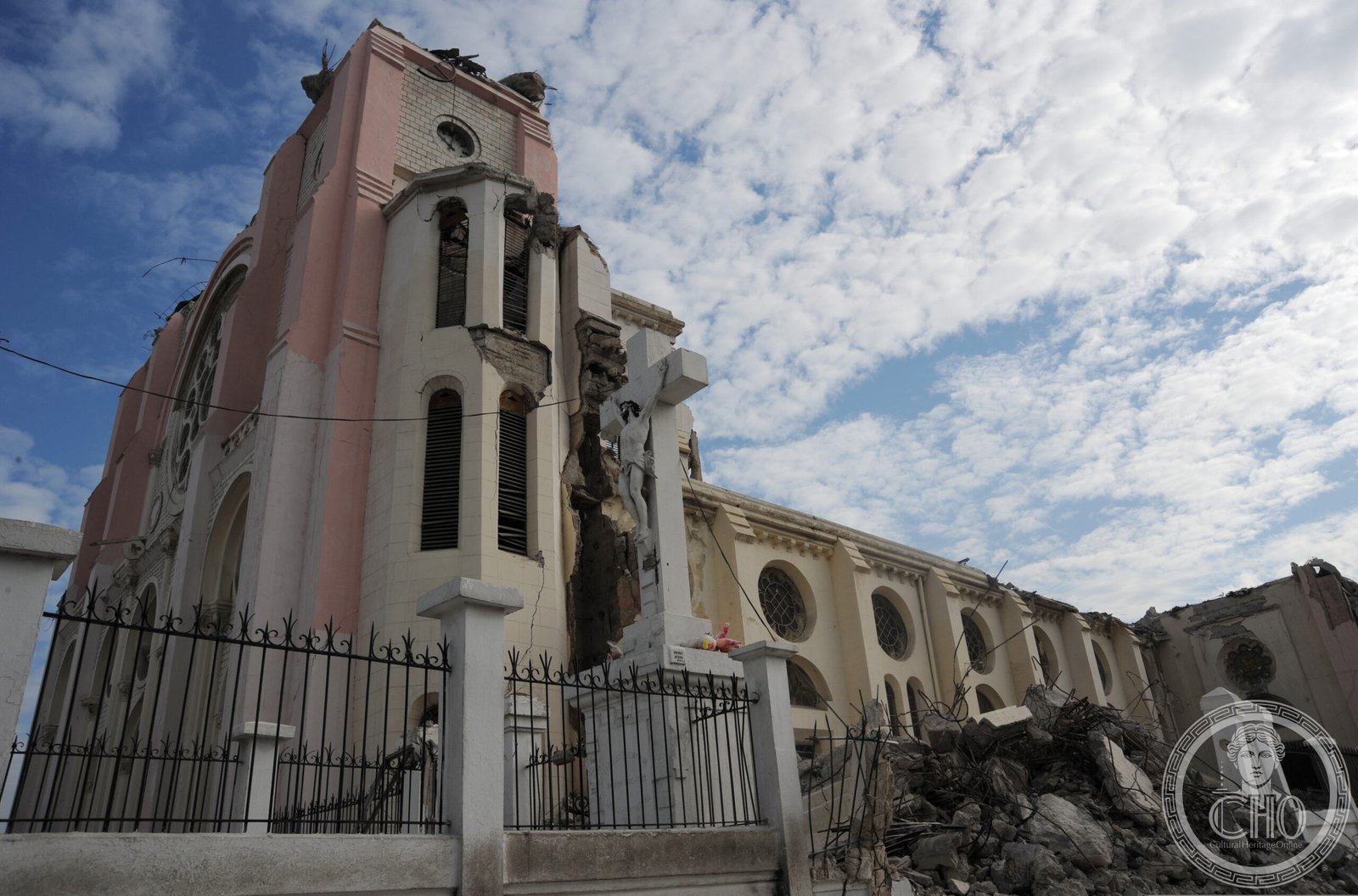
In Port-au-Prince, the capital of Haiti, work on the cathedral of Our Lady of the Assumption began in 1884 and continued, in several phases, until 1914, with the formal consecration on 13 December 1928, a construction lasting about forty-four years in all. No architect’s name is documented, and the sources differ on the exact style, described variously as Romanesque Revival or Gothic Revival, with two twin towers. No earlier cathedral on the same site destroyed by hurricanes, fires or earlier earthquakes is documented, although Port-au-Prince as a whole suffered destructive earthquakes in 1751 and 1770. On 12 January 2010 a catastrophic earthquake brought down the roof and the two twin towers flanking the main entrance, while the lower parts of the walls remained standing, leaving a partly collapsed shell rather than total destruction. The archbishop of Port-au-Prince, Monsignor Joseph Serge Miot, died in that earthquake, but his body was found in the rubble of the archbishop’s residence, not of the cathedral itself, while the vicar general Charles Benoit is said to have died later, in circumstances the sources do not detail. To date, according to the most recent sources found, the building remains essentially in ruins, neither demolished nor rebuilt. A smaller provisional cathedral was built at the back of the same site and, according to one source, consecrated in 2014. In March 2012 the archdiocese launched an international design competition, with about 130 entries, won by the Puerto Rican architect Segundo Cardona, whose design keeps the old surviving façade framed by two new concrete towers and turns the old nave into a covered courtyard, at an estimated cost of 50 million dollars. The reconstruction, however, has stalled, which the sources attribute to a funding gap compared with US Catholic donations for the rebuilding of Haiti’s churches in general, and to the security conditions in the capital, today largely under the control of armed gangs. The archdiocese of Port-au-Prince was raised from that of Santo Domingo on 3 June 1861, according to the papal bull, or on 3 October 1861, according to the date of formal erection given by other sources. The present archbishop is Monsignor Max Leroy Mesidor, in office since 2017. Pope John Paul II visited Haiti from 2 to 10 March 1983, on a journey centred on a Eucharistic and Marian assembly, during which he delivered the famous warning “things must change here”, which became a reference point for the Church’s role against the Duvalier regime. It is not, however, confirmed with certainty that he celebrated mass specifically in this cathedral.
About the Cathedral of Our Lady of the Assumption
In Port-au-Prince, Haiti, work on the Cathedral of Our Lady of the Assumption began in 1884 and continued in phases until 1914, with formal consecration on 13 December 1928 — a construction spanning roughly forty-four years in total. No architect is documented, and sources disagree on its exact style, described variously as Romanesque Revival or Gothic Revival, with twin towers. No earlier cathedral is documented on the same site as having been destroyed by prior hurricanes, fires, or earthquakes, though Port-au-Prince as a whole suffered destructive earthquakes in 1751 and 1770.
Key facts
- 1884-1928: the cathedral built and consecrated over roughly four decades.
- 12 January 2010: the earthquake destroys the roof and twin towers, leaving the lower walls standing.
- Archbishop Joseph Serge Miot dies in the earthquake, though at the archbishop’s residence, not the cathedral itself.
- March 2012: an international design competition for reconstruction is won by architect Segundo Cardona.
- As of the most recent reporting available, the ruin remains neither demolished nor rebuilt.
- 2-10 March 1983: Pope John Paul II visits Haiti and delivers his “things must change here” address.
History
Built over four decades and consecrated in 1928, this cathedral was largely destroyed by the catastrophic 12 January 2010 earthquake, which also claimed the life of Archbishop Joseph Serge Miot, killed in the collapse of the nearby archbishop’s residence. A 2012 design competition produced a reconstruction plan that would frame the surviving facade with new towers, but funding gaps and Haiti’s ongoing security crisis have left the ruin standing, largely unchanged, more than a decade later — a stalled reconstruction that mirrors the broader difficulty of rebuilding after the disaster.
What you see
A partially collapsed shell shows the lower walls of a Romanesque and Gothic Revival design still standing, its twin towers gone, while a marble crucifix survived the earthquake upright amid the rubble — one of the ruin’s most photographed details. A smaller transitional cathedral, built at the rear of the site, has served the archdiocese’s worship needs since the disaster.
Practical information
- Opening hours: the ruin is not a functioning church; visiting conditions depend heavily on current security in Port-au-Prince.
- Address: downtown Port-au-Prince, Haiti.
Getting there
The ruin stands in downtown Port-au-Prince. GPS: 18°32′56″N, 72°20′19″W.
Nearby
- Holy Trinity Cathedral — Port-au-Prince’s separate Episcopal (Anglican) cathedral, also devastated in 2010, not to be confused with this Catholic cathedral.
Sources
- Wikipedia — “Cathedral of Our Lady of the Assumption, Port-au-Prince” and “Joseph Serge Miot”
- NPR and National Catholic Reporter — coverage of Archbishop Miot’s death, January 2010.
- PrayTell Blog — “Design for New Port-au-Prince Cathedral Unveiled,” December 2012.
- Catholic-Hierarchy.org and GCatholic.org — Archdiocese of Port-au-Prince listings.
Find it on the map
See this place and what’s around it →📷 Become a Cultural Heritage Online photographer
Share your photos of places: they stay published under your name as the author. The more they're seen, the more you get noticed — and soon a contest will reward the most appreciated photos.
Log in or sign up free to add a photo