
In Gaborone, the capital of Botswana, the Catholic missionary presence in the country, then Bechuanaland, began in 1951-52: the Irish Passionist Fathers accepted the mission field in 1951, and four priests arrived on 7 February 1952, with Father Urban Murphy founding the first parish at Francistown on 23 May of that year. The apostolic prefecture of Bechuanaland was erected on 2 or 24 April 1959, depending on the source, carved out of territories of the dioceses of Bulawayo and Kimberley and of the apostolic vicariate of Windhoek. The present cathedral, whose construction the sources place between 1967 and 1968 without full agreement on the exact year, has no documented architect or specific patron. The prefecture was raised to a diocese on 5 August 1966, as the «diocese of Gaberones», barely seven weeks before the independence of Botswana from the United Kingdom on 30 September 1966, a notable coincidence in time, but one for which no causal or symbolic link with the process of independence itself is documented. The diocese was then renamed «of Gaborone» on 7 April 1970, following the change in the name of the city itself in 1969. Botswana today has only two Catholic dioceses, Gaborone and Francistown, the latter raised to a full diocese only on 2 October 2017, both under the ecclesiastical province of Pretoria, in South Africa, against a Catholic population estimated at about 87,000 people, 5 to 6 per cent of the national population, in a country with a Christian majority but predominantly Protestant. Among the bishops of Gaborone are Urban Charles Joseph Murphy, an Irish Passionist and the first bishop, from 1966 to 1981, also the founder of the local congregation of the Sisters of Calvary, followed by Boniface Tshosa Setlalekgosi, from 1981 to 2009, Valentine Tsamma Seane, from 2009 to 2017, and the present bishop, Franklyn Atese Nubuasah, a Divine Word missionary, appointed in 2019 and granted the personal title of archbishop in 2021. From 10 to 19 September 1988 Pope John Paul II made an apostolic journey to southern Africa that also took in Botswana: he arrived in Gaborone on 13 September and met priests, religious and lay people that same day in the cathedral itself, according to a primary Vatican source, before leaving on 14 September. No other specific event is documented for the building, beyond an unspecified later extension that brought it to a capacity of about 1,000 people.
About Christ the King Cathedral
In Gaborone, the capital of Botswana, Catholic missionary presence in the country, then Bechuanaland, began in 1951-52: Irish Passionist Fathers accepted the mission field in 1951, and four priests arrived on 7 February 1952, with Fr. Urban Murphy founding the first parish in Francistown on 23 May of that year. The Apostolic Prefecture of Bechuanaland was erected on either 2 or 24 April 1959, depending on the source, carved from territory of the Dioceses of Bulawayo, Kimberley, and the Apostolic Vicariate of Windhoek. The current cathedral, whose construction sources place between 1967 and 1968 without full agreement on the exact year, has no documented architect or specific patron.
Key facts
- 1967/1968: the cathedral built, exact year disputed.
- 5 August 1966: the prefecture elevated to a diocese, seven weeks before Botswana’s independence.
- 30 September 1966: Botswana becomes independent from Britain.
- 7 April 1970: renamed the Diocese of Gaborone, following the capital’s own renaming.
- 13 September 1988: Pope John Paul II meets clergy and laity in the cathedral during his Southern Africa tour.
- Botswana has only two Catholic dioceses, Gaborone and Francistown, serving roughly 5-6% of the population.
History
Elevated to a full diocese just seven weeks before Botswana’s own 1966 independence — a striking coincidence with no documented deeper connection — this cathedral has served one of the country’s smaller religious communities in a nation whose Christian majority leans overwhelmingly Protestant. Its most solidly documented milestone remains Pope John Paul II’s 1988 visit, when he met the country’s small Catholic community inside the cathedral itself during a wider Southern Africa apostolic journey.
What you see
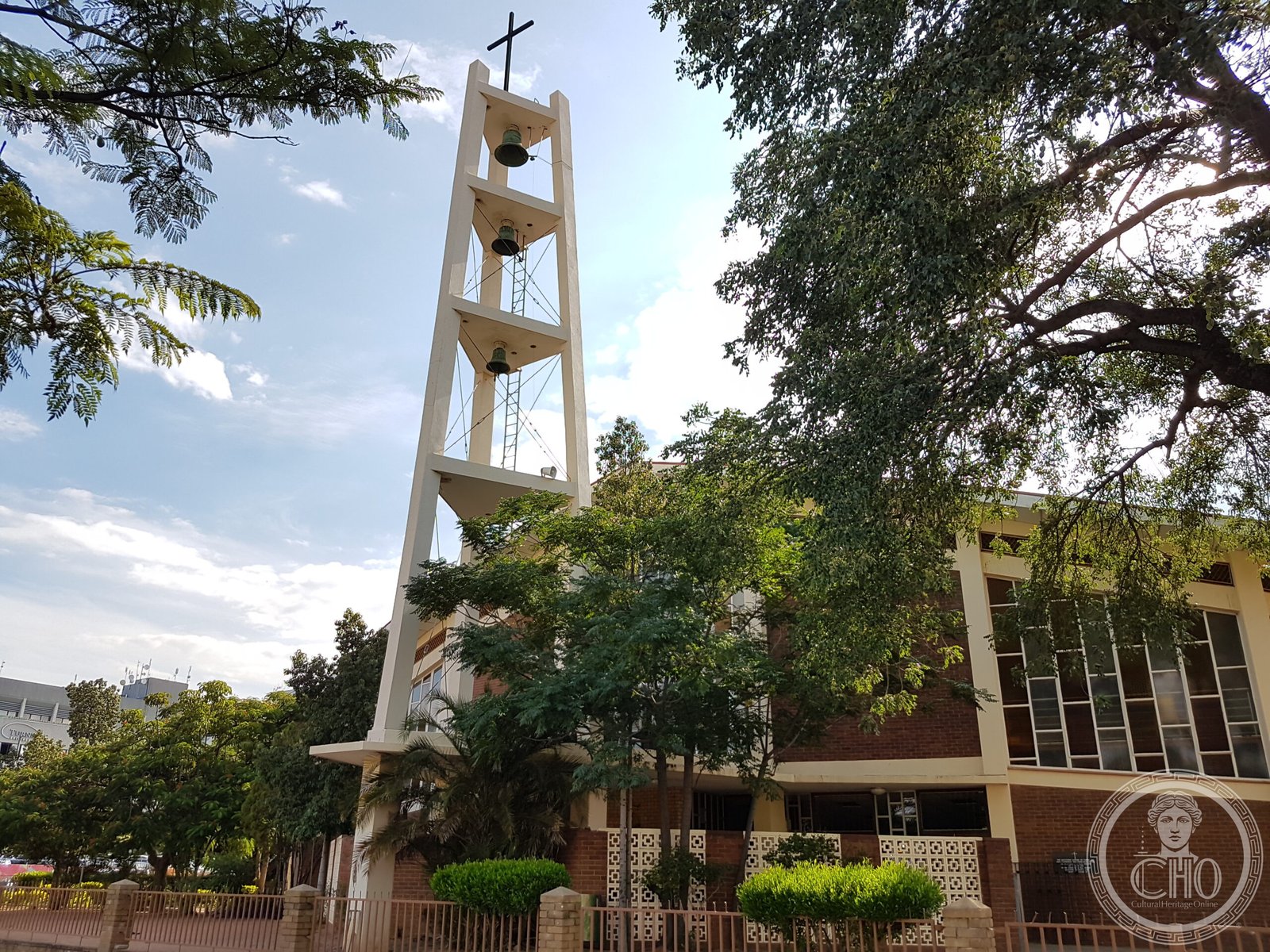
A modest, mid-20th-century church building, later expanded to hold roughly 1,000 worshippers, blends simple modern lines with local touches in its stained glass and woodwork, according to visitor accounts, though no architectural source documents its design in detail.
Practical information
- Opening hours: generally open daily outside services; check current hours before visiting.
- Address: 161 Queens Road, Gaborone, Botswana.
Getting there
The cathedral stands on Queens Road near Gaborone’s Main Mall, opposite the National Museum and Art Gallery. GPS: 24°39′25″S, 25°55′07″E.
Nearby
- Botswana National Museum and Art Gallery — reportedly opposite the cathedral, on the Main Mall.
Sources
- Diocese of Gaborone — official history page (gaboronediocese.org).
- Wikipedia — “Christ the King Cathedral (Gaborone)” and “Diocese of Gaborone”
- Vatican.va — Pope John Paul II, meeting with priests, religious and laity, Cathedral of Gaborone, 13 September 1988.
- Catholic-Hierarchy.org and GCatholic.org — Diocese of Gaborone listings.
Find it on the map
See this place and what’s around it →📷 Become a Cultural Heritage Online photographer
Share your photos of places: they stay published under your name as the author. The more they're seen, the more you get noticed — and soon a contest will reward the most appreciated photos.
Log in or sign up free to add a photo