

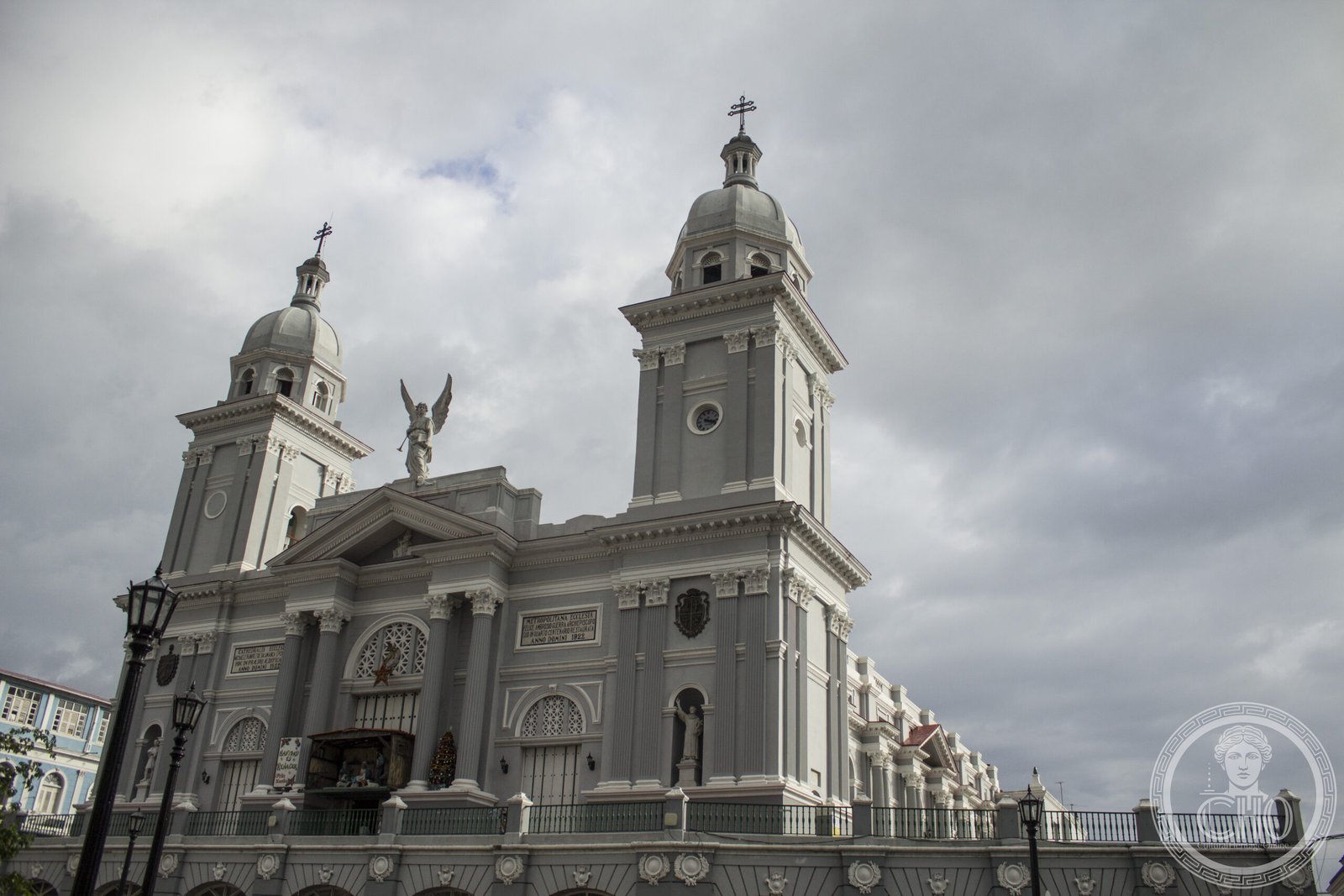
In Santiago de Cuba, a first chapel stood on this site around 1514, and became a cathedral in 1522, when the diocesan seat erected at Baracoa in 1518 was moved there. Spanish-language sources date the first wooden church, roofed with yagua palm, to 1528 instead: the sources leave the discrepancy unresolved. Pirate and corsair raids destroyed the building repeatedly in the sixteenth and seventeenth centuries, and earthquakes did the rest. The tremor of 11 June 1766, among the strongest ever recorded in Cuba, brought down the central nave. The quake of 1852 collapsed the side naves, the dome and the towers, and repairs ran until 1874. On 3 February 1932 another quake cracked the towers, the clock tower above all. The present building, the fourth, was rebuilt from 1810 and blessed on 24 April 1818. The facade seen today is neoclassical, with Corinthian columns, arches and two bell towers, and was redesigned by the architect Carlos Segrera Fernandez in the early Twenties of the twentieth century. The church was given the title of minor basilica on 15 February 1882, and has been a national monument of Cuba since 1958. A restoration completed in 2015, before the visit of Pope Francis, changed the outside from the traditional yellow to the present grey. Under the altar, according to several sources, lie the remains of Diego Velazquez de Cuellar, the first Spanish governor of Cuba, who died in Santiago on 11-12 June 1524 and asked to be buried here. Where exactly his remains lie can no longer be established. He should not be confused with the Spanish Baroque painter of the same name, an entirely different figure. The diocese was a suffragan of the archdiocese of Seville until 1546 and then of Santo Domingo, and was raised to a metropolitan archdiocese in 1803. It is not, as is sometimes assumed, the oldest diocese in the Americas: that distinction belongs to the archdiocese of Santo Domingo, erected in 1511. The present archbishop, by the most recent confirmed appointment, is Monsignor Dionisio Guillermo Garcia Ibanez, in office since 2007. The building faces Parque Cespedes, the main square of the city, named after Carlos Manuel de Cespedes, who on 8 October 1868 began the Ten Years War for Cuban independence from Santiago. No specific event inside the cathedral is documented in connection with the wars of independence, so the link is one of symbolic proximity rather than direct historical fact. On 22 September 2015 Pope Francis met families inside this cathedral, before celebrating mass separately at the shrine of the Virgin of Charity of El Cobre, some twenty kilometres from Santiago. The visits of John Paul II in 1998 and of Benedict XVI in 2012 to the city are well documented, but their main events were held at Plaza de la Revolucion and at the shrine of El Cobre, and no primary source confirms that either pope visited this building.
About the Metropolitan Cathedral Basilica
In Santiago de Cuba, a first chapel stood on this site around 1514, elevated to cathedral status in 1522 when the diocesan seat, erected in 1518 at Baracoa, was transferred there; Spanish-language sources instead date the first wooden, yagua-roofed church to 1528, an internal discrepancy the sources themselves leave unresolved. The building was repeatedly destroyed by pirate and corsair raids across the 16th and 17th centuries, and later by a series of earthquakes: the one of 11 June 1766, among the strongest ever recorded in Cuba, destroyed the central nave; the 1852 quake collapsed the side naves, dome, and towers; and the 3 February 1932 quake cracked the towers, especially the clock tower.
Key facts
- 1810-1818: the fourth and current building constructed and blessed.
- Early 1920s: the present neoclassical facade designed by architect Carlos Segrera Fernández.
- 15 February 1882: designated a minor basilica.
- Beneath the altar lie the reputed, now unmarked remains of Diego Velázquez de Cuéllar, Cuba’s first Spanish governor, who died in Santiago in 1524.
- 1958: declared a National Monument of Cuba.
- 22 September 2015: Pope Francis meets families inside the cathedral.
History
Rebuilt across four successive structures after repeated pirate raids and a string of destructive earthquakes in 1766, 1852, and 1932, this cathedral has stood on the same site since the 1520s, when Santiago became Cuba’s first diocesan seat. It holds the reputed, now-unlocatable grave of Diego Velázquez de Cuéllar, the island’s first Spanish governor, and fronts Parque Céspedes, the plaza named for the independence leader who launched Cuba’s Ten Years’ War in 1868 — a symbolic proximity to that history rather than a documented direct role in it.
What you see
A neoclassical facade of Corinthian columns and twin bell towers, redesigned in the early 1920s, evokes Roman basilica architecture and was repainted from its traditional yellow to gray during a 2015 restoration. Inside, Cuba’s only religious art museum and a first-of-its-kind Music Chapel reflect the cathedral’s long institutional history.
Practical information
- Opening hours: generally open daily outside services; check current hours before visiting.
- Address: Calle Santo Tomás, between San Basilio and Heredia, fronting Parque Céspedes, Santiago de Cuba, Cuba.
Getting there
The cathedral stands on Parque Céspedes, the historic main square of Santiago de Cuba. GPS: 20°01′14″N, 75°49′46″W.
Nearby
- Parque Céspedes — Santiago’s historic main square, named for independence leader Carlos Manuel de Céspedes.
Sources
- Wikipedia (English and Spanish) — “Cathedral Basilica of Santiago de Cuba” and “Archdiocese of Santiago de Cuba”
- EcuRed — “Catedral de Santiago de Cuba” and “Santiago de Cuba” (ecured.cu).
- Granma — “Pope Francis in Cuba: Minute by minute,” September 2015.
- Vatican.va — homily, Shrine of Our Lady of Charity, El Cobre, 22 September 2015.
Find it on the map
See this place and what’s around it →📷 Become a Cultural Heritage Online photographer
Share your photos of places: they stay published under your name as the author. The more they're seen, the more you get noticed — and soon a contest will reward the most appreciated photos.
Log in or sign up free to add a photo