
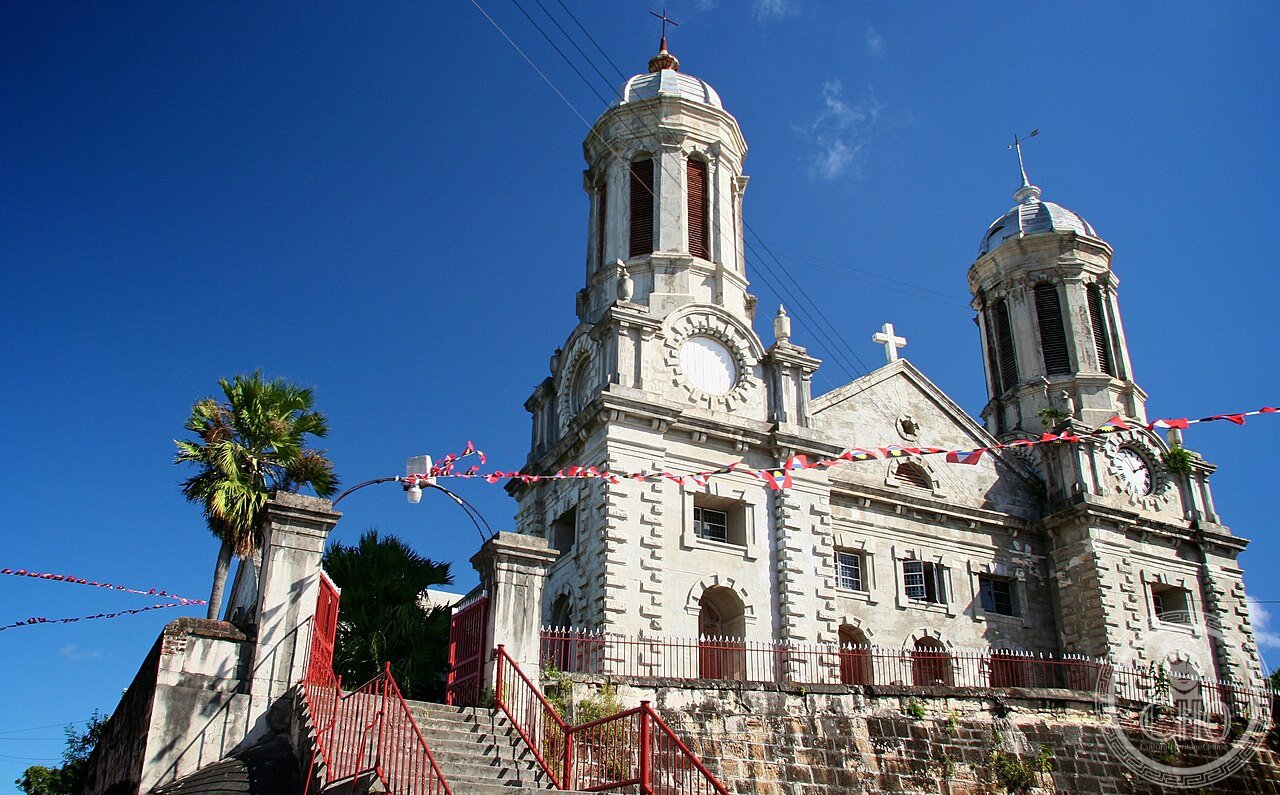
In St. John’s, the capital of Antigua and Barbuda, the first church on the present cathedral site was a simple wooden structure of 1681, without any decoration, damaged by an earthquake in 1745. A second brick church, designed by Robert Cullen, with a construction date reported inconsistently by the sources between 1720 and 1746, was in turn badly damaged by the violent Leeward Islands earthquake of February 1843, just as it was being enlarged following the establishment in 1842 of the diocese of Antigua and the Leeward Islands, which raised the church to a cathedral. The foundation stone of the present, third building was laid by Governor Sir Charles Augustus FitzRoy on a date also uncertain between the sources, 9 October 1843 or 9 October 1845. Work lasted about three years, with services beginning according to one source on 10 October 1847 and the consecration, well documented by several sources, on 25 July 1848. The design was by the architect Thomas Fuller of Bath, with F. W. Rowe of Bristol as supervisor of the works. In Baroque style, not Gothic as is sometimes wrongly reported, the cathedral is built of sandstone, 156 feet long and 46 wide, with a transept of 104 feet, and topped by two Baroque towers 70 feet high with silver-painted domes, visible from the harbour. Its most unusual feature is the interior, entirely encased in dark pitch pine on the principle of a “building within a building”, designed to absorb seismic movement and withstand hurricanes. Two lead statues of St. John the Evangelist and St. John the Baptist flank the southern iron gate, dated 1789. Local tradition attributes them to the French ship “Temple”, captured by the British navy in the waters off Martinique in 1756 during the Seven Years’ War, not during the Napoleonic wars as is sometimes wrongly told, an attribution probably mistaken since the two wars are almost half a century apart. Nicknamed “Big Church” by the planters, the cathedral served mainly the white colonial community until around the First World War. More broadly, the Anglican Church in the British Caribbean, through the Society for the Propagation of the Gospel, directly owned plantations and enslaved people elsewhere in the region, although no direct ownership of plantations by this specific cathedral is documented. The diocese operated under the jurisdiction of the archbishop of Canterbury until 1883, when the Province of the West Indies was established; today it is known as the diocese of the North Eastern Caribbean and Aruba, comprising 12 islands. Cumulative damage from hurricanes, earthquakes and termite infestations, culminating in an incident in December 2009 in which a teacher fell through the floor during rehearsals for a Christmas concert, led to the cathedral’s closure. Restoration of the foundations, roof and pews was completed in 2012, followed by a further restoration of the interior and stained glass between 2016 and 2018, partly funded by the local Mill Reef Fund, with the reopening for the Easter services of 2018 after about eight years of closure. The exterior, however, remained in a precarious state and fundraising for its restoration continued beyond that date. The present bishop is the Right Reverend Ernest Alroy Flemming, elected on 14 January 2022 and installed in the same cathedral on 4 May 2022. The building has been designated national cultural heritage under Antigua and Barbuda’s cultural heritage protection law, one of five sites so recognised in the country, although the exact year the designation took effect is not clearly confirmed by the sources consulted.
About Cathedral of St. John the Divine
In St. John’s, the capital of Antigua and Barbuda, the first church on the current cathedral site was a simple wooden structure built in 1681, devoid of any decoration, damaged by an earthquake in 1745; a second brick church, designed by Robert Cullen and dated inconsistently across sources to either 1720 or 1746, was itself badly damaged by the violent Leeward Islands earthquake of February 1843, just as it was being upgraded following the 1842 creation of the Diocese of Antigua and the Leeward Islands, which elevated the church to cathedral status. The foundation stone of the current, third building was laid by Governor Sir Charles Augustus FitzRoy on a date also disputed between sources — either 9 October 1843 or 9 October 1845; construction took roughly three years, with services beginning, per one source, on 10 October 1847, and consecration, well documented across multiple sources, on 25 July 1848.
Key facts
- 1681: the first wooden church built on the site.
- 1842: the Diocese of Antigua and the Leeward Islands created, the church elevated to cathedral.
- 25 July 1848: the current, third cathedral consecrated.
- Twin 70-foot Baroque towers and an interior entirely clad in earthquake-resistant pitch pine.
- December 2009: a floor-collapse incident exposes cumulative structural decay, closing the cathedral.
- 2018: the cathedral reopens for Easter services after roughly eight years of restoration.
History
Rebuilt three times on the same hilltop site since 1681, each time undone by earthquake or decay, the Cathedral of St. John the Divine’s current form was engineered specifically to survive the next disaster — a pitch-pine “building within a building” designed to flex under seismic and hurricane stress rather than crack. Once nicknamed “Big Church” and serving primarily Antigua’s planter class into the 20th century, the cathedral’s most recent near-decade-long closure, triggered by a 2009 floor collapse, and its 2018 reopening trace a modern history of slow, community-funded restoration.
What you see
Twin silver-painted Baroque towers with cupolas rise 70 feet above a freestone building 156 feet long, its interior entirely encased in dark pitch pine as a deliberate earthquake-resistance strategy. At the south gate, dated 1789, two lead statues of St. John the Evangelist and St. John the Baptist are said by local tradition to come from a French ship captured by the British Navy near Martinique in 1756, during the Seven Years’ War rather than the more popularly cited Napoleonic Wars.
Practical information
- Opening hours: generally open daily outside services; check current hours before visiting.
- Address: corner of Newgate Street and Church Street, St. John’s, Antigua and Barbuda.
Getting there
The cathedral stands on a hilltop at the corner of Newgate Street and Church Street in central St. John’s, easily reached on foot from the city center. GPS: 17°07′22″N, 61°50′31″W.
Nearby
- Central St. John’s — the capital’s main commercial and administrative district.
Sources
- Wikipedia — “St. John’s Cathedral (Antigua and Barbuda)” and “Diocese of the North East Caribbean and Aruba” (en.wikipedia.org).
- “History Of The Cathedral Church In St. John’s, Antigua” (anbanet.com).
- Mill Reef Fund — “The Cathedral of St. John the Divine”
Find it on the map
See this place and what’s around it →📷 Become a Cultural Heritage Online photographer
Share your photos of places: they stay published under your name as the author. The more they're seen, the more you get noticed — and soon a contest will reward the most appreciated photos.
Log in or sign up free to add a photo