
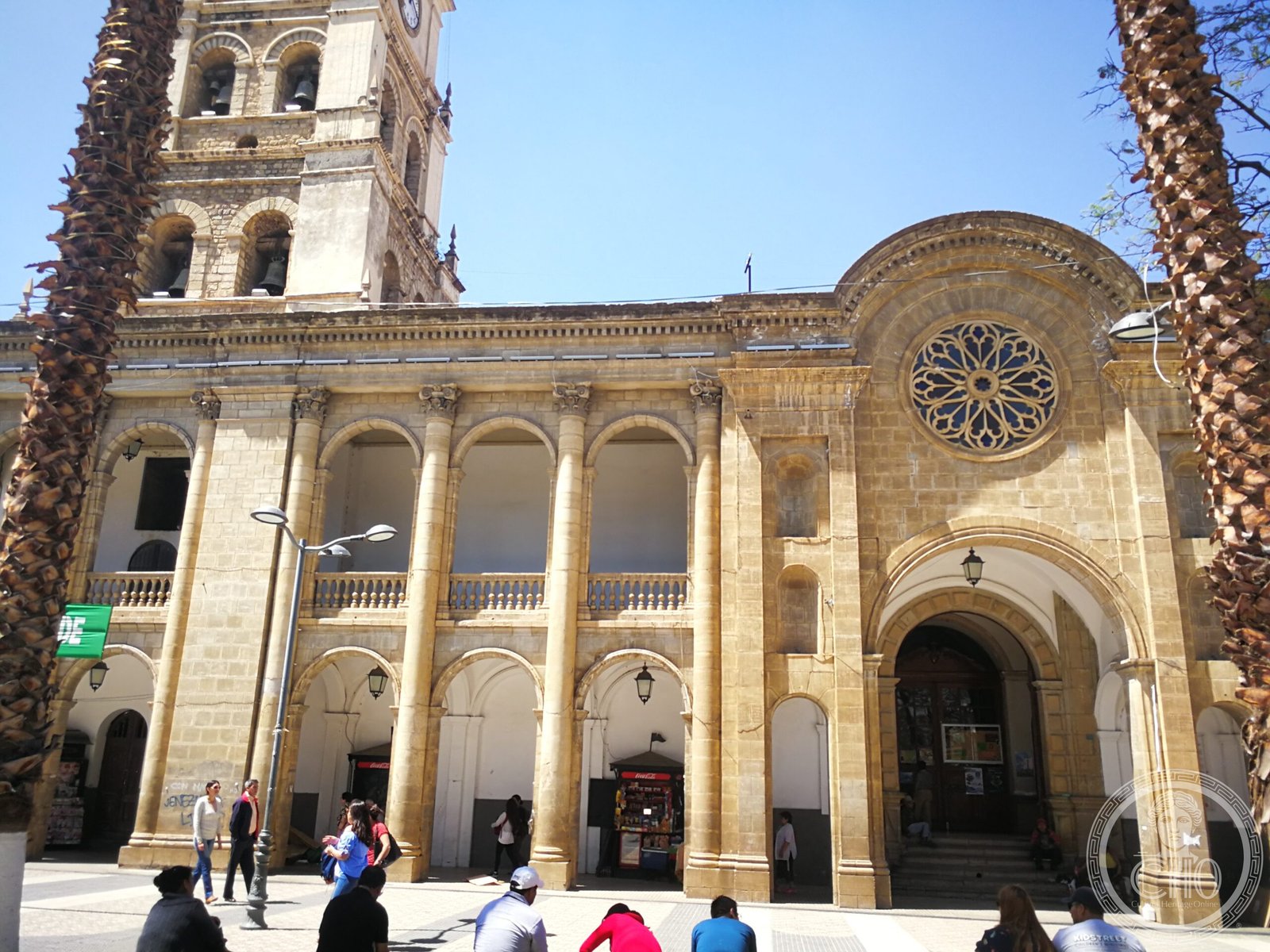
On Plaza 14 de Septiembre, in the historic centre of Cochabamba, in Bolivia, the metropolitan cathedral of San Sebastián was begun in 1701, funded by the rector and vicar Francisco de Urquiza, and completed in 1735. A source of lesser authority, not corroborated elsewhere, holds that the work in fact began around 1630 under the engineer Domingo del Mazo, with 1735 marking rather a rebuilding financed by Urquiza himself: the two versions have not been reconciled by the available sources. Two side aisles were added in 1830 and a gallery facing the square in 1925. The façade, described by the sources not entirely consistently as eclectic or as mestizo Baroque, has Solomonic and Corinthian columns, segmental arches, a pointed rose window and domes of neoclassical taste. The square on which the cathedral stands takes its name from the rising of 14 September 1810, when patriots led by Esteban Arze occupied the royalist barracks of the city and held an open cabildo proclaiming loyalty to the revolutionary junta of Buenos Aires, one of the first anti-colonial risings in South America. Cochabamba was founded twice, according to the sources: a first foundation on 15 August 1571 by Gerónimo de Osorio, the date from which the city still counts its anniversary, and a second, purely symbolic foundation on 1 January 1574 by the judge Sebastián Barba de Padilla, who moved its main square to a more stable site in the Kanata valley. The region has historically been described as the «granary of Bolivia» for its farm output, although an article in the newspaper Los Tiempos of 2023 reports that the valley has by now lost that role, because of the overcrowding of its arable land and the fragmentation of holdings. The diocese of Cochabamba was established on 25 June 1847 with the bull Ubique pateat of Pope Pius IX, detached from the archdiocese of La Plata, today Sucre, and from the diocese of Santa Cruz. It was raised to a metropolitan archdiocese on 30 July 1975 with the bull Quo gravius of Pope Paul VI. On 7 December 1967 the cathedral was declared a Bolivian national monument, together with the churches of San Francisco, La Merced, Santa Teresa, Santo Domingo and San Agustín. During a major restoration, directed by the architect Mario Moscoso, two crypts with skeletal remains were found beneath the floor and, inside a pillar, the mummified remains of Francisco María del Granado, third bishop of Cochabamba, found seated on a chair. A third crypt by the high altar holds today the remains of Bishop René Fernández Apaza, who lived from 1924 to 2013. No damage to the cathedral is documented from the Bolivian earthquake of 22 May 1998, which struck about one hundred and thirty kilometres from Cochabamba.
About the Cathedral
The Metropolitan Cathedral of San Sebastián, on Plaza 14 de Septiembre in Cochabamba, Bolivia, was begun in 1701 and completed in 1735, funded by rector Francisco de Urquiza. It has been a Bolivian national monument since 1967 and became a metropolitan archdiocesan seat in 1975.
Key facts
- 1701–1735: cathedral built, financed by rector Francisco de Urquiza.
- 1830 / 1925: lateral naves added, then a gallery facing the plaza.
- 14 September 1810: the plaza’s namesake uprising, led by Esteban Arze against Spanish rule.
- 25 June 1847: Diocese of Cochabamba established by Pope Pius IX.
- 7 December 1967: declared a Bolivian national monument.
- 30 July 1975: elevated to metropolitan archdiocese by Pope Paul VI.
History
Built across the early 18th century in a valley long known as Bolivia’s agricultural heartland, the cathedral stands on the plaza where, in September 1810, Cochabamba’s patriots staged one of South America’s earliest uprisings against Spanish colonial rule. Restoration work uncovered crypts and the mummified remains of an early bishop beneath its floor, and in 1975 the cathedral became the seat of a full metropolitan archdiocese, nearly 130 years after the diocese itself was established.
What you see
A colonial facade combining Solomonic and Corinthian columns, low round arches and a pointed rose window beneath neoclassical-style domes and a bell tower, fronting Plaza 14 de Septiembre.
Practical information
- Opening hours: generally open daily outside services; check current hours before visiting.
- Address: Plaza 14 de Septiembre, near Calle Esteban Arze, Centro Histórico, Cochabamba, Bolivia.
Getting there
The cathedral fronts Plaza 14 de Septiembre in Cochabamba’s historic center. GPS: 17.3945°S, 66.1568°W.
Nearby
- Plaza 14 de Septiembre — Cochabamba’s main square, commemorating the 1810 uprising against Spanish rule.
Sources
- Wikipedia (Spanish) — “Catedral de San Sebastián (Cochabamba),” “Arquidiócesis de Cochabamba,” “Revolución de Cochabamba (1810)”
- Los Tiempos — “Catedral de San Sebastián, una joya descuidada,” coverage of the 1810 uprising and Cochabamba’s agricultural decline.
- cochabambabolivia.net — cathedral architectural description.
Find it on the map
See this place and what’s around it →📷 Become a Cultural Heritage Online photographer
Share your photos of places: they stay published under your name as the author. The more they're seen, the more you get noticed — and soon a contest will reward the most appreciated photos.
Log in or sign up free to add a photo