
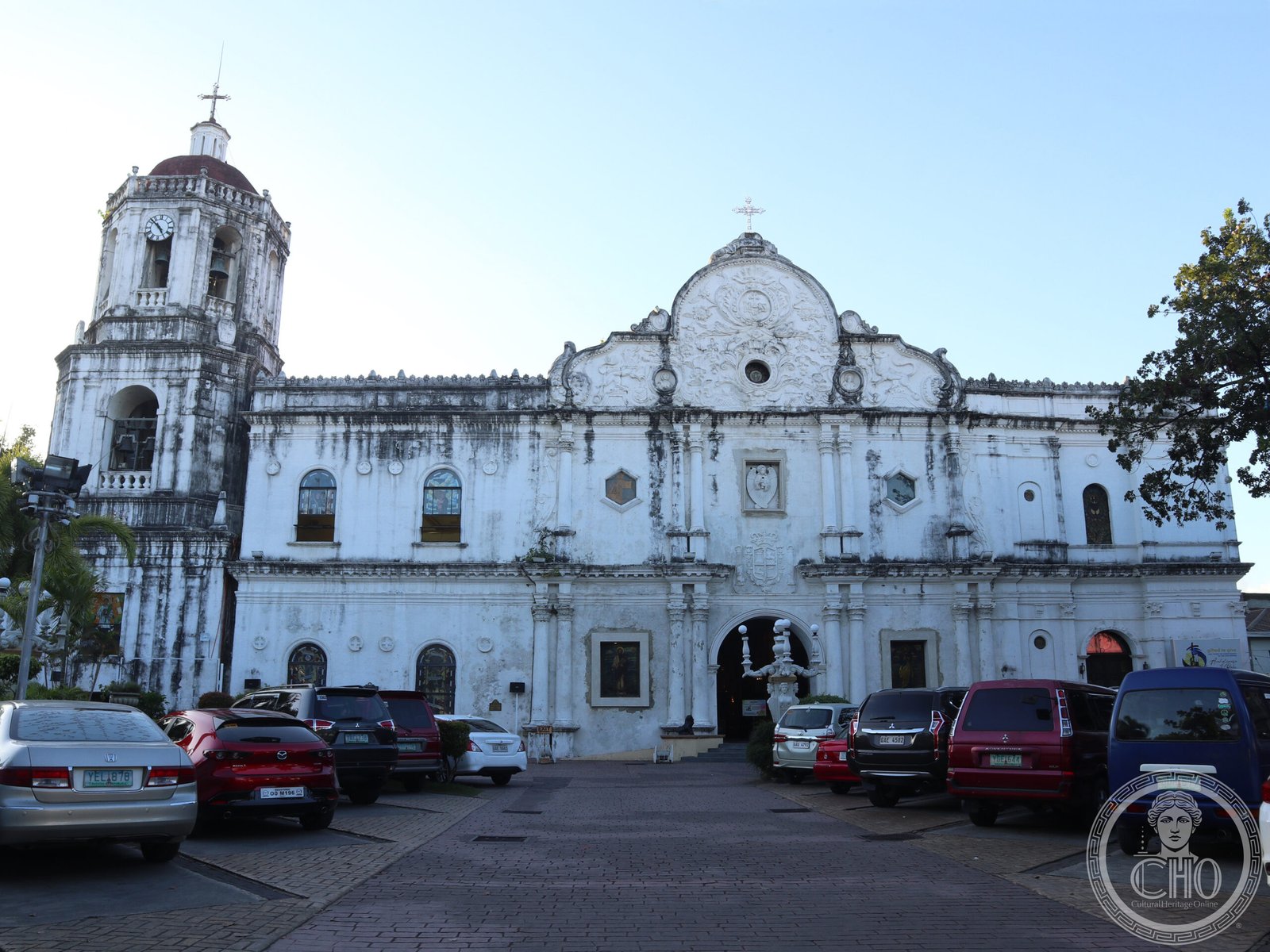
On P. Burgos Street, in Cebu City, in the Philippines, the metropolitan cathedral of the Immaculate Conception is the seat of the Archdiocese of Cebu, distinct from the nearby Basilica del Santo Niño, a separate building located about two blocks to the south. A first church, dedicated to St. Vitalis, was built in April 1565 by Miguel López de Legazpi, fray Andrés de Urdaneta and fray Diego de Herrera, among the first churches of the Philippines. According to local historiographical tradition, not fully confirmed by independent sources in the details of the individual architects, the building was rebuilt seven times over more than two centuries, amid funding difficulties, a typhoon that destroyed an unfinished version of it in 1689, and funds diverted to military campaigns. The seventh and final reconstruction was begun on 7 December 1891 by Bishop Martín García Alcocer and completed in 1909 under Bishop Juan Bautista Gorordo, the first Filipino bishop of Cebu. Between 1933 and 1940 a major renovation was directed by the Chinese-Cebuano engineer Gavino Unchuan, to a design by the architects Eulogio Tablante Jr., Felino C.T. Lepon and Julio Ancheta. On 12 September 1944 Allied air raids during the Second World War badly damaged the recently renovated cathedral and destroyed the nearby episcopal palace, with the loss of centuries of archdiocesan archives: only the bell tower, built in 1835, the facade and the perimeter walls survived. The reconstruction, begun in 1945 by Archbishop Gabriel Reyes under the direction of the architect José Ma. Zaragosa, was completed in 1959 under Archbishop Julio Rosales. The Diocese of Cebu was erected on 14 August 1595 by Pope Clement VIII, together with the dioceses of Nueva Cáceres and Nueva Segovia, as suffragan to the newly created Archdiocese of Manila, under the first bishop Pedro de Agurto. Contrary to a widespread but unfounded claim, it is not the oldest diocese in Asia, since the diocese of Manila itself precedes it by sixteen years, and several dioceses of the Portuguese patronage in India, such as Goa, date back as far as the sixteenth century. On 28 April 1934 Pope Pius XI elevated it to a metropolitan archdiocese; today it is described as the largest archdiocese in the Philippines by number of faithful. From 24 to 31 January 2016 Cebu hosted the fifty-first International Eucharistic Congress, with the cathedral as the archdiocesan venue for the events and Cardinal Charles Bo, of Myanmar, as the legate of Pope Francis at the opening Mass, before more than ten thousand international pilgrims. On 23 November 2016 the National Historical Commission of the Philippines unveiled a second-level historical marker at the cathedral, and in March 2023 the National Museum of the Philippines declared it an important cultural property.
About the Cathedral
Cebu Metropolitan Cathedral, on P. Burgos Street in Cebu City, Philippines, is the seat of the Archdiocese of Cebu, distinct from the nearby Basilica del Santo Niño. Its origins trace to 1565, with the current structure completed in 1909 after repeated earlier reconstructions, then rebuilt again following near-total destruction in Allied bombing during World War II.
Key facts
- April 1565: a church dedicated to St. Vitalis built near the Spanish fort by Miguel López de Legazpi’s expedition.
- 14 August 1595: Diocese of Cebu erected by Pope Clement VIII, suffragan to Manila.
- 1909: current cathedral consecrated under Bishop Juan Bautista Gorordo, Cebu’s first Filipino bishop.
- 12 September 1944: Allied air raids destroy most of the recently renovated cathedral; only the 1835 belfry, facade and outer walls survive.
- 1945–1959: cathedral rebuilt under architect José Ma. Zaragosa.
- 28 April 1934: elevated to metropolitan archdiocese by Pope Pius XI.
History
Tracing its origins to one of the Philippines’ earliest churches in 1565, the cathedral was rebuilt repeatedly over more than three centuries before a 1930s renovation was nearly undone within a decade by Allied bombing in 1944, which left only its facade and bell tower standing. Rebuilt again by 1959, it now serves as the seat of the Philippines’ largest archdiocese by Catholic population, and hosted the 51st International Eucharistic Congress in 2016.
What you see
A white baroque facade with a curved, scrolled pediment and a single asymmetric bell tower topped by a dome and clock, its post-war reconstruction preserving the profile of the 19th-century building destroyed in 1944.
Practical information
- Opening hours: generally open daily outside services; check current hours before visiting.
- Address: P. Burgos Street, Cebu City, Philippines.
Getting there
The cathedral stands on P. Burgos Street, roughly two blocks north of the Basilica del Santo Niño. GPS: 10.2958°N, 123.9029°E.
Nearby
- Basilica del Santo Niño — a separate, older-foundation church roughly two blocks south, historically linked to the cathedral by an annual image-carrying tradition.
Sources
- Wikipedia — “Cebu Metropolitan Cathedral,” “Roman Catholic Archdiocese of Cebu,” “Basilica del Santo Niño”
- Catholic-Hierarchy.org and GCatholic.org — Archdiocese of Cebu records.
- GMA News, Vatican.va — coverage of the 2016 International Eucharistic Congress.
- The Freeman / Philstar, Cebu Daily News — coverage of the 2016 NHCP historical marker.
Find it on the map
See this place and what’s around it →📷 Become a Cultural Heritage Online photographer
Share your photos of places: they stay published under your name as the author. The more they're seen, the more you get noticed — and soon a contest will reward the most appreciated photos.
Log in or sign up free to add a photo