
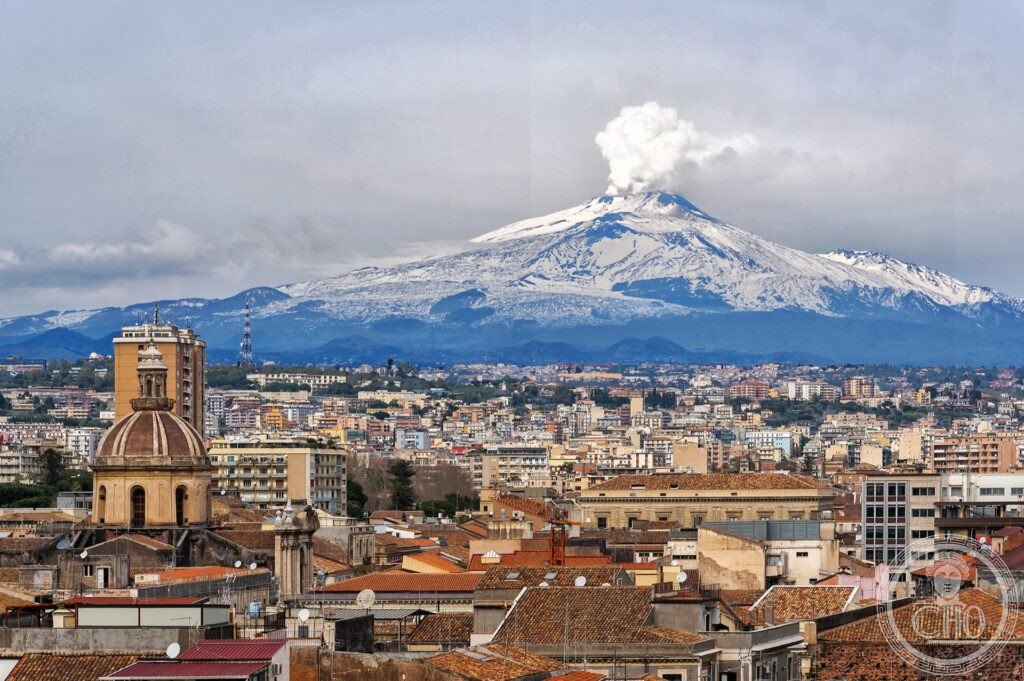
Catania. The most urban and commercially active of the eight UNESCO Late Baroque Val di Noto cities, built in black lava stone from Etna on the ruins of a city that had been simultaneously buried by the lava flow of 1669 and then flattened by the earthquake of 1693. Has a material identity found nowhere else in European Baroque: its architect Giovanni Battista Vaccarini articulated civic buildings and churches in a two-tone palette of white Sicilian limestone (for decoration) and dark Etna basalt (for structure), producing a Baroque-meets-geology aesthetic in which the volcanic material of the city’s near-destruction became the fabric of its reconstruction.
At a glance
Catania (province of Catania, Sicilia; UNESCO 2002, ref. 1024) is the largest (population approximately 315,000) and most architecturally complex of the eight cities in the serial inscription “Late Baroque Towns of the Val di Noto.” Catania is inscribed for the exceptional quality of the Baroque urban fabric rebuilt by Giovanni Battista Vaccarini (1702-1768) and his contemporaries between 1693 and 1750. Four pieces carry the inscription. The Piazza del Duomo gathers the Fontana dell’Elefante, the Duomo di Sant’Agata with its reused Roman columns, the Palazzo del Municipio and the Palazzo degli Elefanti. The Via Crociferi is a Baroque street-scene of six major churches in 200 m. The Via Etnea, the main axis, runs 3 km oriented precisely toward the summit of Etna. Beneath all of it lies the urban grid the Spanish engineer José Bermúdez designed in 1693, a regular street plan laid over the irregular pre-earthquake site.
Key facts
- La Fontana dell’Elefante (1736, Vaccarini): The Elephant Fountain (designed by Vaccarini for the Piazza del Duomo) is the most visited Baroque monument in Catania: the central element is an ancient basalt elephant (believed to date from Roman-period Catania or earlier; the elephant has been the heraldic symbol of the city since at least the 13th century) mounted on a Baroque pedestal and supporting an Egyptian obelisk (originally a Roman-period re-use of an actual Egyptian obelisk, likely from the Hadrianic period, 2nd century CE, found in Catania in the 16th century). The design integrates three temporalities. The Roman obelisk, the ancient elephant, and the Baroque pedestal. Into a single composition that makes the fountain a condensed archaeology of the city.
- La Via Crociferi (Vaccarini, 1700-1750): Via Crociferi is a 200-m Baroque street built entirely after 1693 between the Piazza Mazzini and the Piazza San Francesco d’Assisi, containing six major Baroque church and convent facades in sequence (from north to south: San Benedetto, San Francesco Borgia, the Collegio dei Gesuiti, the former church of the Gesù, San Giuliano, and the Chiesa Benedettine). The street has been described as “the most theatrical Baroque street composition in Sicily” because the facades are designed to be viewed from a fixed perspective (at the street entrance under the arch of San Benedetto) as a theatrical scene, not individually.
- Il “barocco lavico” di Catania: The distinctive material identity of Catania Baroque (unique among the Val di Noto cities) derives from the combination of Etna basalt (dark grey-black volcanic stone, used for structural elements, paving, cornices) and white Baroque limestone (used for decorative details, capitals, statuary): this two-tone palette gives Catanian Baroque a graphic sharpness and contrast that distinguishes it from the warm amber stone of Noto, the grey stone of Ragusa, or the whitewash of Scicli.
- Vincenzo Bellini (Catania 1801-Puteaux 1835): The composer of “La Sonnambula” (1831), “Norma” (1831), and “I Puritani” (1835) was born in Catania. The Museo Civico Belliniano (in his birthplace, Piazza San Francesco 3) holds manuscripts, portraits, scores, and the piano on which he composed. The Teatro Massimo Bellini (1890, designed by Carlo Sada in neo-Baroque style) is named after him.
- UNESCO: 2002, ref. 1024.
- GPS: 37.5026, 15.0875. Google Maps (Piazza del Duomo, Catania).
History
Catania (Greek “Katane,” founded 729 BCE by Chalcidian settlers from Naxos) was one of the largest Greek cities of Sicily. It passed through Carthaginian, Roman (63 BCE; it was a Roman municipium with an amphitheatre and extensive baths), Byzantine, Arab (902), Norman, Aragonese, and Spanish periods before the double disaster of 1669 and 1693. The eruption of Etna in March 1669 destroyed the western quarter of the city and buried the harbour under a lava flow (the lava delta is still visible as the promontory of Porto Vecchio). Twenty-four years later, the earthquake of January 11, 1693 collapsed virtually the entire remaining city. The Spanish viceroy ordered a complete rebuilding on a regular orthogonal street plan (designed by José Bermúdez) laid over the rubble of the old city. Architect Giovanni Battista Vaccarini (born in Palermo, trained in Rome under Carlo Fontana) arrived in 1730 and designed or directed most of the key monuments of the rebuilt city until his death in 1768.
What you see
The Catania Baroque circuit is concentrated in a 1 km radius around the Piazza del Duomo. Start at the Piazza del Duomo (the Fontana dell’Elefante; the Duomo di Sant’Agata — go inside for the Roman column capitals reused in the nave and the side chapel of Sant’Agata with the reliquary bust; the Palazzo degli Elefanti with its black basalt lower story and white limestone upper story). Then walk north on Via Crociferi (the arch of San Benedetto marks the start of the theatrical Baroque sequence). Continue to the Piazza Mazzini (with the former Roman macellum — 32 Roman columns surviving in an astonishing in-situ survival under the post-earthquake church). For Bellini: the Museo Belliniano is 5 min walk south of the Piazza del Duomo. For the best bird’s-eye view of the city’s relationship with Etna: Via Etnea, walking north toward the Villa Bellini park (20 min). The view up Via Etnea toward the summit of Etna on a clear day is one of the memorable urban sightlines in Italy.
Gallery
Practical information
- Fontana dell’Elefante e Piazza del Duomo: Piazza del Duomo, Catania. Always accessible. The Duomo di Sant’Agata is open daily 07:30-12:00 and 16:00-19:00. Free entry. The Cappella di Sant’Agata (right transept, with the reliquary bust and the silver casket) is open at the same hours. The Museo Diocesano (adjacent to the Duomo) holds the most significant Catanian Baroque decorative arts collection.
- Via Crociferi: 5 min walk north from Piazza del Duomo via Via dei Crociferi. Individual churches open morning hours (09:00-12:30). The exterior of the street can be seen at any time. The arch of San Benedetto at the southern entrance is the best photographic viewpoint.
- Museo Belliniano: Piazza San Francesco d’Assisi 3, Catania. Open Tuesday-Sunday 09:00-19:00. Closed Monday. Admission ~€3 (combined with other civic museums available).
Getting there
Piazza del Duomo, Catania (CT), Sicilia. GPS 37.5026, 15.0875. By air: Aeroporto di Catania-Fontanarossa (CTA) is the main gateway to Sicily. 15-20 min from city centre by taxi (~€20) or AMT bus (Alibus, ~€4). Direct flights from most Italian and European cities. By train: Trenitalia Intercity and Regionale from Messina (1h-1h30), Palermo (2h30 Intercity), Siracusa (1h30). By car: A18 from Messina (95 km, 1h15). A19 from Palermo (215 km, 2h30). The city centre is a ZTL (Limited Traffic Zone) for vehicles. Park on the periphery (Parcheggio Borsellino, Via Forlanini) and walk or take AMT bus.
Nearby
- Etna. 40 km north. (CHO card TBD). The active volcano (3,357 m asl) has cable car access from Nicolosi or from Zafferana Etnea. Guided crater rim walks available with authorized guides from the Rifugio Sapienza (2,950 m).
- Siracusa. 60 km south. (CHO card: Siracusa UNESCO 2005). The Greek theatre (5th century BCE, one of the largest in the Greek world), Ortigia island (the Baroque cathedral with the Greek temple columns), and the Museo Archeologico Paolo Orsi.
- Noto. 80 km south. (CHO card: Noto UNESCO 2002). The “capital” of the Val di Noto Baroque inscription, with the most unified Baroque urban fabric and the most famous Baroque facade in Sicily (the Duomo di San Nicolò).
Sources
- UNESCO: whc.unesco.org/en/list/1024.
- Wikipedia EN: Catania.
- Tobriner, Stephen: The Genesis of Noto: An Eighteenth-Century Sicilian City, Berkeley: University of California Press, 1982.
- Comune di Catania. Turismo: comune.catania.it.
Find it on the map
See this place and what’s around it →Historical events at this place (2)
📷 Become a Cultural Heritage Online photographer
Share your photos of places: they stay published under your name as the author. The more they're seen, the more you get noticed — and soon a contest will reward the most appreciated photos.
Log in or sign up free to add a photo