

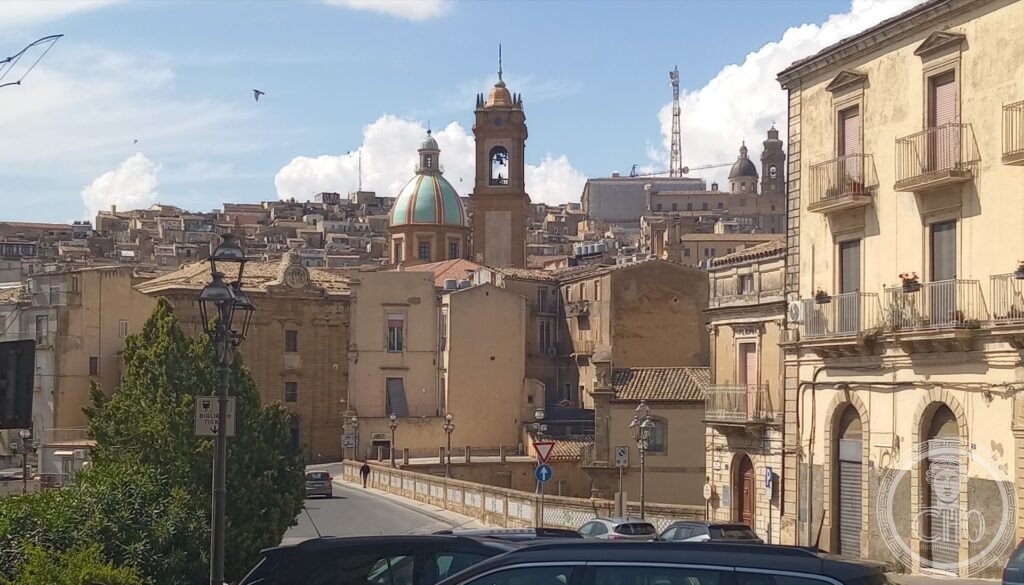
Caltagirone — the “city of ceramics” of Sicily, whose pottery tradition stretches from Greek colonial workshops of the 6th century BCE through Arab-Norman lustre-ware to the contemporary production of the 120+ ceramic workshops currently operating on its streets — was rebuilt in Baroque style after the 1693 earthquake on the same hill-town plan it had occupied since the Arab period, and placed at the end of the 142-step staircase of Santa Maria del Monte a tiled programme of hand-painted ceramic panels that is now the most photographed ceramic monument in Italy.
At a glance
Caltagirone (province of Catania, Sicilia; UNESCO 2002, ref. 1024) is one of eight cities in the serial inscription “Late Baroque Towns of the Val di Noto.” Caltagirone is singular among the eight for two reasons: (1) it has a living, commercially active artisanal ceramics tradition (the 120+ ceramic workshops on Via Roma and Via Vittorio Emanuele make it the largest ceramics production centre in Sicily); and (2) the Scalinata di Santa Maria del Monte — the 142-step ceremonial staircase connecting the lower city (with the Piazza Umberto I) to the upper city (with the church of Santa Maria del Monte) — is lined with hand-painted ceramic panels on each stair riser, creating a tiled polychrome programme that makes the staircase itself an ensemble of ceramic art. The staircase is illuminated with candles during the Festa di San Giacomo (July 24-25), creating one of the most spectacular festival scenes in Sicily.
Key facts
- La Scalinata di Santa Maria del Monte (142 gradini maiolica): The staircase was built in the 17th century — the stone structure dates from 1608 — as the main ceremonial access route from the Piazza Umberto I to the Church of Santa Maria del Monte at the top of the hill. The ceramic panels on the stair risers, the “alzate”, were progressively added and replaced over the 18th, 19th, and 20th centuries, and each of the 142 stair risers has a different hand-painted majolica panel with a distinct decorative motif: geometric, floral, figurative, or architectural. The current programme is not a single unified design from one period but an accumulated palimpsest of different ceramic styles and dates, from the 18th century to the 1950s restorations. The total width of the staircase is approximately 12 m, and the height difference between base and summit is approximately 36 m
- La tradizione ceramica di Caltagirone (VI sec. a.C. – oggi): The Caltagirone ceramics tradition is documented from the 6th century BCE (Greek colonial pottery workshops) through the Arab period (10th-11th century, which introduced the tin-glazed earthenware lustre technique), the Norman period, and the continuous production from the 16th century to the present; the characteristic Caltagirone style uses a white tin-glaze ground with blue, yellow, green, and manganese-brown overglaze painting in floral and figurative patterns; the local clay (the “creta” of Caltagirone) has particular plasticity and thermal properties that make it ideal for the tin-glaze technique; the Museo della Ceramica (in the Giardino Pubblico) has the definitive collection of production from the Greek period to the 20th century
- La Festa di San Giacomo (24-25 luglio): On the evening of July 24 (the vigil of the feast of St. James the Apostle, patron of Caltagirone), the 142 steps of the staircase are decorated with approximately 4,500 oil lamps in coloured glass (mosaico di fuoco = “fire mosaic”) arranged in figurative patterns that change year by year; the illumination is a tradition documented from the 17th century; the 2024 pattern covered the full height of the staircase
- UNESCO: 2002, ref. 1024
- GPS: 37.2397, 14.5150 — Google Maps (Scalinata di Santa Maria del Monte, Caltagirone)
History
Caltagirone (from the Arabic “Qal’at al-Ghiran” = “castle of the ceramic vessels”) was founded as an Arab hilltop settlement; the name itself records the pre-Arab ceramic tradition of the site. The Norman conquest (late 11th century) maintained and expanded the ceramics industry; the Aragonese administration (15th-17th century) built the civic staircase and organized the ceramicists’ guild (the “Arte dei Figuli,” documented from the 15th century). The earthquake of January 11, 1693 destroyed the upper city; the rebuilding (1693-1750) was primarily of civic and church buildings in the Baroque style, leaving the ceramics industry physically concentrated in the lower city workshops. The municipal museum (opened 1906) systematized the documentation of the tradition; the designation of Caltagirone as a UNESCO city in 2002 boosted tourism and ceramics sales significantly.
What you see
The Caltagirone visit is organized around two poles: the Scalinata (lower Piazza Umberto I, the base; Church of Santa Maria del Monte, the summit) and the ceramic workshop street (Via Roma and Via Vittorio Emanuele, running parallel to the staircase on the western side of the hill). Start at the Piazza Umberto I (with the Baroque Duomo di San Giuliano and the Palazzo Senatorio); climb the Scalinata (allow 15 min for the full ascent, with pauses to examine the individual ceramic panels on each riser); visit the Church of Santa Maria del Monte (interior open mornings; 18th-century stucco altar); descend via Via Roma (where approximately 60% of the active ceramic workshops are concentrated, with production visible in progress in many shops) to the Museo della Ceramica (in the Giardino Pubblico, open Tuesday-Sunday 09:00-18:00, ~€4, the most comprehensive overview of the production tradition). Allow 3-4 hours.
Gallery
Practical information
- Scalinata di Santa Maria del Monte: Piazza Umberto I / Via Luigi Sturzo, Caltagirone; always open and freely accessible; the steps are steep (use the handrail on the right side for the ascent); the Church of Santa Maria del Monte (at the top) is open daily 09:00-12:30 and 16:30-18:30; the staircase is best photographed from the bottom in the late afternoon (south-facing, optimal light).
- Museo della Ceramica di Caltagirone: Via Roma (Giardino Pubblico), Caltagirone; open Tuesday-Sunday 09:00-18:00 (winter) and 09:00-19:00 (summer); closed Monday; admission ~€4 (combined ticket with the Museo Civico available).
- Ceramic workshops: The largest concentration is on Via Roma and Via Pittore Vaccaro (adjacent to the staircase); most shops are open Monday-Saturday 09:00-13:00 and 15:30-19:30; summer hours extended; prices range from €5-8 for small decorative tiles to €200-1000+ for large decorative amphoras.
Getting there
Scalinata di Santa Maria del Monte, Piazza Umberto I, Caltagirone (CT), Sicilia. GPS 37.2397, 14.5150. By train: Trenitalia from Catania (1h, Catania-Gela line, limited frequency); from Gela (45 min). The Caltagirone train station is on the edge of the lower city; the Scalinata is 15 min on foot. By car: from Catania, SS385 (55 km, 1h); from Ragusa, SP66/SS194 (55 km, 1h); from Siracusa, SS194 (75 km, 1h15). Parking available in Piazza Progresso (near the Scalinata base).
Nearby
- Militello in Val di Catania — 20 km north; (CHO card: Militello UNESCO 2002); the smallest of the 8 Val di Noto cities, with the Sacrestia Intagliata di Santa Maria della Stella (the most complete Baroque wooden sacristy in rural Sicily)
- Ragusa Ibla — 50 km south-west; (CHO card: Ragusa Ibla UNESCO 2002); Gagliardi’s San Giorgio (the most architecturally significant of the Val di Noto churches) + the Giardino Ibleo
- Villa Romana del Casale — 25 km west (Piazza Armerina); the late Roman imperial hunting villa (3rd-4th century CE) with the most extensive Roman floor mosaic programme surviving in the world (3,500 m² of polychrome mosaic, including the “Bikini Girls” mosaic in the gymnasium); UNESCO 1997
Sources
- UNESCO: whc.unesco.org/en/list/1024
- Wikipedia EN: Caltagirone
- Museo della Ceramica di Caltagirone: museocaltagirone.it
- La Scalinata di Santa Maria del Monte: Comune di Caltagirone, comune.caltagirone.ct.it
Find it on the map
See this place and what’s around it →📷 Become a Cultural Heritage Online photographer
Share your photos of places: they stay published under your name as the author. The more they're seen, the more you get noticed — and soon a contest will reward the most appreciated photos.
Log in or sign up free to add a photo