

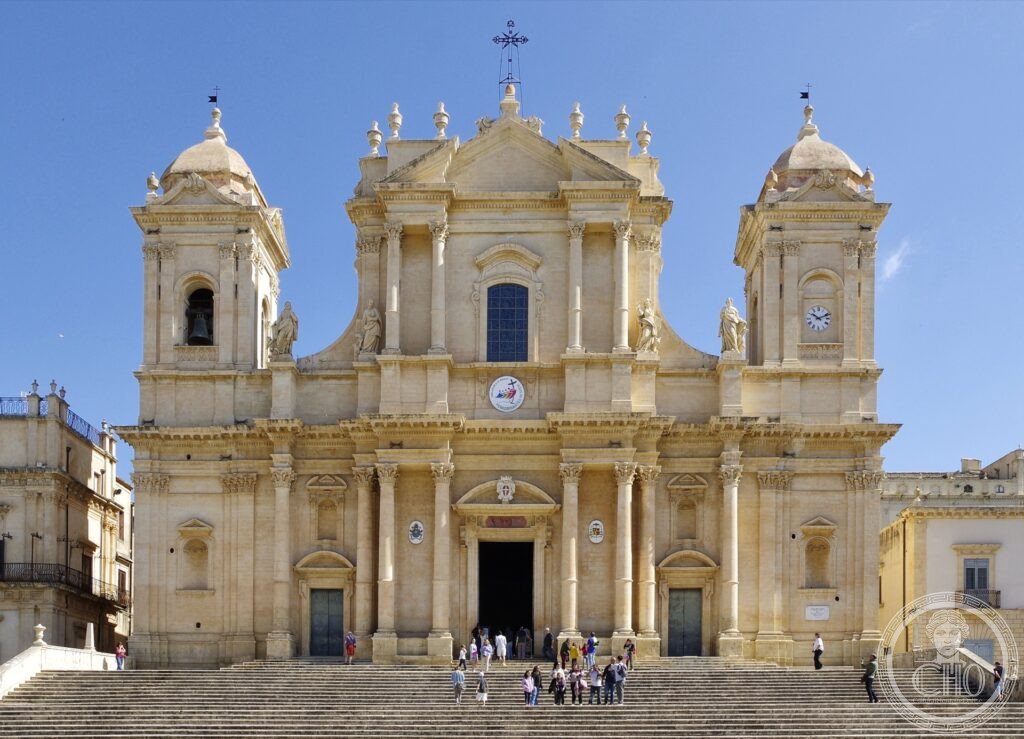
Noto. The “capital” of the Late Baroque Val di Noto inscription and the city most consistently described as the finest Baroque town in Sicily. Was not rebuilt on the ruins of the old city after the 1693 earthquake but was deliberately relocated 8 km to the south, on a new site chosen for its defensive position and its level topography. The result is the only major Sicilian city whose entire 18th-century street plan, building volumes, and architectural vocabulary were designed as a unified ensemble from the ground up, making Noto the closest European approximation to a Baroque ideal city built in practice.
At a glance
Noto (province of Syracuse, Sicilia; UNESCO 2002, ref. 1024) is one of eight cities in the serial inscription “Late Baroque Towns of the Val di Noto.” Noto holds a unique position within the inscription for the comprehensiveness and coherence of its Baroque urban planning: the entire city was built new between 1693 and c.1776 on a site 8 km from the destroyed “Noto Antica” (Old Noto), with a regular three-tier street plan that rises up the hillside in horizontal terraces connected by ceremonial staircases, and with a visual axis along the Corso Vittorio Emanuele that terminates at the Palazzo Ducezio (Town Hall) to the east and opens to panoramic views of the Syracuse plain to the west. The key architects of Noto. Rosario Gagliardi (designer of the San Giorgio facades in both Noto and Ragusa Ibla), Paolo Labisi, and Vincenzo Sinatra. Shared a single design language that produces the visual unity of the city’s palaces, churches, and piazze.
Key facts
- Il Duomo di San Nicolò (iniziato 1703, facciata completata 1776, crollo 1996, restauro 2007): The Cathedral of San Nicola is the most photographed Baroque building in Sicily: a three-bay facade with twin bell towers (not completed as planned), a double staircase at the entrance, and a broad stepped pediment that rises 40 m above the Piazza Municipio. The interior was entirely rebuilt after the collapse of the dome in March 1996 (which destroyed the apse and the crossing). The dome and interior were restored and reopened in 2007. The interior (3 naves, 18 columns with composite capitals) is simpler than the exterior suggests, focusing attention on the light entering from the restored dome.
- Palazzo Villadorata / Palazzo Nicolaci (1737, arch. Vincenzo Sinatra): The Palazzo Nicolaci di Villadorata (Via Corrado Nicolaci, off the Corso) is the most ornate secular Baroque building in Noto: the street-level story has 12 balcony corbels (mensole) carved with alternating fantastical figures (monsters, mermaids, winged horses, centaurs, lions with human faces) in a programme of sculptural invention that is more concentrated than anything in Ragusa or Modica. The palace was the residence of the Nicolaci princes of Villadorata (one of the wealthiest noble families of 18th-century Noto). The first floor is partially open to visitors (check local tourist office for current access).
- La Via Corrado Nicolaci (Infiorata di Noto): The Via Corrado Nicolaci (the street below the Palazzo Nicolaci) is famous for the Infiorata di Noto (held the third Sunday of May): one of the oldest and most elaborate flower-carpet festivals in Italy, in which the entire length of the street (approximately 180 m) is covered with patterns of cut flowers (approximately 350,000 flower petals are used) arranged in pictorial compositions that change year by year. The tradition began in 1980.
- Noto Antica (sito abbandonato, XIV sec. – 1693): The site of the medieval “Old Noto”. Abandoned after 1693 when the population relocated to the new site. Is a ruined archaeological zone on the Monte Alveria plateau (8 km north-west of modern Noto): the ruins of the medieval town, the Norman castle, the churches, and the massive late 16th-century fortifications (built during the Spanish period) are still visible. The site is accessible by car and on foot (no infrastructure). The romantic ruin landscape is a significant complement to the manicured Baroque of the new city.
- UNESCO: 2002, ref. 1024.
- GPS: 36.8907, 15.0674. Google Maps (Duomo di San Nicolò, Noto).
History
Noto Antica (Old Noto) was a significant Byzantine and Arab-Norman town on the Monte Alveria plateau, known in the Arab period as “Noto” or “Noto al-Quds” (Noto the Holy, from the Arab period 9th-11th century). It survived the Angevin, Aragonese, and Spanish periods. In 1693 the earthquake of January 11 destroyed it almost entirely. The decision NOT to rebuild on the same site was taken by Giannettino Landolina (the Spanish commissioner sent to oversee recovery): he selected a new site 8 km to the south-east, at a lower altitude on the edge of the valley, arguing it had better defensibility, better access routes, and better climate. The new city was laid out on a three-tier plan (the lower corso for civic buildings, the middle level for churches, the upper level for convents) and was substantially complete by 1776 (the date of the completion of the Duomo facade). The collapse of the Duomo dome in 1996. A structural failure due to deferred maintenance. Became the catalyst for a comprehensive restoration of the entire Baroque fabric, completed between 1998 and 2007.
What you see
The Noto Baroque circuit follows the Corso Vittorio Emanuele from west to east (45-90 min, plus museum stops): the Piazza Immacolata (west end; the Church of San Francesco d’Assisi with its restrained Baroque facade). The Piazza Municipio (central; the Duomo di San Nicolò on the north side, the Palazzo Ducezio/Town Hall opposite — go inside for the gilded Sala degli Specchi if open). Then detour left on Via Corrado Nicolaci for the Palazzo Nicolaci/Villadorata (the balcony corbel monsters are on the south facade, best seen from across the street). Back to the Corso. The Piazza XVI Maggio (east; the church of San Domenico with the concave Baroque facade). The Porta Reale (east gate). For the panoramic view: the Belvedere di Noto (10 min walk east of the Porta Reale) gives the classic view of the Duomo dome and the city silhouette against the sea horizon (on clear days Ortigia/Siracusa is visible 30 km south-east).
Gallery
Practical information
- Duomo di San Nicolò: Piazza Municipio, Noto. Open daily 09:00-12:30 and 16:00-19:00 (summer to 20:00). Free entry. The Museo del Palazzo Vescovile (attached, with diocesan collection) has separate admission (~€3).
- Palazzo Nicolaci di Villadorata: Via Corrado Nicolaci 18, Noto. The balcony corbels are visible from the street at any time (free). The first floor interior has irregular opening hours. Check with the Noto tourist office (Piazza XVI Maggio) or book in advance (Associazione Amici della Villa Orsini, who manage access). Admission ~€5 if open.
- Noto Antica (ruins): Contrada Noto Antica, 8 km north-west of Noto. No infrastructure. Access by car from the SS287 (turn at the Noto Antica sign). Best visited with the free walking guide published by the Riserva Naturale di Noto Antica.
Getting there
Duomo di San Nicolò, Piazza Municipio, Noto (SR), Sicilia. GPS 36.8907, 15.0674. By train: Trenitalia from Siracusa (30 min, frequent). From Catania (1h30, change at Siracusa). Noto station is on the southern edge of town, 15 min on foot to the Duomo along Via Principe di Piemonte. By car: from Siracusa, A18/SR287 (31 km, 35 min). From Ragusa, SS115 (73 km, 1h10). From Catania, A18/SR287 (100 km, 1h30).
Nearby
- Siracusa. 31 km north. (CHO card: Siracusa UNESCO 2005). The Greek theatre (5th century BCE), the Roman amphitheatre, the Ortigia Baroque waterfront, and the Museo Archeologico Paolo Orsi (the best Greek-Sicilian archaeological museum in the world).
- Vendicari Nature Reserve. 12 km south-east. The coastal lagoon nature reserve (area protetta regionale) with flamingos, migratory birds, and the ruins of a Byzantine tuna-processing plant (tonnara). Accessed from the beach road south of Noto.
- Modica. 50 km west. (CHO card: Modica UNESCO 2002). Gagliardi’s San Giorgio + the 250-step staircase + the Modica chocolate workshops (Aztec method, 16th century tradition).
Sources
- UNESCO: whc.unesco.org/en/list/1024.
- Wikipedia EN: Noto, Sicily.
- Tobriner, Stephen: The Genesis of Noto: An Eighteenth-Century Sicilian City, University of California Press, 1982.
- Comune di Noto: comune.noto.sr.it.
Find it on the map
See this place and what’s around it →📷 Become a Cultural Heritage Online photographer
Share your photos of places: they stay published under your name as the author. The more they're seen, the more you get noticed — and soon a contest will reward the most appreciated photos.
Log in or sign up free to add a photo