
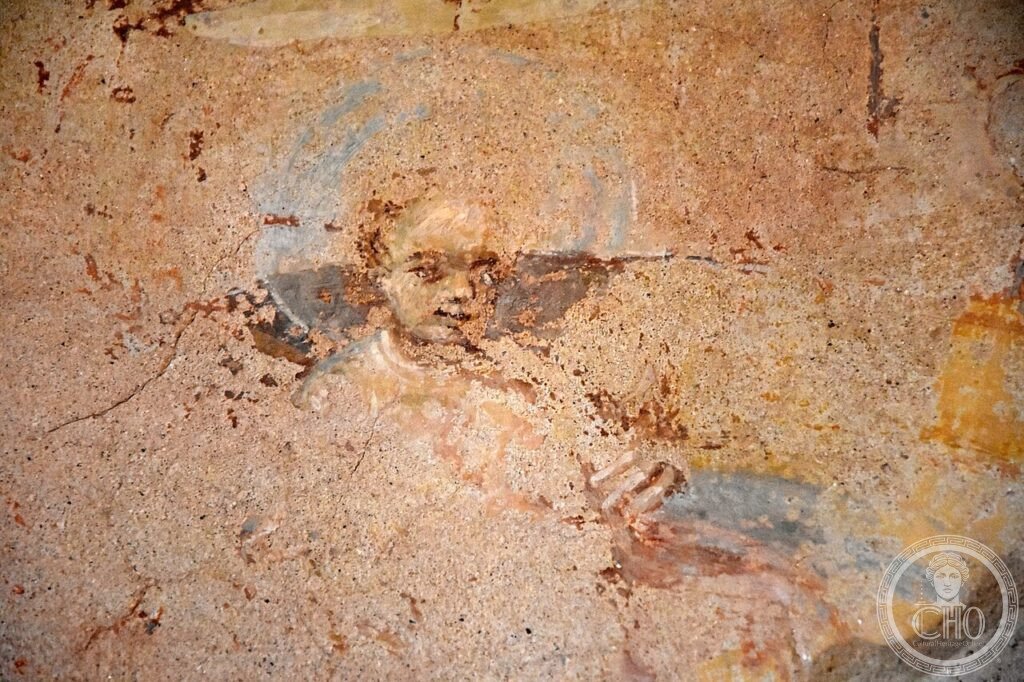
A small brick church in a wood outside Varese holds the most puzzling paintings in early medieval Europe. The frescoes of Santa Maria foris Portas were found in 1944 under a layer of lime, and eighty years later scholars still cannot agree on when they were made: the proposals run from the seventh century to the tenth. What is not in dispute is the hand. The painter modelled faces and drapery with light and shadow, freehand, in a manner with no close parallel in surviving Western painting of the period.
At a glance
Castelseprio was inscribed in 2011 as one of seven components of the serial UNESCO property Longobards in Italy: Places of Power (568–774 AD), reference 1318. The site has two parts, about six hundred metres apart. The archaeological park occupies the hill where the fortified town of Castrum Seprium stood until Milan destroyed it in 1287; below and outside its walls stands the church of Santa Maria foris Portas, whose name means simply “outside the gates”. A short walk east, the Monastero di Torba grew inside a late Roman watchtower and is today owned and opened to the public by FAI, the Italian national trust.
Key facts
- The frescoes of Santa Maria foris Portas. The apse and the triumphal arch carry a cycle of scenes from the childhood of Christ: the Annunciation, the Visitation, the Nativity, the journey and the adoration of the Magi, the Presentation in the Temple, the Flight into Egypt. They were uncovered in 1944, when plaster was stripped from the walls of a building then used as a store, and were first published in 1948 by Gian Piero Bognetti and his collaborators in the monograph Santa Maria di Castelseprio.
- A date nobody agrees on. Proposed datings have ranged across three centuries, from the late seventh to the tenth. The argument turns on style rather than documents: there is no foundation charter, and the graffiti and painted layers give only relative sequences. The cycle is usually discussed as Lombard or early Carolingian work by a painter formed in the Hellenistic and Byzantine tradition of the eastern Mediterranean, but the identification remains an argument, not a conclusion.
- The Monastero di Torba. A watchtower of the late Roman defensive line, built around the fifth century, was taken over in the eighth century by a community of Benedictine nuns. The upper floor of the tower keeps a painted wall with a row of standing nuns, several of them named in the inscriptions beside them — an unusually direct record of early medieval female monastic life. The complex was restored by FAI and opened as a museum.
- The end of the town, 1287. Castrum Seprium was one of the fortified towns of the Seprio, on the road from Milan towards Lake Maggiore and the Alpine passes. Milan destroyed it in 1287 and forbade its rebuilding; the population moved down to the valley. The hilltop was never reoccupied, which is why the plan of the town survives in the ground.
- Where things are. Santa Maria foris Portas: 45.7298° N, 8.8559° E. Monastero di Torba: 45.7295° N, 8.8636° E — about 600 m east of the church. Coordinates from OpenStreetMap.
History
The hill above the Olona was fortified in the late Roman period, part of the system that watched the roads coming down from the Alps towards Milan. The tower at Torba belongs to that system. After the Lombard conquest of northern Italy in 568 the castrum became the centre of the Seprio, a district governed for the king by a local officer, and it kept that role through the Carolingian period that followed the Frankish conquest of 774.
Santa Maria foris Portas was built outside the walls in this Lombard and Carolingian world; the church is small, of brick, with three apses set in a trefoil around the eastern end. The tower at Torba was converted to monastic use in the eighth century and the nuns painted its upper room. In 1287 Milan, under Ottone Visconti, took and destroyed the town; the church and the tower survived because they stood outside it. The frescoes were covered with lime at some later point, and that covering is why they are still here.
What you see
The church is plain from outside: brick walls, a trefoil of three shallow apses, a doorway rebuilt in the Romanesque period. The interior is one room, and the frescoes are in the apse straight ahead of the door. The Annunciation on the arch is the most legible single scene; the rest of the cycle runs around the curve of the apse wall. The light is natural, so the surface reads very differently at different hours — morning raking light shows the modelling that makes these paintings famous.
On the hill above, the archaeological park keeps the outline of the town: the circuit of walls with its towers, the foundations of the basilica of San Giovanni Evangelista, the streets. At Torba, the tower can be entered and climbed to the painted room; the small church at its base has further early medieval painting, and FAI has replanted the garden.
Gallery
Practical information
The archaeological park and the church are administered by the Italian ministry of culture through the regional museum authority for Lombardy; the Monastero di Torba is a FAI property with its own opening times and admission. The two are visited separately, and their calendars do not always coincide — check both before travelling, since seasonal hours change and the church is sometimes opened only for guided visits.
- Parco archeologico di Castelseprio, including Santa Maria foris Portas: Via Castelvecchio, Castelseprio (VA).
- Monastero di Torba (FAI): Via Stazione 2, Gornate Olona (VA) — fondoambiente.it.
- Photography: flash is not allowed on the frescoes.
- Time needed: allow half a day for both, with the walk between them.
Getting there
Castelseprio lies between Varese and Gallarate, west of the Olona. By car it is reached from the A8 Milan–Varese motorway, leaving at Solbiate Arno and following the local roads for a few kilometres; there is parking at the edge of the park. By train, the nearest stations are on the Varese and Gallarate lines, with a local bus or taxi for the last stretch; Sunday bus service is sparse. Malpensa airport is about twenty kilometres to the south.
Nearby
- Sacro Monte di Varese — about 15 km north. A devotional way of chapels climbing the hillside above Varese, inscribed by UNESCO in 2003 as one of the Sacri Monti of Piedmont and Lombardy.
- Santa Giulia, Brescia — the nearest other component of the same Lombard serial property, with the monastery of San Salvatore and the Desiderius cross.
- Lake Maggiore — about 25 km north-west, with the Borromean islands.
Sources
- UNESCO World Heritage Centre: whc.unesco.org/en/list/1318.
- Bognetti, G. P., Chierici, G., de Capitani d’Arzago, A., Santa Maria di Castelseprio, Milan, 1948.
- FAI — Monastero di Torba: fondoambiente.it.
- Coordinates: OpenStreetMap contributors, ODbL.
Find it on the map
See this place and what’s around it →📷 Become a Cultural Heritage Online photographer
Share your photos of places: they stay published under your name as the author. The more they're seen, the more you get noticed — and soon a contest will reward the most appreciated photos.
Log in or sign up free to add a photoIs this page about you?
This page is read by travellers and heritage enthusiasts who find it on Google. Tell us how you are connected to this place and we will take it from there.