

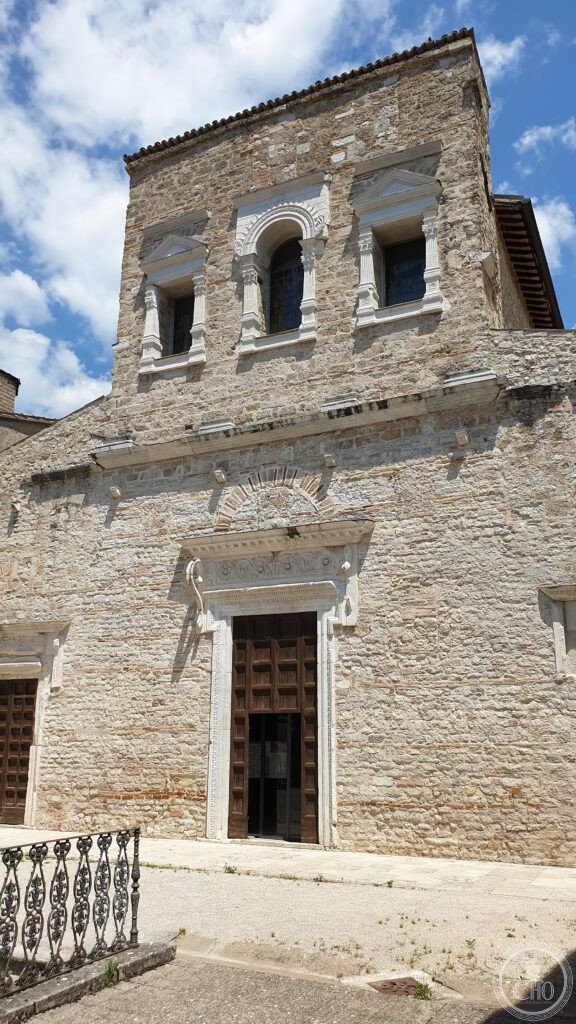
The Basilica di San Salvatore is one of the oldest surviving churches in Umbria, its Roman columns and capitals reused inside a building later reshaped by the Lombard dukes who made Spoleto the capital of their southern duchy.
At a glance
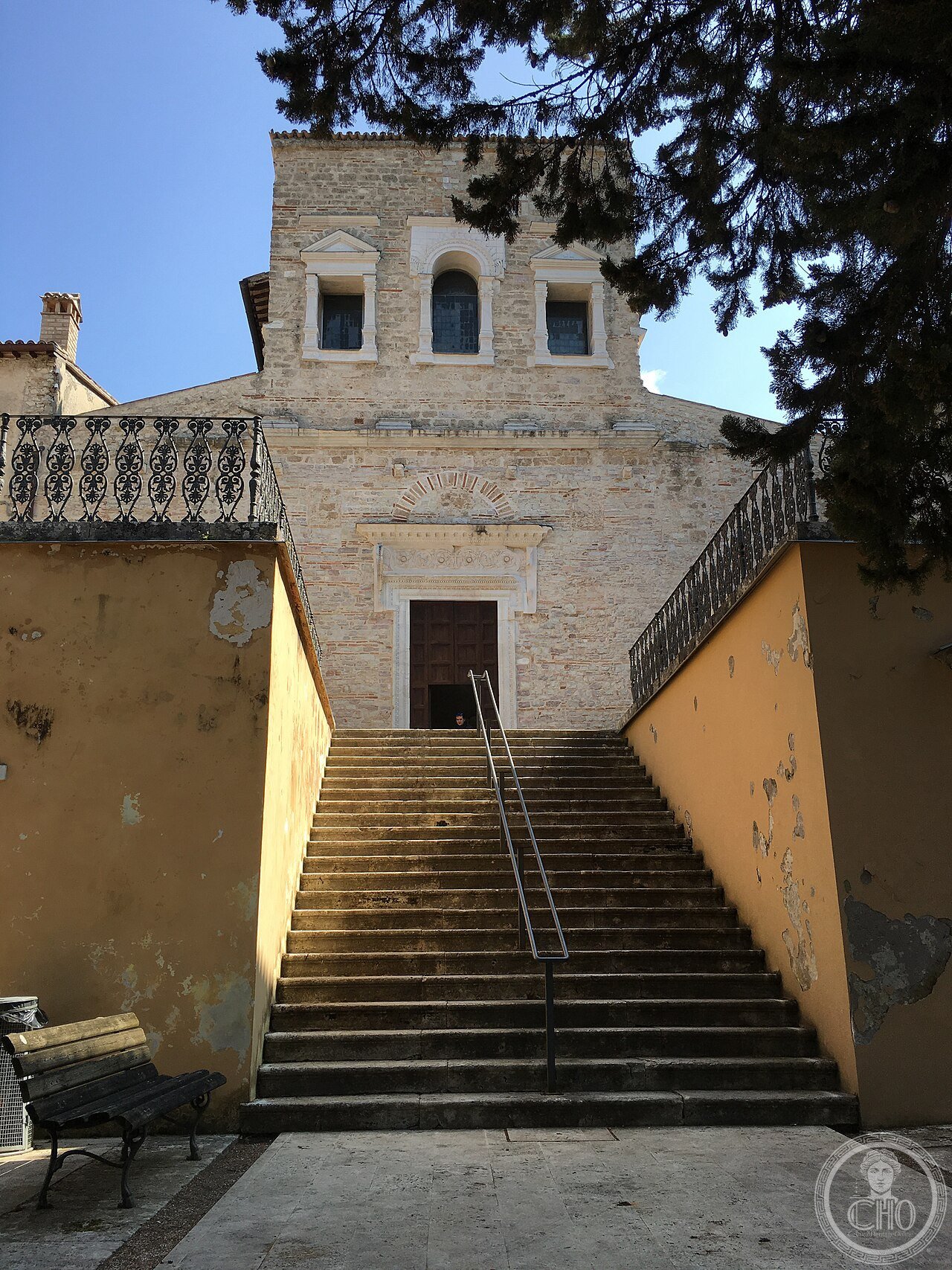
The Basilica di San Salvatore stands in Spoleto as a rare survival of a late Roman basilica converted into a Christian church without major structural change. Its tripartite façade, three portals and paired windows reflect the three-aisled plan inside, while four Roman columns at the crossing and a Lombard apse and narthex show two building phases layered onto one another.
Key facts
- Location: Via della Basilica di San Salvatore, Spoleto, Umbria
- Founded: 4th–5th century CE, as a Christian basilica built with reused Roman material
- Later works: 8th-century CE remodelling under the Lombard Duchy of Spoleto
- Notable features: four cipollino marble columns with Corinthian capitals, a Lombard apse and narthex, carved interlace decoration on the lateral portals
- Recognition: included in 2011 in the UNESCO serial inscription ‘Longobards in Italy. Places of Power’ (reference 1318)
History
Spoleto began as a Roman colony founded in 241 BCE, and traces of that city survive in the arch of Drusus, a Roman theatre and an amphitheatre later reused by the Lombards. The Basilica di San Salvatore was built either in the mid-4th century, under Pope Julius I, or in the early 5th century, during the reign of Theodosius II; the question remains open, though the masonry technique and the reused Flavian-Trajanic columns and capitals point architectural analysis toward a 4th-century nave.
In the 8th century the church was remodelled by the Lombards, who had made Spoleto the capital of their duchy after Alboin’s forces occupied the city around 570 CE under the first duke, Faroald I. The duchy at its height covered the whole of Umbria and parts of the Marche and Lazio, ruled from the fortress hill above the city. Charters surviving in the Archivio Capitolare of Spoleto Cathedral, dated between 655 and 774 CE, record donations of land and churches by Lombard nobles. The duchy submitted to Frankish rule under Charlemagne in 774 CE but continued under Frankish dukes until 900 CE, when it became a march of the Holy Roman Empire. The Lombards rebuilt the apse, added the two lateral portals in local grey limestone with carved interlace ornament, and replaced the narthex with the barrel-vaulted structure that survives today. The name of the abbot who oversaw this work is not recorded, and only fragments remain of the frescoes added at this time, including traces of a Christ in Majesty on the apse walls.
What you see
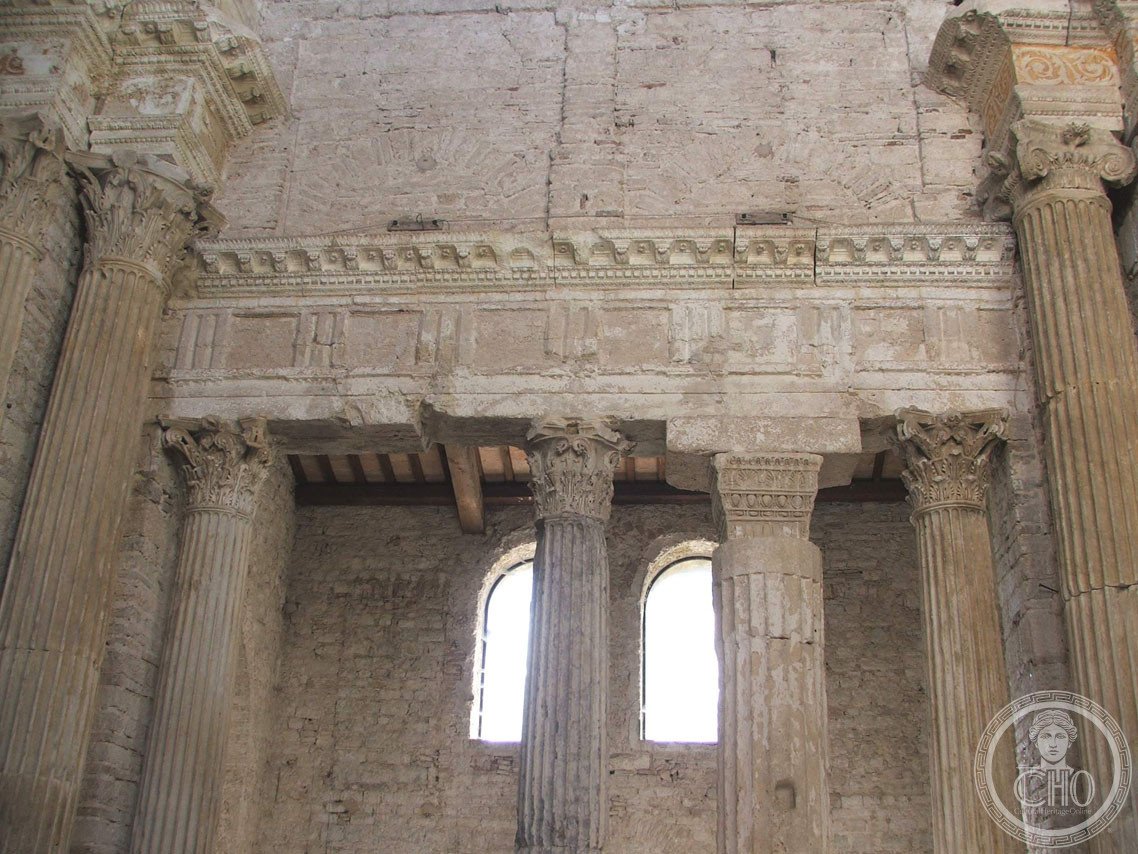
The interior is divided into a nave and two lower side aisles, following the three-part division visible on the façade. At the crossing stand four columns in grey cipollino marble from Euboea, each about 5.5 metres tall, topped with Corinthian capitals carved with deeply undercut acanthus leaves and dated to the late 1st or early 2nd century CE. Their quality is comparable to capitals from the imperial palaces on Rome’s Palatine Hill. Standing at the back of the nave and looking toward the apse allows the visitor to take in the full sequence of Roman and Lombard work in a single view.
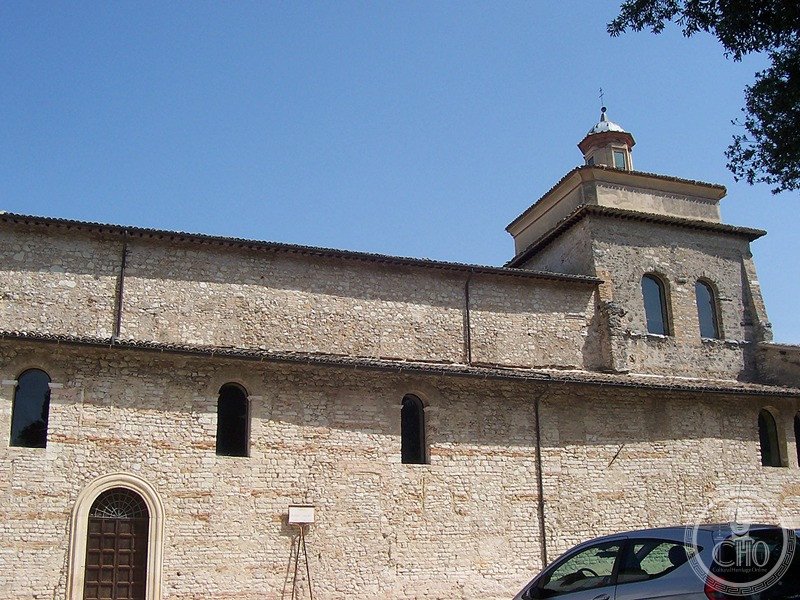
Beneath the nave lies a crypt with six Lombard columns, plain and without capitals, and wall niches that once held the burials of monks; three of these still contain fragments of limestone sarcophagi. Traces of 8th- or 9th-century frescoes survive on the crypt vault, showing part of a Christ Pantocrator composition, though seeing them in full requires a specific request to the regional heritage authority. On the exterior, the scar of the original semicircular Roman apse, replaced by the lower and narrower Lombard one, is visible on the south wall.
A short uphill walk leads to the Rocca Albornoziana, the fortress built above the city, which now houses the Museo Nazionale del Ducato di Spoleto. Its lapidary room holds Lombard inscriptions from the 8th century, along with fibulae and belt fittings recovered from graves near the basilica.
Practical information
- Access: the church can usually be visited free of charge; a custodian can arrange entry to the crypt on request, and current opening arrangements should be checked with the site or the Soprintendenza dell’Umbria before visiting
- Nearby museum: the Museo Nazionale del Ducato di Spoleto at the Rocca Albornoziana charges its own admission, which should also be confirmed locally
- On site: allow time to look closely at the crossing capitals and the exterior apse scar, both easily missed on a quick visit
Getting there
Spoleto is served by regional and direct rail connections from Rome, with the station a short walk, aided by an escalator, from the historic centre where the basilica stands. Details of timetables and fares are best checked directly with Trenitalia.
Nearby
- Rocca Albornoziana — about 15 minutes uphill on foot, a 14th-century fortress housing the Museo Nazionale del Ducato di Spoleto and its Lombard lapidary
- Spoleto Cathedral — in the historic centre, with a Romanesque façade and a rose window, and an apse mosaic by Filippo Lippi from 1481–82
- Church of San Pietro fuori le mura — a Lombard-era foundation of the 6th to 8th century with a 12th-century sculpted façade showing Lombard-influenced interlace reliefs
- Arch of Drusus — a Roman arch of 23 CE still standing in Piazza del Mercato in the centre of Spoleto
Sources
- Soprintendenza dell’Umbria
- Archivio Capitolare della Cattedrale di Spoleto
- UNESCO
Gallery
Find it on the map
See this place and what’s around it →📷 Become a Cultural Heritage Online photographer
Share your photos of places: they stay published under your name as the author. The more they're seen, the more you get noticed — and soon a contest will reward the most appreciated photos.
Log in or sign up free to add a photo