Castel del Monte
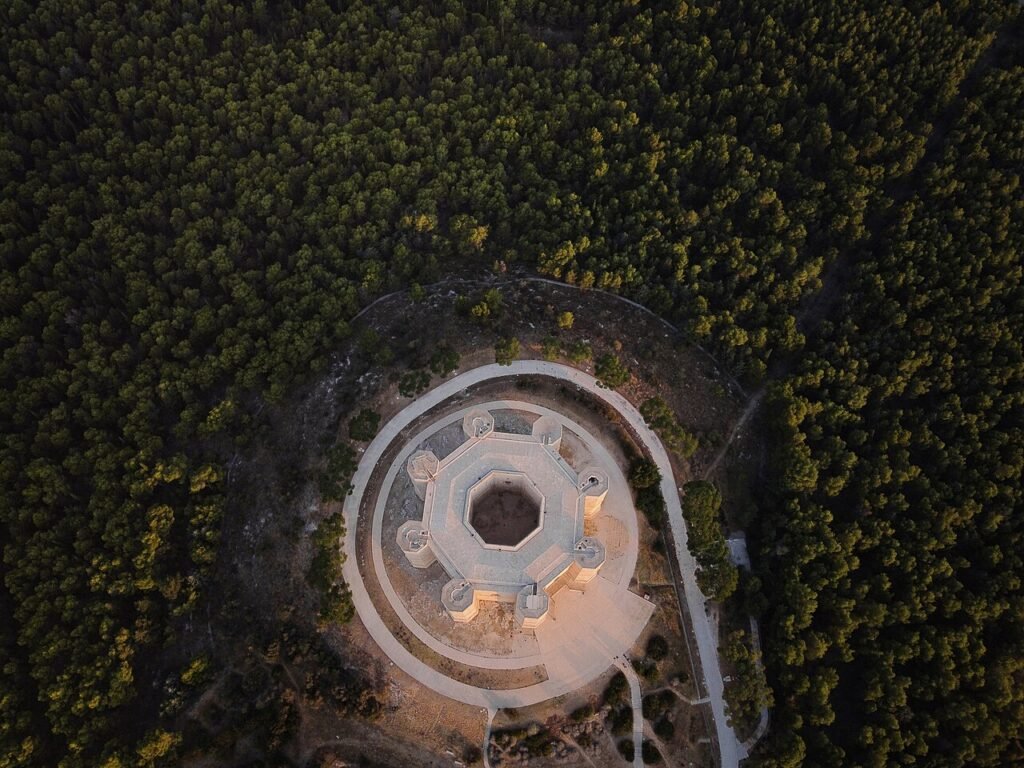
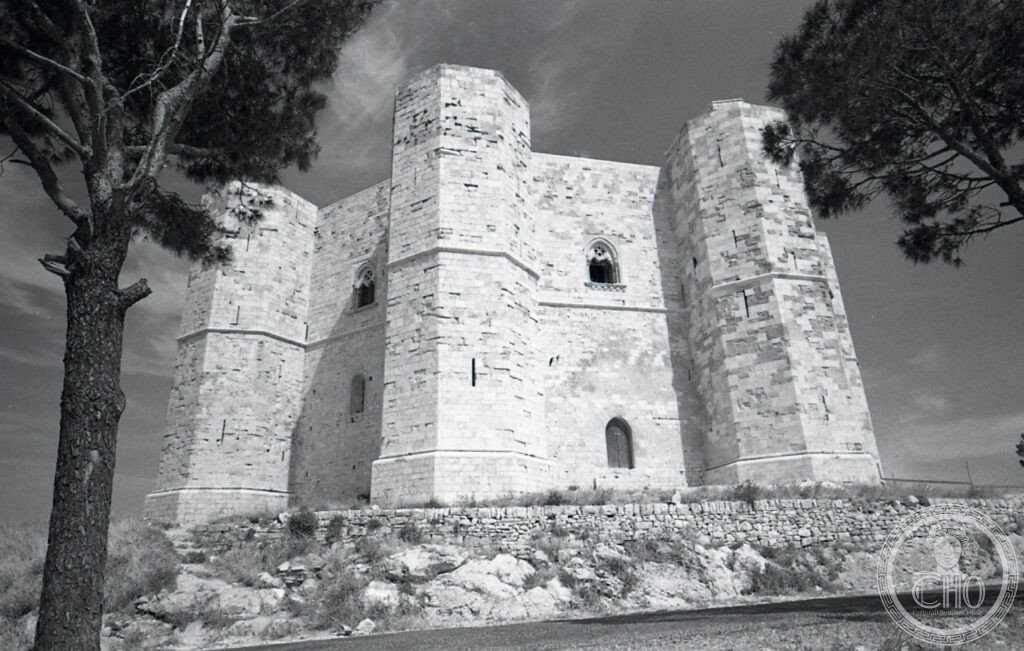
Castel del Monte (UNESCO 1996) is the most intellectually complex building erected by the medieval Holy Roman Emperor Frederick II — a perfectly regular octagon with octagonal towers built c.1240 CE in the Apulian highlands with no military function (no moat, no drawbridge, no garrison), whose geometry embeds Roman, Gothic, and Arab architectural elements in a single mathematical programme that remains the most studied example of 13th-century imperial architectural symbolism.
At a glance
Castel del Monte (the most precisely CastelDelMonte single Andria Puglia Italy 41.0847 N 16.2705 E UNESCO WHS 1996 reference 788: the building programme: built c.1240 CE (first documentary reference: a 1240 CE imperial decree ordering the delivery of lead for the roof); the architect is unknown (no name survives in any document; the technical mastery of the mathematical geometry — 3 nested regular octagons; the integration of Roman vault techniques, Gothic pointed arches, and Arab muqarnas corbels — suggests a figure with direct experience of all three traditions (the most likely candidate: a member of the cosmopolitan court of Frederick II, which included German, French, Italian, Arab, and Byzantine scholars)); the geometry: the outer octagon (the main castle body): 8 sides × 16.5m = 132m total perimeter; side angle: 135° (the interior angle of a regular octagon); 8 towers at each vertex (also regular octagons; 5.1m side length); the inner octagon (the central courtyard): 17.7m face-to-face; the 8 trapezoidal rooms (the spaces between the two octagons are divided by internal walls into 8 trapezoidal rooms on each of the 2 floors — 16 rooms total); the height (the outer walls rise to 26m; the towers rise 3m higher to 29m; the whole silhouette from a distance reads as a single geometric form on the Apulian plateau)); the astronomical alignment (the most debated feature of the castle): at the summer solstice (June 21), the shadow of the east tower falls exactly across the entrance portal — a solar alignment that could only have been deliberate in a building designed with such geometric precision; at the winter solstice (December 21), a light shaft enters through the north-east window and falls on the north wall of the main hall in a specific position; the interpretation: the castle was designed as an astronomical instrument as well as a residence, expressing Frederick II’s specific interest in astronomy (he corresponded with Arab astronomers; he commissioned the first Latin translation of astronomical texts from Arabic; the Imperial Falconer (Michael Scot, court astrologer and polymath, 1175–1232 CE) was a member of the imperial court).
Key facts
- Frederick II (1194–1250 CE) and why Castel del Monte is the most explicit architectural expression of his imperial ideology: Frederick II (Stupor Mundi — “The Wonder of the World” — the epithet given him by contemporaries, both admirers and enemies; Holy Roman Emperor (from 1220 CE); King of Sicily (from 1198 CE as a 4-year-old ward of Pope Innocent III); King of Jerusalem (1225 CE, by marriage; 1229 CE by crusade — the only crusader who took Jerusalem without fighting, by negotiating a 10-year treaty with the Egyptian Sultan Al-Kamil that gave the Christians Jerusalem, Bethlehem, and Nazareth in exchange for a Christian-Islamic shared sovereignty over the holy places)); the specific context of the Castel del Monte commission: Frederick II built or rebuilt at least 200 castles in the Kingdom of Sicily (approximately 150 in mainland southern Italy and 50 in Sicily); the Castel del Monte was NOT the most militarily important (the Castel Ursino in Catania and the Castello di Lagopesole were more strategically significant); the Castel del Monte was the most symbolically significant: the octagonal form, the astronomical alignments, the three architectural traditions (Roman structural technique, Gothic ornament, Arab mathematical planning), and the isolation on a hilltop with no military purpose all suggest that this building was designed as a statement — of imperial power, universal knowledge, and divine legitimacy — rather than as a functioning military structure; the specific symbolism of the octagon: the number 8 was the number of the resurrection (the 8th day = the day beyond the 7-day week; the first day of the new creation in Christian numerology); the 8-sided baptistery tradition (every bishop’s baptistery in the Roman West was octagonal) meant that an octagonal building was inherently associated with rebirth, royalty, and divine sanction; Frederick II was claiming, in stone, that his empire was as sacred as baptism
- GPS: 41.0847° N, 16.2705° E
History
From Frederick II’s 1240 commission to the Bourbon prison to 1996 UNESCO (the most precisely CastelDelMonte single 1240 CE construction: the construction timeline: the 1240 CE imperial order for lead is the earliest documentary reference; the castle was likely complete by 1249 CE (Frederick II died 1250 CE; the castle is mentioned as a hunting lodge in a 1249 document from the imperial chancery)); Frederick II and Apulia (Frederick II had a specific relationship with Apulia: he was born in Jesi (near Ancona) but was raised in Palermo; he died at Fiorentino (near Lucera) in Puglia; Castel del Monte was his preferred autumn residence (the Apulian highlands (the Murge plateau at 400–500m altitude) were the best falconry territory in southern Italy; Frederick II wrote “De arte venandi cum avibus” (On the Art of Hunting with Birds, 1244 CE) — the most important medieval treatise on falconry; it is also one of the most important scientific works of the 13th century (Frederick observed animal behavior directly and critically, rejecting Aristotle where his own observations contradicted the ancient authority)); after Frederick II (the castle passed to his son Manfred (reigned 1258–1266 CE); then to the Angevin dynasty (after 1266 CE); then to the Aragonese (after 1442 CE); the Aragonese used the castle as a prison for the heirs of the Apulian nobles who opposed the Aragonese conquest; the Bourbon period (the Spanish-Bourbon kings of Naples used the castle as a hunting reserve in the 18th century); 1876 CE the Italian state acquired the castle from the Bourbon heirs; 1938 CE the first restoration (Mussolini-era restoration that removed the accumulated debris from the interior rooms); 1996 CE UNESCO inscription reference 788.
What you see
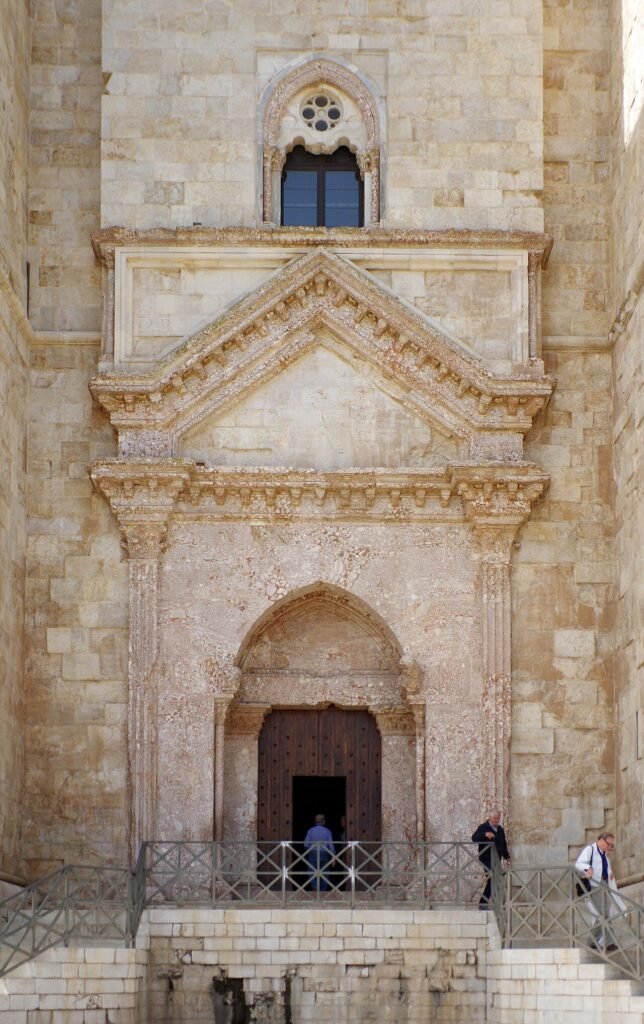
The exterior geometry, the 8 trapezoidal rooms, the Carrara marble portal, and the courtyard (the most precisely CastelDelMonte single visit (1.5–2 hours; the shuttle bus from the parking area is required (the parking lot is 2.5 km from the castle; the shuttle bus runs every 20 min; €2); admission: €5 (MiC; Ministero della Cultura; the ticket includes the shuttle bus)); 1) the approach (the shuttle bus stops on the flank of the Murge plateau; the first view of the castle from 1.5 km away: the specific visual effect of a perfect geometric form isolated on a hilltop against the Apulian plain is striking — there is no other building within visible range (the castle is the only structure on the plateau)); 2) the entrance portal (the main portal on the east face; the only Carrara marble element in the castle (all other stone is the local Apulian limestone (calcarenite)); the portal: two half-columns supporting a pointed arch with a frieze of Roman-style acanthus carving; the specific detail: the column capitals are Corinthian but with unusual proportions (the volutes are larger than in classical Corinthian) — the suggestion of a craftsman trained in the Romanesque tradition attempting classical Corinthian)); 3) the courtyard (the central octagonal courtyard; the surface is hard-packed soil (the original paving — marble or limestone? — was removed in the medieval or early modern period; traces of stair supports on the courtyard walls show that the interior could be accessed from the courtyard at both floor levels via external stairs); the summer solstice shadow (best observed on June 21 at approximately 11:30 AM local time — the east tower shadow falls exactly on the portal); 4) the trapezoidal rooms (8 rooms per floor; the floor plan is the same on both floors; each room has: a ribbed Gothic vault (pointed arches in the local calcarenite); 1–2 Gothic double-lancet windows (bifore); a marble column at the center of the room supporting the vault; a fireplace in the north or west rooms (evidence of 13th-century fireplaces); a latrine alcove in the tower angles (the tower rooms contain latrines — the most technically advanced sanitary provision in a 13th-century European castle; the latrines discharge through the tower walls via chutes)).
Practical information
- Getting to Castel del Monte from Bari or Andria and combining with the other Apulian UNESCO sites: transport from Bari: Bari→Andria by Ferrotramviaria (the local rail line; every 30 min; 45 min; €3); Andria→Castel del Monte by shuttle bus (the Ferrotramviaria operates a castle shuttle from Andria station on weekends and holidays; 30 min; €6 round trip; book at trenitalia.com; the shuttle is NOT available on weekdays (the castle is not easily accessible without a car on weekdays)); by car: the A14 autostrada (Bari→Andria exit; 50 km; 45 min) + SP170 from Andria to the castle parking (15 km; 20 min); the castle opening hours: daily 9 AM–7 PM (summer) / 9 AM–6 PM (winter); the UNESCO circuit (combining Castel del Monte with the other Apulian UNESCO sites): Castel del Monte (UNESCO 1996); Alberobello trulli (UNESCO 1996; 60 km south; the trulli are the conical-roof dry-stone houses of the Valle d’Itria; best in the Rione Monti quarter); Matera Sassi (UNESCO 1993; 80 km south of Alberobello; the cave-dwelling city); the 3-site circuit requires 2 days with a car
Getting there
Bari→Andria (Ferrotramviaria, 45 min, €3) + shuttle bus Andria→castle (weekends/holidays, 30 min, €6 RT, book trenitalia.com). By car: A14 exit Andria + SP170 (15 km). Open daily 9-19 (summer). Admission €5. GPS: 41.0847, 16.2705.
Nearby
- Alberobello — 60 km south (UNESCO WHS 1996; the trulli (conical limestone dry-stone houses; the Rione Monti quarter has 1,030 intact trulli; the most visited single neighborhood in Puglia); Trenitalia from Bari (1h30))
- Trani Cathedral — 25 km northeast (the most dramatic location of any Italian cathedral: the Romanesque Trani Cathedral (begun 1099 CE; the apse faces the Adriatic sea directly; at sunset, the Apulian limestone turns deep amber and the shadow of the campanile falls into the sea))
Gallery


Sources
- Wikipedia, Castel del Monte, Apulia; Frederick II, Holy Roman Emperor; Michael Scot, accessed June 2026
- UNESCO, Castel del Monte, WHS reference 788, inscribed 1996
- Götze, Heinz. Castel del Monte: Geometric Marvel of the Middle Ages. Munich: Prestel, 1998
Find it on the map
See this place and what’s around it →📷 Diventa un fotografo di Cultural Heritage Online
Condividi le tue foto dei luoghi: restano pubblicate con la tua firma come autore. Più vengono viste, più ti fai conoscere — e presto un concorso premierà le foto più apprezzate.
Accedi o registrati gratis per aggiungere una foto