Verona

Verona Arena Roman amphitheater Opera festival Romeo Juliet Scaligeri Castelvecchio Veneto Italy UNESCO 2000
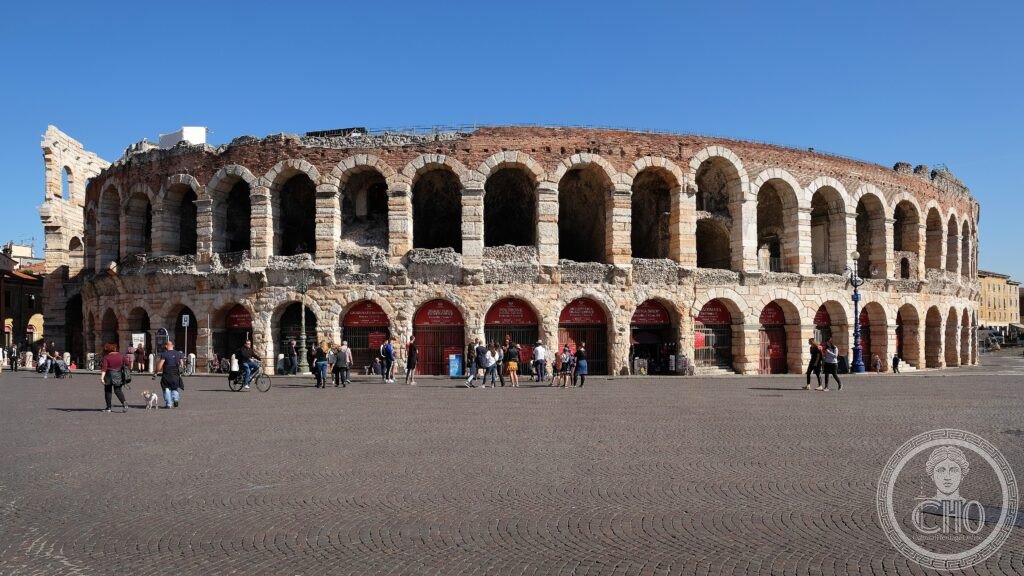
Arena di Verona (the Roman amphitheatre; Piazza Bra, Verona, Province of Verona, Veneto, Italy): the exterior view from the Piazza Bra (the 44 pink Verona limestone arches of the surviving outer wall facing north — the 4 arches of the “ala” (the wing: the only surviving fragment of the original outer wall) visible in the upper right; the elliptical plan (139m × 110m; capacity: originally 30,000 spectators; the current seating plan for the Opera Festival: 14,000 seats); the Arena was built in the 1st century CE (c.30 BCE–30 CE; the Augustan construction date is based on the stone type and the construction technique comparison with the Colosseum (70–80 CE) and the Amphitheatre of Capua (2nd century CE)); the Arena is the third-largest surviving Roman amphitheater in Italy (after the Colosseum 188m × 156m and the Amphitheatre of Capua 170m × 139m)). UNESCO World Heritage Site 2000 (reference 797). Photo via Wikimedia Commons.
Verona, Province of Verona, Veneto, Italy · Roman (Augustan era), medieval (Scaligeri dynasty 1262–1387 CE), Venetian (1405–1797 CE); Arena c.30 BCE; Romeo & Juliet (Shakespeare 1597, set here); UNESCO WHS 2000 (ref 797)

Verona

Verona (UNESCO 2000) is Italy’s best-preserved layered historic city — where a 1st-century BCE Roman theatre and the third-largest surviving amphitheater in Italy occupy the same center as the Scaligeri dynasty’s 14th-century fortified tombs, the Venetian Republic’s loggia and walls, and the specific location where Shakespeare’s Romeo and Juliet is set, making it simultaneously a site of 1st-century CE, 14th-century, and early modern European literary memory.

At a glance

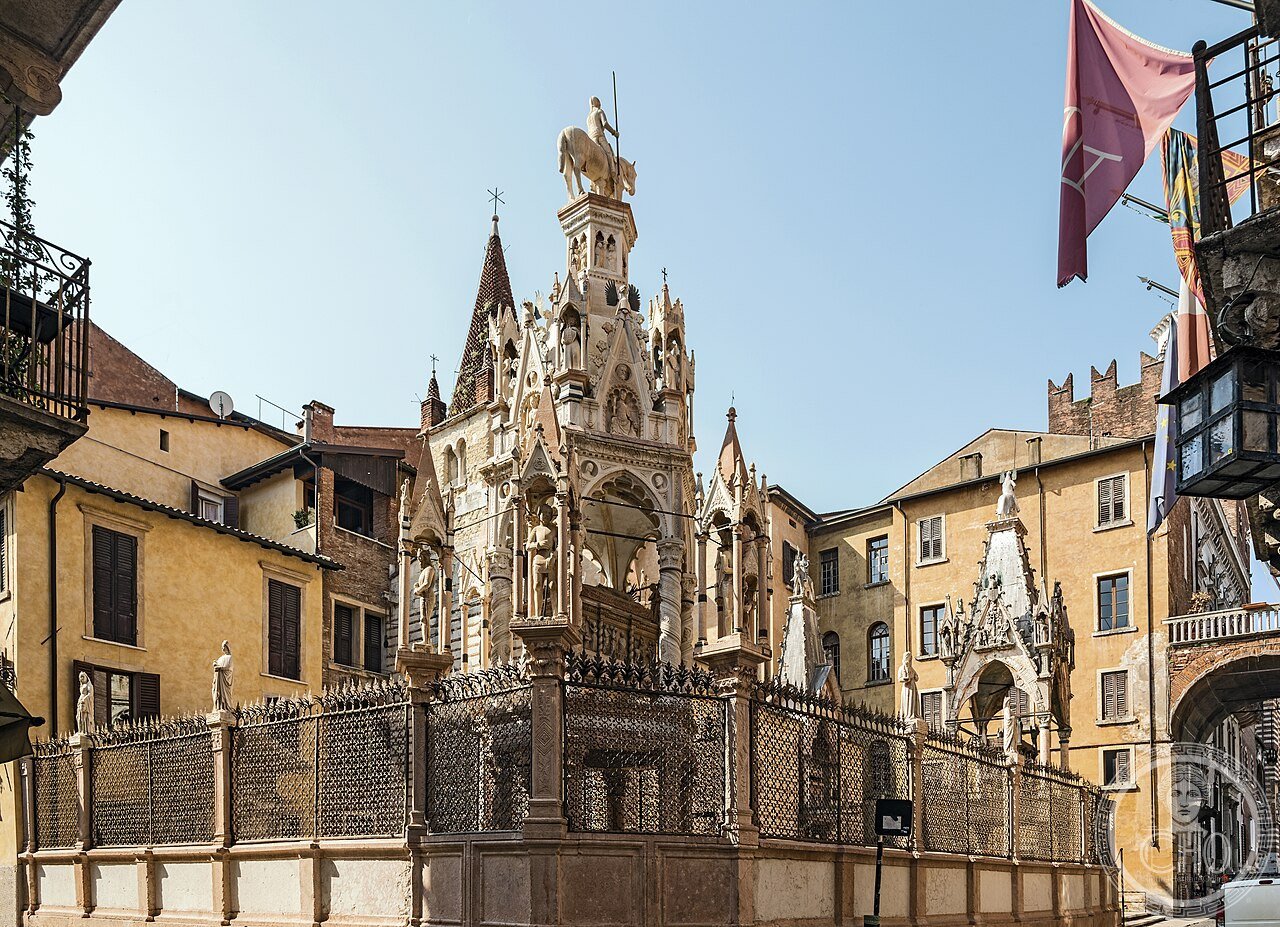
Verona (the most precisely Verona zone Veneto Italy 45.4384 N 10.9916 E UNESCO WHS 2000 reference 797: the historical layers: Roman (Verona was a Roman municipium from 89 BCE and a colony from 49 BCE; the major surviving Roman monuments: the Arena di Verona (amphitheatre, 1st century CE), the Teatro Romano (theatre, 1st century BCE; on the north bank of the Adige), the Porta Borsari (the main Roman gate; 1st century CE), the Arco dei Gavi (the most elegant 1st-century CE honorific arch in northern Italy; originally spanning the decumanus maximus; dismantled in 1805 CE by Napoleon’s troops; reconstructed 1932 CE in the courtyard of the Castelvecchio)); the Scaligeri period (the Scaligeri (della Scala) family ruled Verona from 1262 CE to 1387 CE: (1) Cangrande I della Scala (1291–1329 CE; the greatest Scaligeri ruler; the patron of Dante (Dante dedicated the Paradiso to Cangrande and died in Ravenna in 1321 CE while in Cangrande’s political orbit); the equestrian statue of Cangrande (c.1330 CE; the original is in the Castelvecchio Museum; the copy on the sarcophagus tomb is on the facade of S. Maria Antica); (2) the Arche Scaligere (the fortified family tombs in the piazza adjacent to S. Maria Antica (the Scaligeri family church); the 3 principal tombs: Cangrande I (died 1329), Mastino II (died 1351), Cansignorio (died 1375); the Cansignorio tomb (the most elaborate: a 2-level Gothic canopy with 5 equestrian statues on the upper level — the most complex funerary monument in 14th-century Italy)); the Venetian period (Verona was part of the Venetian Republic from 1405 CE to 1797 CE (the Napoleonic conquest); the major Venetian contribution: the Loggia del Consiglio (1476–1493 CE; the most beautiful Venetian Renaissance civic building outside Venice; the facade of the loggia was designed by Giovanni Giocondo (Fra Giocondo; 1433–1515 CE; the architect who worked on Saint Peter’s Basilica in Rome and designed the Pont Notre-Dame in Paris)); Romeo and Juliet (Shakespeare’s Romeo and Juliet (1597 CE) is set in Verona (Shakespeare never visited Italy; the story derives from Luigi Da Porto’s novella “Historia novellamente ritrovata di due nobili amanti” (1530 CE) and Matteo Bandello’s version (1554 CE); the “Juliet’s balcony” (Casa di Giulietta; Via Cappello 23) is a 14th-century house associated with the Cappello (Capulet) family by a 19th-century literary tradition; the balcony itself was added to the building in 1936 CE to meet tourist expectations — it has no medieval historical authenticity; nonetheless, 1.5 million visitors per year touch the bronze Juliet statue in the courtyard)).

Key facts

  • The Arena di Verona Opera Festival and why it is the largest open-air opera venue in the world: the Arena di Verona Opera Festival (first edition: 1913 CE; the occasion: the centenary of the birth of Giuseppe Verdi (born 1813 CE in Le Roncole, near Parma)); the scale: 14,000 seats (the current seating plan; the original Roman capacity was 30,000); 50–60 performances per season (June–September); the specific operational challenge: the 14,000-seat open-air venue has no permanent stage (the stage is built from scaffolding and dismantled each season); no amplification (the natural acoustic of the stone amphitheater amplifies the singers’ voices without electronic assistance — the same acoustic that allowed 30,000 Romans to hear gladiatorial announcements in the 1st century CE); no roof (the performance continues regardless of weather; audience members bring umbrellas; only lightning stops a performance (the 45-minute rain delay rule: if rain stops for 45 minutes, the performance continues)); the traditional candle lighting (the tradition of the audience bringing small candles (the “lumini”) to the Arena dates from the 1913 inaugural season; the effect of 14,000 candles lit simultaneously at the opening of each performance is the most famous audience ritual in opera); the most frequently performed operas: Verdi’s Aida (the most performed work in Arena history; first staged 1913 CE; the specific production challenge: the 4th act temple scene requires 400+ extras, 2 live horses, and occasionally live elephants — the production scale that no conventional opera house could accommodate)
  • GPS (Arena): 45.4384° N, 10.9916° E

History

From the 89 BCE Roman municipium to the Scaligeri to the Venetian Republic to 2000 UNESCO (the most precisely Verona zone Roman period: Verona (Veronenses in the Roman spelling; the -ona suffix suggests a pre-Roman, probably Celtic, settlement before the Roman occupation); the strategic importance (Verona controlled the Adige river crossing and the road from Rome to the Alps (the Via Postumia, opened 148 BCE, ran through Verona on its way from Genua to Aquileia — the most important road in Roman northern Italy until the Via Aemilia)); the Arena (the amphitheatre was built as a permanent structure for the gladiatorial games and animal hunts (venationes) that replaced the temporary wooden amphitheatres of the Roman Republic; the precise construction date: the comparison of the Arena’s opus mixtum (alternating brick and stone construction) with the Amphitheatre of Capua and the Colosseum places it in the Augustan–Flavian period (30 BCE–90 CE); the specific limestone: the pink Verona marble (breccia di Verona; technically a limestone breccia, not a marble; the specific quarries at Sant’Ambrogio di Valpolicella north of Verona); the outer wall (the original outer wall was demolished at an unknown date (the medieval urban fabric of Verona was built directly against the Arena exterior, using the Arena wall as a convenient building platform; the demolition of the outer wall allowed the medieval houses to be built closer to the amphitheatre; only the “ala” — 4 arches of the outer wall — survived because it was isolated at the north end)); the Scaligeri period (Cangrande I della Scala; Dante’s patron; the Arche Scaligere; the Castelvecchio fortress (1354–1376 CE; the most important Scaligeri military work; the crenellated walls, the drawbridge over the Adige, and the Torre del Mastio are all Scaligeri works; the Castelvecchio Museum (Carlo Scarpa renovation 1957–1964 CE; the most important museum design in postwar Italy)); the Venetian period (1405–1797 CE; the Venetian contributions: the Loggia del Consiglio (1476–1493 CE); the Palazzo della Ragione; the Lion of St Mark above the Arco della Costa in the Piazza delle Erbe)); 2000 CE UNESCO inscription reference 797.

What you see

The Arena, the Arche Scaligere, the Castelvecchio Scarpa renovation, and the Piazza delle Erbe (the most precisely Verona zone visit (full day; the historic center is walkable)): the Piazza Bra circuit (the Arena di Verona (Piazza Bra; open daily 10 AM–6 PM (non-performance days), 10 AM–3:30 PM (performance days); admission €10; the interior seating is original Roman stone (the steps are worn smooth by 2,000 years of spectators)); the Piazza delle Erbe (the central piazza; the site of the Roman forum (the column of the Madonna in the center is on the exact spot of the Roman forum rostra (the speaker’s platform)); the market stalls (the daily produce and tourist market); the Palazzo Maffei (17th century); the Arco della Costa (the arch connecting the Piazza delle Erbe to the Piazza dei Signori; the whale rib (costa) suspended from the arch keystone — a 17th-century folklore tradition; the rib was said to fall on the first truly honest person who passed beneath it); the Piazza dei Signori / Dante (the civic center; the equestrian statue of Dante in the center (the Dante statue was placed here in 1865 CE — Verona’s claim to Dante’s connection via Cangrande); the Loggia del Consiglio facing the piazza)); the Arche Scaligere (the fortified family tombs; free to view from the street (the enclosure is locked; interior visits organized by the Museum); the Castelvecchio Museum (Corso Castelvecchio 2; €6; Carlo Scarpa’s 1957–1964 renovation — the most important Italian museum design of the postwar period: Scarpa exposed the layers of the building (medieval, Napoleonic, WWII) and created new connections between the interior spaces using poured concrete bridges and steel platforms; the Cangrande equestrian statue in the Scarpa installation (displayed at eye level on a cantilevered concrete plinth, not in the conventional raised position) is the most published object in the museum)).

Practical information

  • Attending the Arena Opera Festival and combining with the Verona Wine Fair (Vinitaly): the Opera Festival (June–September; season program at arena.it; ticket prices: €23 (unreserved stone seating — the “anfiteatro non numerato” — bring a cushion) to €220 (numbered seats in the central stalls); the booking advice: book 3–6 months in advance for Aida, Nabucco, or Turandot (the most popular productions sell out months ahead); for less-known productions (I Pagliacci, Roméo et Juliette) tickets are available 1–2 weeks in advance; bring: a folding cushion (the stone seats are hard); a warm layer (temperatures drop after 11 PM even in August); the lumini (small candles are sold at the entrance for €1; the tradition is to light them during the interval or at the specific moment when the conductor appears))); the Vinitaly wine fair (April; veronafiere.it; the world’s largest wine trade fair (4,000+ exhibitors, 80,000 visitors); the consumer day (Vinitaly and the City; Sunday of the fair week; open to non-trade visitors); the Valpolicella wine circuit (north of Verona; Amarone della Valpolicella DOCG (the most complex red wine of Veneto; the appassimento process (the grapes are dried 90–120 days before pressing; the resulting wine is 14–16% alcohol with a cherry-dark-chocolate flavor profile)); Soave DOCG (white; east of Verona; the Castelsoave (13th-century castle) rises above the vine slopes))

Getting there

Frecciarossa from Milan (1h15, €15-30) or Venice (1h10, €12-25). Airport: Verona Villafranca (Aeroporto Catullo, 12 km, bus every 20 min). Historic center walkable. Arena: Piazza Bra. Opera tickets at arena.it. GPS: 45.4384, 10.9916.

Nearby

  • Lago di Garda — 30 km west (the largest lake in Italy; 50 km long; 17 km wide; the western shore: Salò, Gardone Riviera (Vittoriale degli Italiani — Gabriele D’Annunzio’s estate museum; the MAS torpedo boat + the Puglia warship + the Schifamondo villa garden); the eastern shore: Lazise, Bardolino, Garda town (the specific wine: Bardolino DOC + Lugana DOC (from the southern Garda lakeside vineyards))
  • Mantova e Sabbioneta — 50 km southwest (UNESCO WHS 2008; Gonzaga dynasty Renaissance city (Palazzo Ducale + Camera degli Sposi Mantegna frescoes + Palazzo Te by Giulio Romano); Trenitalia from Verona 45 min)

Sources

  • Wikipedia, Verona; Arena di Verona; Cangrande I della Scala; Castelvecchio Museum; Carlo Scarpa, accessed June 2026
  • UNESCO, Verona, WHS reference 797, inscribed 2000
  • Los, Sergio. Carlo Scarpa. Cologne: Taschen, 1994

Hero image: Verona, Veneto, Italy, Wikimedia Commons. Editorial text © Cultural Heritage Online, 2026.

📷 Diventa un fotografo di Cultural Heritage Online

Condividi le tue foto dei luoghi: restano pubblicate con la tua firma come autore. Più vengono viste, più ti fai conoscere — e presto un concorso premierà le foto più apprezzate.

Accedi o registrati gratis per aggiungere una foto
📋 Copy & share on social
Scroll to Top