
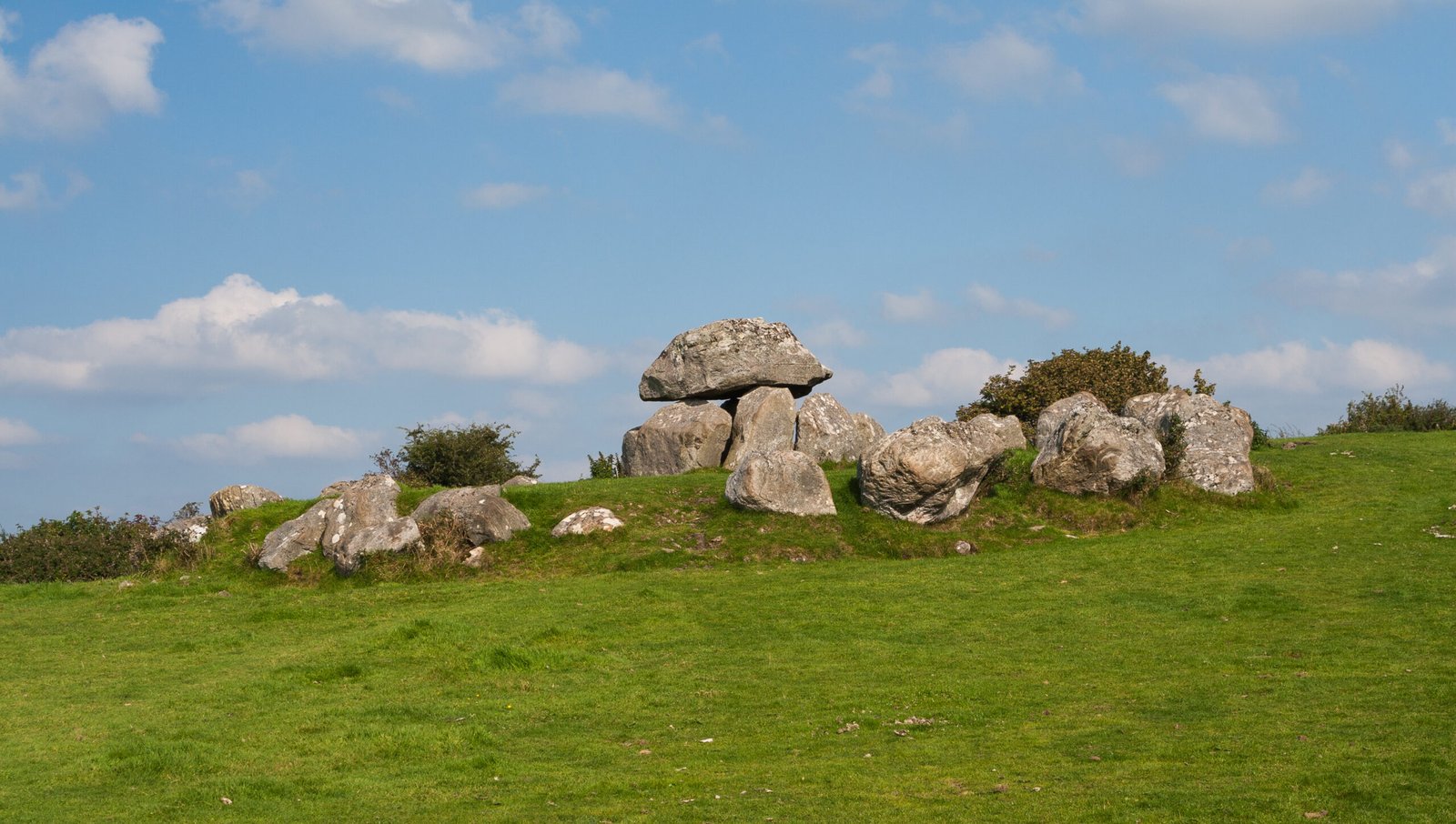
The largest concentration of megalithic tombs in Ireland and possibly the oldest megalithic cemetery in Europe, Carrowmore is a Neolithic ritual landscape of roughly 60 surviving stone monuments on a ridge overlooking Sligo Bay, within sight of Knocknarea.
At a glance
Carrowmore occupies a low limestone ridge in County Sligo, northwestern Ireland, where approximately 60 megalithic tombs survive within a radius of one kilometre. Radiocarbon dates from cremated bone in tomb deposits have suggested construction as early as c. 5400 BC, which would make Carrowmore among the earliest stone-built ceremonial complexes in the world — predating Newgrange by over two millennia. Each tomb follows a consistent pattern: a small polygonal dolmen chamber at the centre, surrounded by a ring of large glacial erratic boulders. The central tomb (No. 51) is the largest and is encircled by smaller satellite tombs, creating a ritual landscape that anticipates the organisation of later Irish passage tomb complexes. Carrowmore is now a national monument managed by Ireland’s Heritage Service and is open to visitors year-round.
Key facts
- Location: County Sligo, northwestern Ireland, near Sligo town
- Earliest dates: Radiocarbon dates of c. 5400–4700 BC (cremated bone deposits); construction debated by some scholars as 4000–3700 BC
- Number of monuments: Approximately 60 surviving tombs (originally 100+; many destroyed in the 19th century)
- Monument type: Megalithic passage tombs and dolmen chambers with boulder rings
- Central tomb: Tomb No. 51, the largest monument at the site
- Nearest landmark: Knocknarea mountain (3 km west), traditionally associated with the grave of Queen Medb
- Status: National Monument; managed by the Office of Public Works / Heritage Service
History
The question of when Carrowmore was built is one of the most debated in Irish prehistoric archaeology. Radiocarbon analysis of cremated human bone from tomb chambers has produced dates as early as 5400–4700 BC — which, if valid, would place Carrowmore’s first phase of construction at the very threshold of the Neolithic in Europe, roughly contemporary with early farming in the Balkans and predating the pyramid age in Egypt by three thousand years. Critics of these early dates argue that contamination from old organic material (the “old wood effect”) inflated the results and that the main construction phase falls closer to 4000–3700 BC, which still makes Carrowmore one of the oldest megalithic complexes in Ireland and western Europe.
What is clear is that Carrowmore was a communal cremation cemetery. The tombs are not elite monuments in the way the great passage tombs of the Boyne Valley are — they lack the astronomical orientations, carved stone art, and restricted access corridors that characterise later Irish megalithic tradition. They are instead relatively simple structures: collective deposits of cremated bone beneath boulder-ringed dolmen chambers, implying a phase of megalithic practice that was less hierarchical, less politically organised, and perhaps more widely distributed across Neolithic communities than what followed. Carrowmore may represent the earliest stratum of an Irish megalithic tradition that culminated, several centuries later, in the great passage tombs at Newgrange, Knowth, and Dowth in the Boyne Valley.
By the early 19th century, intensive agriculture and land improvement had already destroyed more than 40 monuments; later surveys found only about 60 intact. Systematic excavation began in the 1970s under the direction of Göran Burenhult, whose work produced both the contested early radiocarbon dates and a comprehensive record of the tomb structures and their contents. Burenhult’s seasons of excavation, combined with more recent investigations, have made Carrowmore one of the best-documented megalithic complexes in Ireland.
What you see
A typical Carrowmore tomb consists of three elements: a central chamber, a surrounding boulder circle, and the original earthen mound (now largely eroded). The chamber is a small polygonal structure built from five to seven upright stone slabs (orthostats) supporting a capstone, forming a space roughly two metres across — large enough for the deposit of cremated remains but not for the elaborate approach corridor of classic passage tombs. Around the chamber, a ring of large glacially deposited boulders (often limestone or gneiss) demarcates the sacred space; these rings typically measure 15 to 20 metres in diameter. Tomb No. 51, at the centre of the cemetery, is larger than the others and has been interpreted as the focal monument around which the satellite tombs were arranged. Looking west from the tombs on a clear day, Knocknarea mountain dominates the horizon; the large cairn on its summit, known as Miosgan Medhbha, is traditionally identified as the grave of the legendary Queen Medb of Connacht, though it has never been fully excavated.
The visitor centre at the site, managed by the Office of Public Works, provides interpretive material about the tombs and the broader megalithic landscape of County Sligo, which includes Knocknarea cairn, Creevykeel court tomb, and the passage tomb complex on Carrowkeel mountain to the south. The combination of these monuments within a single county makes Sligo one of the densest concentrations of Neolithic ritual architecture in Europe.
Practical information
- Open: Daily, year-round; visitor centre open seasonally (May–October)
- Admission: Small fee for the visitor centre; open site accessible free outside visitor centre hours
- Guided tours: Available from Heritage Service during the season
- Facilities: Visitor centre, toilets, small exhibition
- Dogs: Permitted on leads
- Accessibility: Parts of the site accessible by wheelchair; some monuments on uneven ground
Getting there
Carrowmore is located approximately 3 km west of Sligo town centre, signposted from the N4 and N17 roads. By car from Sligo: take the R292 towards Strandhill; the site entrance is clearly signposted on the left. No direct public bus service stops at the site, but Sligo town (served by Bus Éireann and train from Dublin) is close enough for a taxi or bicycle. The nearest accommodation hub is Sligo town; the site can be combined with a visit to Knocknarea cairn (accessible by foot from the Strandhill direction) in a full-day excursion.
Nearby
- Knocknarea mountain (3 km west) — hilltop cairn traditionally linked to Queen Medb, reachable by marked trail
- Carrowkeel Megalithic Cemetery (30 km south) — another major Neolithic passage tomb complex in the Bricklieve Mountains
- Creevykeel Court Tomb (25 km northwest) — one of Ireland’s best-preserved Neolithic court tombs
- Sligo town (3 km east) — county town with museums, the Model arts centre, and W. B. Yeats cultural sites
Sources
- Burenhult, G. (1980). The Archaeological Excavation at Carrowmore, Co. Sligo, Ireland. University of Stockholm.
- Sheridan, A. (2010). “The Neolithization of Britain and Ireland: the ‘big picture’”. In Landscapes in Transition. Oxbow Books.
- Cooney, G. (2000). Landscapes of Neolithic Ireland. Routledge.
- Office of Public Works / Heritage Ireland: Carrowmore Megalithic Cemetery
- Wikipedia contributors. “Carrowmore.” Wikipedia, The Free Encyclopedia. Wikimedia Foundation.
Find it on the map
See this place and what’s around it →📷 Become a Cultural Heritage Online photographer
Share your photos of places: they stay published under your name as the author. The more they're seen, the more you get noticed — and soon a contest will reward the most appreciated photos.
Log in or sign up free to add a photo