

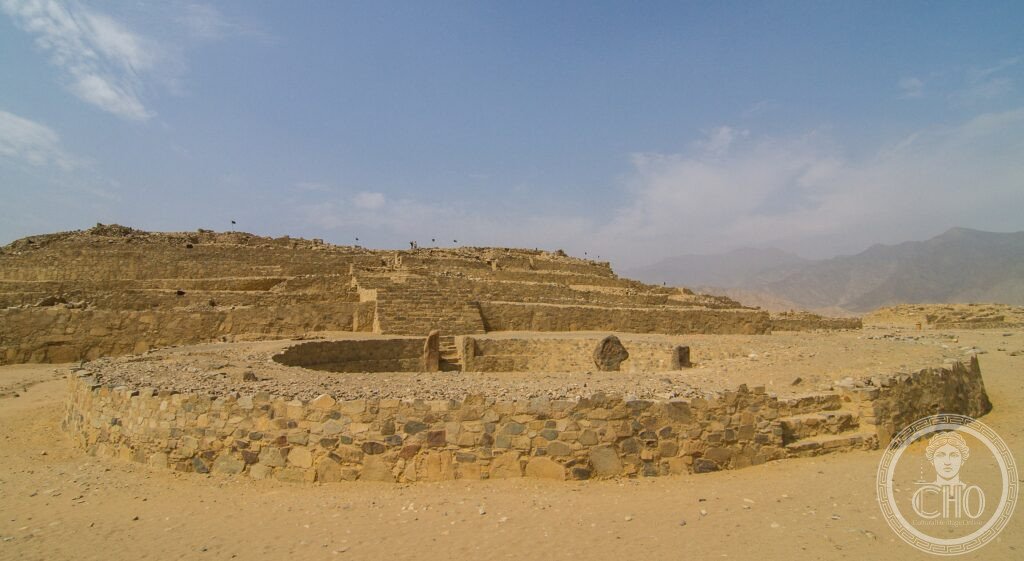
A city was standing here while the pyramids of Giza were being built — on a desert terrace in Peru, with monumental mounds, sunken round plazas and planned residential quarters, but no pottery, no writing and, so far, no weapons. Caral pushed the beginning of civilisation in the Americas back by well over a thousand years.
At a glance
Caral occupies 626 hectares of dry terrace above the green floor of the Supe valley, a hundred and eighty kilometres north of Lima. It belongs to the Late Archaic period of the central Andes and is the oldest centre of civilisation known in the Americas, one of eighteen urban settlements clustered in the same stretch of coast and river valleys. Six large pyramidal structures of stone and earth dominate the plan, each paired with a sunken circular court, and around them lie residential quarters that separate elite from ordinary housing. The Peruvian state manages the site through the Zona Arqueológica Caral, and UNESCO inscribed it in 2009.
Key facts
- The date: radiocarbon dating puts the monumental phases in the third millennium BC, making Caral contemporary with the Old Kingdom in Egypt and with Sumer, and older by more than a thousand years than the Olmec centres long treated as the starting point of civilisation in the Americas.
- What is missing: no pottery has been found, nor writing, nor metal tools. A society capable of moving this much stone and organising this much labour did it without any of them — which is why the site forced a rethink of what the preconditions for urban life actually are.
- The quipu: a knotted cord of the kind used across the later Andes to record information was recovered here, thousands of years before the Inca made the system famous.
- No sign of war: excavation has turned up no weapons, no defensive works and no bodies showing violent death. Archaeologists read Caral as a society organised around ritual and exchange rather than conquest — an interpretation, not a certainty, but one the evidence so far supports.
- The research: the site was identified as a major centre by the Peruvian archaeologist Ruth Shady Solís, whose team’s dating in the late 1990s and publication in 2001 established its antiquity. She still directs the work.
- Heritage: UNESCO World Heritage Site, Sacred City of Caral-Supe, inscribed 2009 (reference 1269).
- GPS: 10.8903° S, 77.5219° W
History
Caral was the largest and most elaborate of a group of settlements spread across the valleys of the north-central Peruvian coast, a society usually called Caral-Supe or Norte Chico. Its economy joined irrigated farming in the valley — squash, beans, and above all cotton — to fishing on the coast a few hours’ walk away: cotton for nets, fish for protein, and an exchange between the two that appears to have been the engine of the whole arrangement. Long-distance trade brought in materials from the highlands and the Amazon side of the Andes.
The city was occupied for something over a thousand years and then given up, some time around 1800 BC. The explanations proposed turn on climate and water: a prolonged El Niño-driven disruption, drought, and damage to the irrigation systems the valley depended on. Nothing was built over the abandoned mounds, and the next great culture of the Peruvian coast, Chavín, shows no direct continuity with what happened here. That absence of later building is why the site survived so legibly, and why local people took the mounds for natural hills until the excavations began.
What you see
The scale reads best from the edge of the terrace: six flat-topped mounds of stone and earth arranged around open ground, the largest rising some thirty metres over a base of more than a hundred and fifty metres a side, with staircases running up the front to summit platforms and small enclosed rooms. Set into the ground before several of them are the sunken circular courts, a form that recurs throughout the Andes for the next three thousand years and appears here at its beginning.
Away from the monuments are the residential sectors, built of stone, cane and mud, with the larger and better-built houses close to the mounds. The dry climate has preserved a great deal that normally rots: cotton textiles, netting, plant remains, and the flutes made from condor and pelican bones found in one of the plazas, thirty-two of them together.
Practical information
- Visiting: the site is open to visitors and is seen on a guided circuit with the resident staff, which is the only way to understand what is otherwise a landscape of low mounds. Check opening arrangements with the Zona Arqueológica Caral before setting out, as access depends on the state of the valley road.
- Conditions: desert terrace, no shade, strong sun; hat, water and closed shoes. Mornings are cooler and the light is better on the mounds.
- Time: two hours on site, and most of a day counting the drive from Lima and back.
Getting there
Caral lies inland from the Panamericana Norte, about 180 km from Lima and roughly 25 km up the Supe valley from the coast at Supe Puerto. The last stretch is unsurfaced. Day trips run from Lima and from Barranca, the nearest town of any size. GPS: -10.8903, -77.5219.
Nearby
- Áspero — on the coast at the mouth of the Supe; the fishing settlement that supplied Caral, and part of the same World Heritage inscription.
- Vichama — in the neighbouring Huaura valley; a later settlement of the same tradition, with reliefs read as a record of drought and famine.
- Bandurria — south along the coast; another early centre of the same period, still under excavation.
Sources
- UNESCO World Heritage Centre, Sacred City of Caral-Supe, reference 1269, inscribed 2009, with the ICOMOS evaluation
- Zona Arqueológica Caral (Ministerio de Cultura, Peru) — the state body that excavates and manages the site
- Ruth Shady Solís, The Social and Cultural Values of Caral-Supe, Zona Arqueológica Caral, 2008
- Encyclopaedia Britannica, Caral
Find it on the map
See this place and what’s around it →📷 Become a Cultural Heritage Online photographer
Share your photos of places: they stay published under your name as the author. The more they're seen, the more you get noticed — and soon a contest will reward the most appreciated photos.
Log in or sign up free to add a photo