

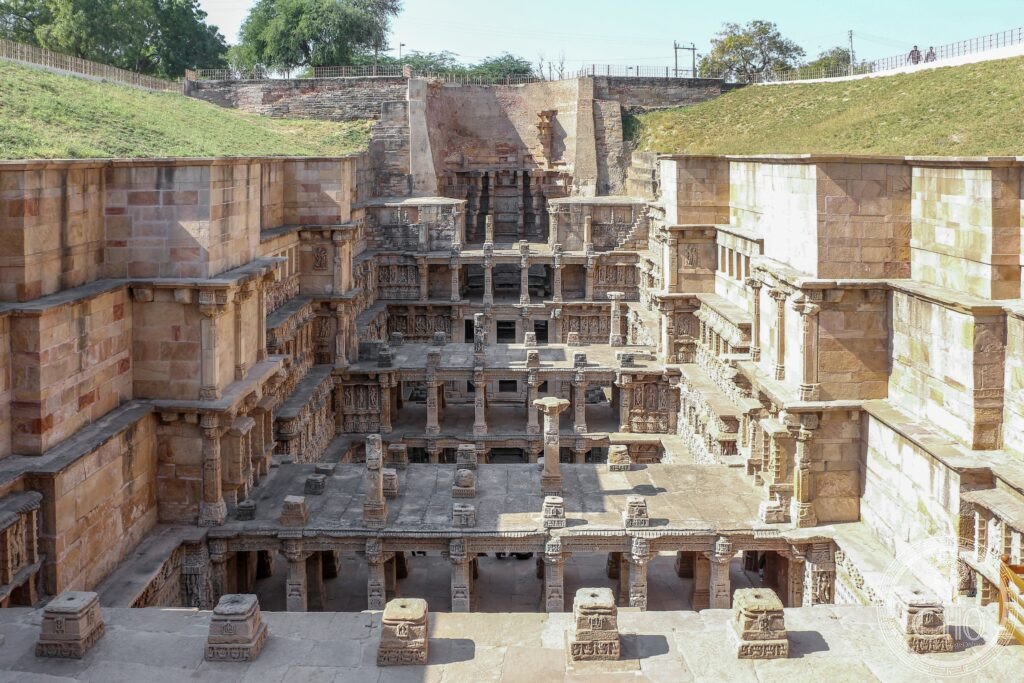
Seven storeys below the plain of Patan, a stepwell built as a memorial to a king lay hidden under river silt for seven centuries, its walls covered in some of the finest sculpture of eleventh-century India, and remains one of the most complete examples of this uniquely South Asian building type.
At a glance
Rani-ki-Vav, the Queen’s Stepwell, was commissioned around 1063 CE by Queen Udayamati of the Solanki dynasty as a memorial to her husband, King Bhimdev I. It belongs to a distinctly South Asian architectural type, the vav or baoli, in which a well is reached by a long descending staircase lined with galleries, landings and colonnades.
The structure was buried under alluvial silt deposited by floods of the Saraswati River, probably by the thirteenth century, and lay forgotten for around 700 years. The Archaeological Survey of India excavated it between 1958 and 1968, finding the sculpture beneath the silt in near-perfect condition.
Key facts
- Type: stepwell (vav), seven levels descending to a depth of 28 metres
- Sculpture: around 1,500 principal panels and 900 minor ones, dominated by the Dashavatara, the ten incarnations of Vishnu, with the largest panel showing Vishnu reclining on the cosmic serpent Ananta at the lowest level
- Style: the supreme surviving example of Maru-Gurjara temple architecture, the tradition also seen at the Dilwara Jain temples on Mount Abu
- Currency: depicted on the reverse of a modern Indian 100-rupee banknote, one of only a few monuments to appear on Indian currency
- Coordinates: 23.8585° N, 72.1013° E
History
Rani-ki-Vav stands on the banks of the Saraswati River, one of the semi-mythical rivers of northern India whose course has since shifted or vanished underground. Seasonal flooding and the gradual silting of the river buried the stepwell to a depth of some 10 metres, and it was this burial, ironically, that preserved its sculpture for centuries after the memory of the building itself had faded.
The Solanki, or Chaulukya, dynasty ruled Gujarat from Patan, then known as Anhilwara, between the tenth and thirteenth centuries and made the city one of the most prosperous in India. Besides Rani-ki-Vav, they built the Modhera Sun Temple south of Patan and were patrons of the Jain temple builders of Mount Abu.
What you see
The visitor descends from ground level through seven terraces to a circular well at the bottom, a sequence structured like a ritual procession. Each level opens onto its own gallery, with colonnaded corridors and carved niches, and the transition between levels is marked by a decorated archway. The density and refinement of the sculpture increases as the descent goes deeper.
At the base lies the circular well shaft itself, the stepwell’s original water source, once essential to Patan during the region’s long dry season. Water is still present at the lowest level today.
Practical information
- Visit duration: allow a leisurely amount of time to take in all seven levels and their carving; the site’s official channels give current details on tickets and opening times
- Best time of day: early morning, before the heat builds
- Season to avoid: the peak of Gujarat’s hot season
- Combine with: the Patan Patola Heritage, where double-ikat silk saris are still woven by the Salvi family, said to have no counterpart elsewhere in the world
Getting there
Patan lies north of Ahmedabad and is reached by road, with state bus services running from Ahmedabad’s Geeta Mandir bus stand. Rani-ki-Vav itself is a short distance from the Patan bus stand, easily covered by local auto-rickshaw. Current timetables and fares are best checked with the state transport authority before travelling.
Nearby
- Modhera Sun Temple — around 35 km south of Patan; built by Bhimdev I around 1026 CE and dedicated to the sun god Surya, with a stepped tank ringed by 108 small shrines and an alignment that lets the rising sun illuminate the main idol at the equinoxes
- Ahmedabad — roughly 130 km south of Patan; India’s first city to receive UNESCO World Heritage City status, in 2017, with a walled old city, the Jama Masjid, the Sidi Saiyyed Mosque and its carved stone jali window, and Gandhi’s Sabarmati Ashram
Sources
- Wikipedia, Rani ki vav
- Wikipedia, Solanki dynasty
- Wikipedia, Maru-Gurjara architecture
- UNESCO, Rani-ki-Vav (the Queen’s Stepwell) at Patan, Gujarat, World Heritage List reference 1548
Find it on the map
See this place and what’s around it →📷 Become a Cultural Heritage Online photographer
Share your photos of places: they stay published under your name as the author. The more they're seen, the more you get noticed — and soon a contest will reward the most appreciated photos.
Log in or sign up free to add a photo