
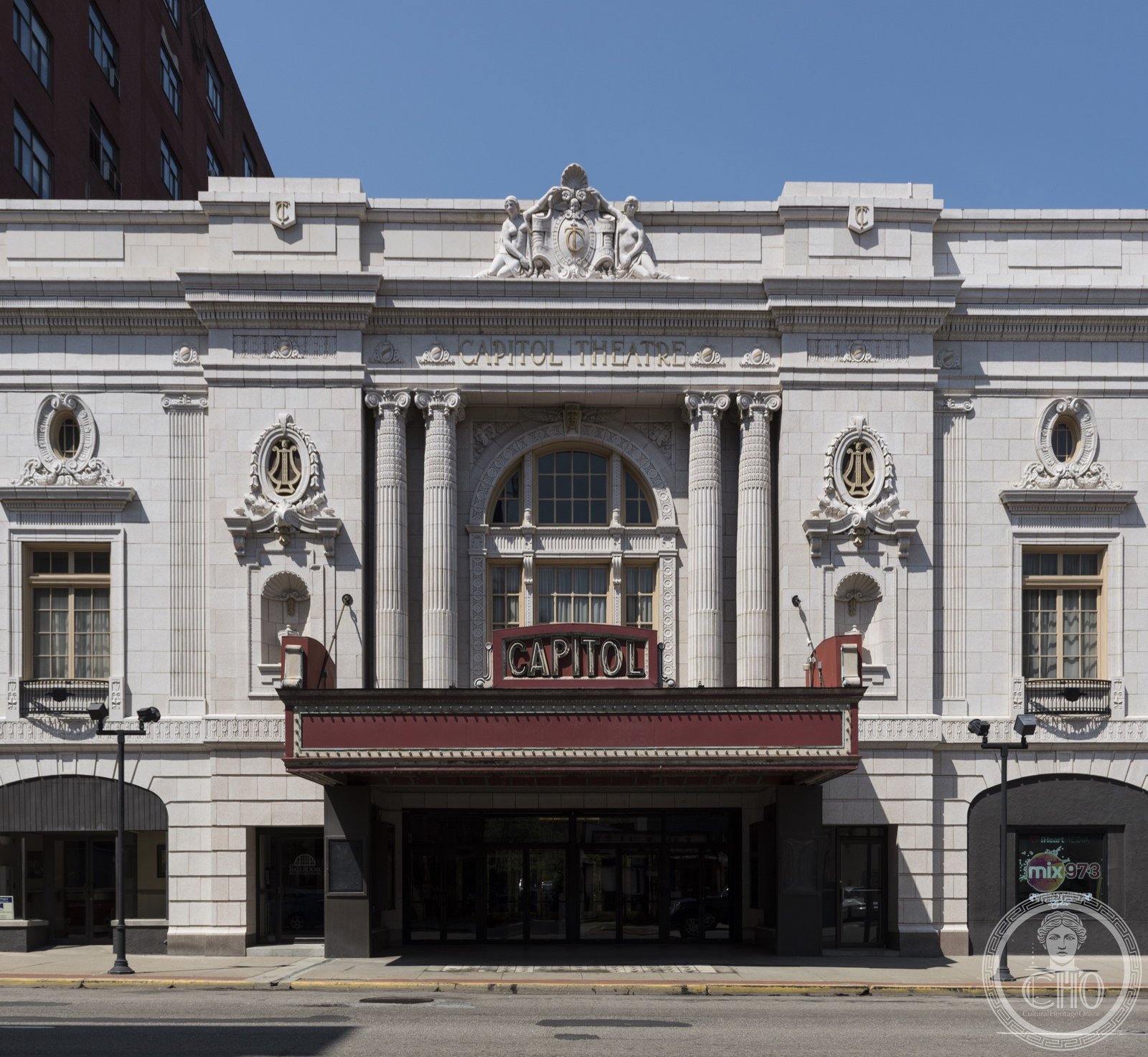
Opened in 1928 as the Capitol Theatre, the Capitol Music Hall in downtown Wheeling is one of the most intact atmospheric picture palaces in West Virginia, its ornate interior preserved through continuous operation as a home for live music, theater, and the long-running radio program Wheeling Jamboree.
At a glance
The Capitol Theatre opened on Market Street in 1928, giving Wheeling one of the grandest entertainment venues in the upper Ohio Valley. The atmospheric interior — with its layered plasterwork, decorative archways, and theatrical lighting — created an experience of luxurious immersion that the city’s industrial working class and business elite alike could share for the price of a movie ticket. The theater became home to the Wheeling Jamboree, a country music radio program broadcast from the stage from 1933 onward, which brought national attention to the building and embedded it in the cultural identity of the upper Ohio Valley.
Key facts
- Address: Market Street, downtown Wheeling, WV 26003
- Opened: 1928 as the Capitol Theatre
- Style: Atmospheric (Spanish / Mediterranean)
- Capacity: approximately 2,500 seats
- Listed: National Register of Historic Places
- Signature program: Wheeling Jamboree (WWVA), country music radio broadcast since 1933
History
Wheeling occupied a strategic position in 1928 as the largest city in West Virginia and a significant commercial and industrial center in the upper Ohio Valley. Steel, glass, and nail manufacturing had built the city’s prosperity; the Ohio River made it a transport hub. When the Capitol Theatre opened, it offered Wheeling audiences first-run Hollywood films in an atmospheric interior that matched anything available in Pittsburgh, which was visible across the Ohio state line.
The theater’s destiny changed in 1933, when WWVA radio began broadcasting the Wheeling Jamboree from the Capitol’s stage. The program — a country music variety show modeled on Nashville’s Grand Ole Opry and Chicago’s WLS National Barn Dance — drew regional audiences to the Capitol in person and reached a national radio audience through WWVA’s 50,000-watt clear-channel signal. Artists from Hank Williams to the Everly Brothers appeared on the Jamboree stage, embedding the theater in the history of American country music.
The building was renamed Capitol Music Hall to reflect its evolving role as a live music venue rather than a cinema, and it has continued to operate through the decades as a home for the Jamboree and other programming. The atmospheric interior has been maintained and partially restored, preserving the visual character of a 1920s picture palace while serving the demands of a working music venue.
What you see
The Capitol Music Hall’s Market Street facade is a commercial composition typical of late 1920s atmospheric theater design, with a vertical marquee and the arched entrance bay that signals the transition from street to interior spectacle. Inside, the auditorium reveals the atmospheric program in full: a ceiling painted to suggest an open sky, side walls organized as series of arched openings suggesting outdoor arcades or Moorish garden walls, and layered plasterwork that creates a sense of depth and ornamental richness throughout the hall.
The scale of the auditorium — seating approximately 2,500 — places the Capitol among the larger atmospheric theaters in the mid-Atlantic and Appalachian states. The stage is a full theatrical stage with fly space, reflecting the building’s original intention to serve both films and live performance. The Jamboree years added production infrastructure, and today the hall operates as a fully equipped live music and event venue whose ornate atmospheric interior remains intact.
Practical information
- Access: Market Street in downtown Wheeling, easily walkable from the center
- Hours: Vary by event programming; check the venue website
- Best for: Country music history, atmospheric theater architecture, Ohio Valley heritage
- Tip: The Wheeling Jamboree is still performed at the Capitol; attending a Jamboree show gives the most complete experience of the building’s historic role
Getting there
Wheeling is located on I-70 at the northern West Virginia panhandle, approximately 55 miles south of Pittsburgh and 90 miles west of Morgantown. Market Street is the main commercial corridor of downtown Wheeling, paralleling the Ohio River. Wheeling’s position at the junction of I-70 and I-470 makes it easily accessible from Pittsburgh, Columbus, and the northern Ohio cities. The nearest commercial airport is Pittsburgh International (PIT), approximately 60 miles northeast.
Nearby
- Wheeling Suspension Bridge (1849) — the first long-span suspension bridge in the United States, still carrying traffic across the Ohio River adjacent to downtown Wheeling
- Independence Hall, Wheeling — where West Virginia voted to separate from Virginia in 1861 and where the state’s founding documents were drafted; now a museum
- Oglebay Resort — 1,700-acre park east of Wheeling with museums, golf, and the annual winter Festival of Lights
- West Virginia Independence Hall — downtown Wheeling, where the reorganized government of Virginia remained loyal to the Union during the Civil War
Sources
- Capitol Music Hall — official history and programming documentation
- National Register of Historic Places — Capitol Theatre (Capitol Music Hall), Wheeling, West Virginia
- WWVA Wheeling Jamboree — broadcast history archive
Find it on the map
See this place and what’s around it →Record researched and written by Luigi De Marchi for Cultural Heritage Online, 2026.
📷 Become a Cultural Heritage Online photographer
Share your photos of places: they stay published under your name as the author. The more they're seen, the more you get noticed — and soon a contest will reward the most appreciated photos.
Log in or sign up free to add a photoIs this page about you?
This page is read by travellers and heritage enthusiasts who find it on Google. Tell us how you are connected to this place and we will take it from there.