
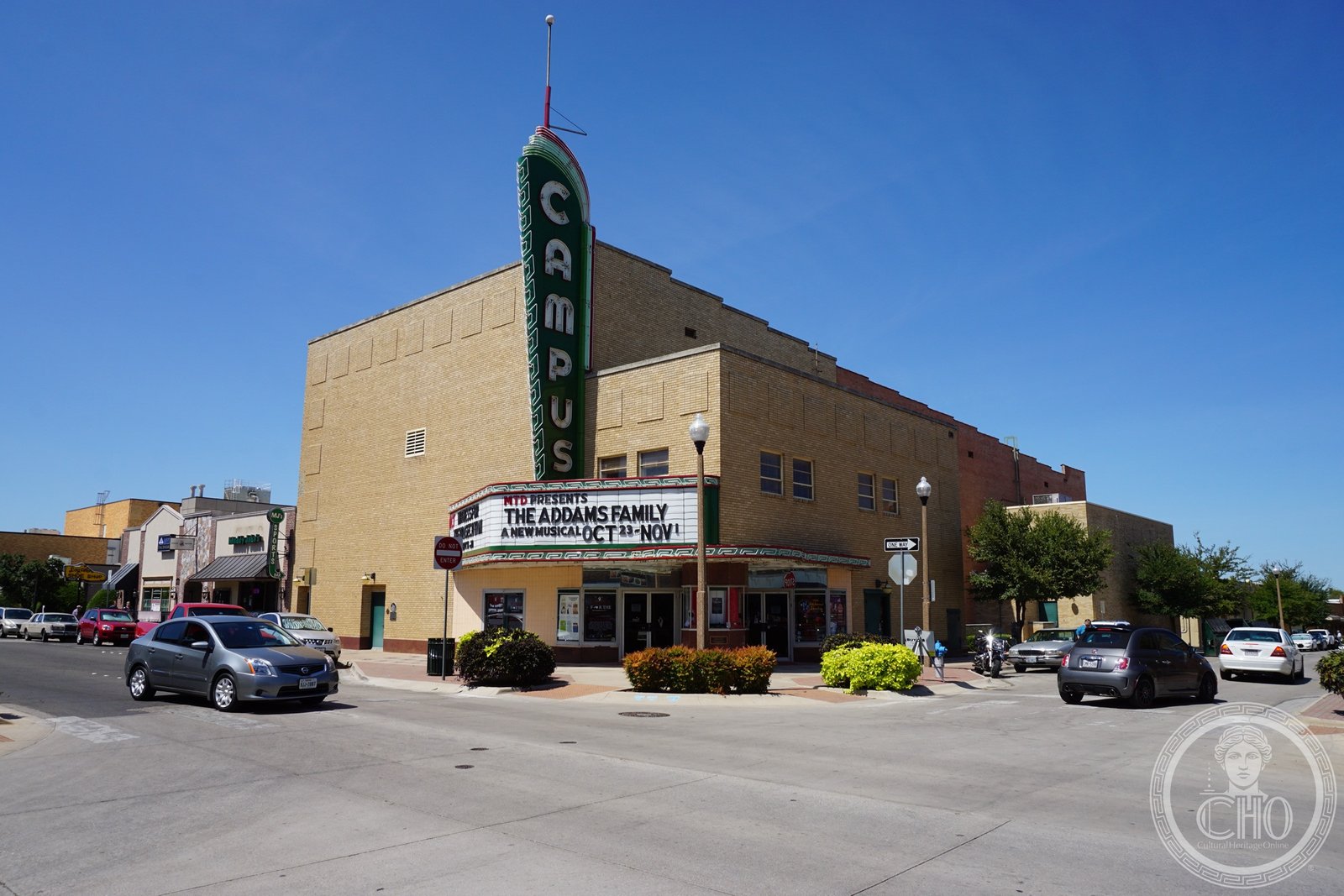
A Streamline Moderne landmark on Denton’s courthouse square, the Campus Theatre has anchored the cultural life of this North Texas university city since 1936.
At a glance
The Campus Theatre stands on West Hickory Street in downtown Denton, Texas, within a short walk of the Romanesque Revival Denton County Courthouse and at the edge of the dense commercial grid that serves two major university campuses — the University of North Texas and Texas Woman’s University. Built in 1936 at the close of the Art Deco era’s most productive phase, the theater brought Streamline Moderne design to a North Texas college town whose intellectual and cultural life had been accelerating since the 1920s. Listed on the National Register of Historic Places, the Campus today operates as a community performing-arts venue under the stewardship of the Campus Theatre Foundation, presenting concerts, independent film, and theatrical productions throughout the year.
Key facts
- Address: 214 W Hickory Street, Denton, TX 76201
- Built: 1936
- Style: Streamline Moderne (Art Deco)
- NRHP: Listed on the National Register of Historic Places
- Current operator: Campus Theatre Foundation (nonprofit)
- County: Denton County, Texas
- Coordinates: 33.2148° N, -97.1331° W (Google Maps)
History
Denton in 1936 occupied an unusual economic position for a small North Texas city. The town had survived the Depression partly on the stability provided by two state institutions: the North Texas State Teachers College (today the University of North Texas) and the College of Industrial Arts (today Texas Woman’s University). Both enrolled students whose presence sustained local businesses through the worst years of the 1930s, and by 1936, with the national economy slowly recovering, the construction of a new first-run theater on the central square represented an act of civic confidence.
The Campus Theatre served its original function — presenting Hollywood productions in the Streamline Moderne comfort that the 1930s audience expected of a first-class movie palace — for several decades. As multiplex cinemas drew audiences to the suburban fringes in the 1970s and 1980s, the Campus Theatre, like many of its contemporaries, fell on harder times. A preservation campaign organized around the building’s historic significance eventually led to a restoration and the establishment of the Campus Theatre Foundation, which now operates the venue as a multipurpose arts space serving the student population, the faculty, and the broader Denton community.
What you see
The Campus Theatre’s facade belongs to the Streamline Moderne phase of American commercial architecture — the post-1933 idiom that replaced the vertical ornamental towers of Zigzag Moderne with horizontal banding, smooth curves, and a machine-age vocabulary drawn from aeronautical and industrial design. The vertical marquee sign, a defining element of the American movie palace streetscape, projects over the West Hickory sidewalk in the same position it has occupied since 1936. The stepped cornice above it carries a geometric ornamental band that anchors the composition without the elaborate figurative carving of the earlier Deco style.
The setting amplifies the building’s architectural effect: the Denton County Courthouse (1896), a Romanesque Revival composition in red Sunset Red granite, rises half a block away, making the Campus Theatre’s smooth Art Deco surfaces read as a deliberate stylistic counterpoint to the courtly Victorian masonry of the 19th century courthouse square. The two buildings together compress nearly fifty years of American civic architecture into a single downtown block.
Practical information
- Programming: Concerts, independent and classic film screenings, theatrical productions. Check the Campus Theatre Foundation website for current schedule.
- Tickets: Available online and at the box office.
- Season: Year-round, with academic-calendar programming density in fall and spring.
- Parking: City parking lots on Hickory Street and the surrounding courthouse square; metered street parking throughout downtown Denton.
- Denton Square: The courthouse square hosts a farmers market on Saturdays and an active independent retail and restaurant scene that makes the Campus Theatre visit easy to combine with a half-day in downtown Denton.
Getting there
Dallas/Fort Worth International Airport (DFW) lies approximately 22 miles south-southeast of downtown Denton via Interstate 35E. DART’s Orange Line light rail connects DFW Airport’s Terminal A station to Carrollton, where the DCTA A-Train commuter rail continues north to Denton Transit Center — a journey of roughly 75 minutes door to door from the terminal. By road, I-35E and I-35W split at the south edge of Denton, providing dual access from the Dallas and Fort Worth metro areas respectively. There is no direct Amtrak service to Denton; the nearest Amtrak stop is Dallas Union Station, 35 miles southeast.
Nearby
- Denton County Courthouse (1896) — the red Romanesque Revival granite courthouse at the center of the square, half a block from the Campus Theatre and the architectural anchor of historic downtown Denton.
- University of North Texas campus — the sprawling UNT campus begins one block south of the courthouse square; the university’s College of Visual Arts and Design maintains active gallery exhibitions year-round.
- Texas Woman’s University campus — half a mile northwest; the university’s art and history collections are open to the public.
- Fort Worth Cultural District — approximately 35 miles south, with the Kimbell Art Museum (Louis Kahn, 1972), the Amon Carter Museum (Philip Johnson, 1961), and the Modern Art Museum of Fort Worth (Tadao Ando, 2002).
Sources
- National Register of Historic Places nomination — Campus Theatre, Denton County, Texas.
- Campus Theatre Foundation — venue history and programming documentation.
- Texas Historical Commission — Recorded Texas Historic Landmark designation records.
- Wikimedia Commons — Denton September 2015 41 (Campus Theatre).jpg, CC BY-SA 4.0 (Michael Barera).
Find it on the map
See this place and what’s around it →Record researched and written by Luigi De Marchi for Cultural Heritage Online, 2026.
📷 Become a Cultural Heritage Online photographer
Share your photos of places: they stay published under your name as the author. The more they're seen, the more you get noticed — and soon a contest will reward the most appreciated photos.
Log in or sign up free to add a photoIs this page about you?
This page is read by travellers and heritage enthusiasts who find it on Google. Tell us how you are connected to this place and we will take it from there.