

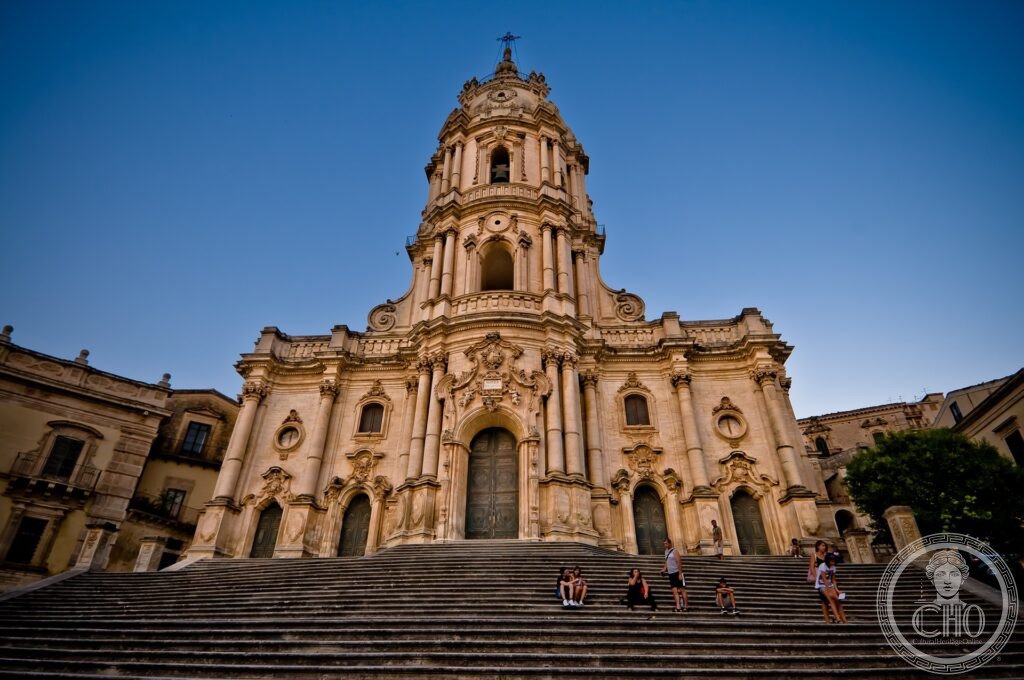
Modica — the capital of the most powerful feudal county in medieval and early modern Sicily (the Contea di Modica, 1097-1812, which at its peak covered a quarter of the island) — was rebuilt after the earthquake of 1693 in a Baroque style of exceptional exuberance by the architect Rosario Gagliardi, who raised San Giorgio’s church on a cliff face so steep that its 250-step staircase is more famous than the church itself, and who designed the system of arched terraces and interlocking streets that gives Modica its characteristic split-level urban form — and who was also the architect of the San Giorgio in Ragusa Ibla, making him the defining voice of Val di Noto Baroque.
At a glance
Modica (province of Ragusa, Sicilia; UNESCO 2002, ref. 1024) is one of eight cities in the serial inscription “Late Baroque Towns of the Val di Noto.” Modica is inscribed for: (1) the exceptional quality of the Baroque urban fabric rebuilt by Rosario Gagliardi and other architects after 1693; and (2) the unusual morphology of the city, which is built in three levels along the confluence of two river valleys (the Modicano and the Pozzo dei Pruni), with the different levels connected by dramatic staircases and ramps. The city’s principal Baroque monuments are the Basilica di San Giorgio (1702-1738, Gagliardi’s masterpiece), the Church of San Pietro (1700-1730, with a facade sequence of 12 life-size apostle figures), the Palazzo dei Conti di Modica (the county palace, partially preserved), and the many 18th-century Baroque palaces along Corso Umberto I.
Key facts
- San Giorgio di Rosario Gagliardi (1702-1738): The Basilica of San Giorgio is Gagliardi’s acknowledged masterpiece: a five-storey convex-plan facade (35 m wide × 47 m high) with three registers separated by entablatures, twisted (Solomonic) columns on the first register, composite columns on the second, and a large bell tower incorporated into the third register above the pediment. The 250-step staircase that rises from the Piazza Matteotti to the church entrance is an integral part of Gagliardi’s compositional scheme: it is designed to foreshorten the facade as one climbs, creating a dramatic proportional distortion that makes the church appear taller and more imposing at close range. The comparison with Gagliardi’s San Giorgio in Ragusa Ibla (designed c.1740, slightly later) shows the evolution of his style toward greater plasticity
- La Contea di Modica (1097-1812): The County of Modica was the largest and most powerful feudal lordship in Sicily from the Norman conquest to the Napoleonic abolition of feudalism (1812): at its largest extent (15th century) it included 42 municipalities covering a quarter of the island’s territory, with its own administrative system, courts, and tax collection independent of the royal administration. The counts were the Chiaramonte family (1296-1392), then the Cabrera (1392-1480), then the house of Enríquez (Spanish, 1480-1812 with one interruption) — the longest-lived Spanish feudal dynasty in Sicily. The county’s wealth (from wool, wheat, and silk) is directly visible in the quality of the Baroque monuments: no other city in the Val di Noto received such consistently high-quality patronage after 1693
- Il Cioccolato di Modica (metodo azteco, secoli XVI-XIX): The Modica chocolate tradition — chocolate prepared without tempering (i.e. without adding emulsifiers or extra fat) by grinding raw cacao paste with sugar at low temperature and pouring it into molds — derives from the pre-Columbian Aztec/Mayan tradition of cold-ground chocolate (xocolatl) introduced into Sicily via Spain in the 16th century; the result is a granular, non-melting chocolate with a sharp cacao and sugar intensity that is radically different from modern tempered chocolate; the production technique (unchanged since the 16th century in the major Modica chocolate workshops) was submitted for UNESCO Intangible Cultural Heritage recognition in 2018; the best workshops (Bonajuto, the oldest Sicilian chocolate shop at 1880; Quetzalcoatl; Antica Dolceria Bonajuto) are on Corso Umberto I
- UNESCO: 2002, ref. 1024
- GPS: 36.8614, 14.7594 — Google Maps (Basilica San Giorgio, Modica Alta)
History
Modica was a significant Siculo-Arab settlement (the name derives from the Arabic “Mudiq/Moudiq”) before the Norman conquest (1091-1097); Count Roger I of Sicily granted Modica as a fief to his relative Goffredo Malaterra, establishing the Contea di Modica in 1097. The county passed through the Chiaramonte, Cabrera, and Enríquez families; the Spanish connection (the Enríquez were Aragonese) brought Counter-Reformation cultural impulses and the chocolate tradition in the 16th century. The earthquake of January 11, 1693 destroyed virtually all the buildings of Modica Alta (the upper city) and severely damaged Modica Bassa (the lower city); the reconstruction, financed by the county’s surviving revenues and by ecclesiastical patronage, produced the current Baroque fabric in the period 1693-1780, with Rosario Gagliardi as the dominant architectural figure.
What you see
The Modica circuit is organized in two levels: Modica Alta (upper) and Modica Bassa (lower), connected by a series of staircases. Start in Modica Alta at the Piazza Matteotti: ascend the 250-step staircase to the entrance of San Giorgio (go inside for the interior — the polychrome marble altarpieces and the 18th-century wooden choir stalls are the main elements; the Polyptych of the Pietà, c.1510, is in the sacristy); then walk south along the ridge of Modica Alta for the views over the lower city (the best panoramic point is the belvedere at Piazza Corrado Rizzone). Descend to Modica Bassa via the Scala di Santa Teresa; walk along Corso Umberto I (the principal corso, with the Baroque palaces, the Museo Civico, the chocolate workshops of Bonajuto and Quetzalcoatl, and the Church of San Pietro with its 12 apostle statues on the facade staircase). Allow 3-4 hours for the full circuit including stops at the chocolate workshops.
Gallery
Practical information
- Basilica di San Giorgio: Piazza San Giorgio, Modica Alta; open daily 9:00-12:30 and 15:30-19:00; free entry; the sacristy (with the Polyptych of the Pietà) is open on request to the sacristan (donation expected).
- Modica Chocolate: The best workshops on Corso Umberto I (Bonajuto, founded 1880, at no. 159; Quetzalcoatl at no. 157-161). The Antica Dolceria Bonajuto sells the classic Modica chocolate in flavours of cinnamon, vanilla, and hot pepper (the traditional flavours, derived from the pre-Columbian tradition); the cinnamon variant is the most historically authentic. Shop hours typically 9:00-20:00; summer hours extended.
- Museo Civico di Modica: Corso Umberto I 149, Modica; open Tuesday-Sunday 9:00-13:00 and 15:00-18:00; admission ~€3; holds the civic collection including the Polyptych of the Pietà (if it is not in San Giorgio) and the Branciforte collection of silver.
Getting there
Basilica di San Giorgio, Piazza San Giorgio, Modica Alta (RG), Sicilia. GPS 36.8614, 14.7594. By train: Trenitalia from Siracusa (1h regional); from Ragusa (15 min regional, very frequent); from Catania (2h, change at Siracusa). Modica station is in Modica Bassa (the lower city), 15 min on foot from Corso Umberto I. By car: from Ragusa, SS194 (15 km, 20 min); from Siracusa, SS115 west (70 km, 1h); from Catania, A18/SS115 (120 km, 1h30).
Nearby
- Ragusa Ibla — 15 km north-west; (CHO card: Ragusa Ibla UNESCO 2002); Gagliardi’s other San Giorgio (the comparison between the two churches is the central experience of a Val di Noto Baroque tour) + the Giardino Ibleo
- Scicli — 20 km south-west; (CHO card: Scicli UNESCO 2002); the city in three valleys, with the Palazzo Beneventano facade and the Inspector Montalbano set locations
- Punta Secca e le spiagge iblee — 20 km south; the Mediterranean beaches of the southern Val di Noto (Punta Secca, Marina di Ragusa, Donnalucata); the Punta Secca lighthouse was used as Inspector Montalbano’s house in the Italian television series (RAI due, 1999-2021)
Sources
- UNESCO: whc.unesco.org/en/list/1024
- Wikipedia EN: Modica
- Di Vita, Antonino: Modica: l’architettura del’600 e del’700, Palermo: Sellerio, 1980
- Antica Dolceria Bonajuto: bonajuto.it
Find it on the map
See this place and what’s around it →📷 Become a Cultural Heritage Online photographer
Share your photos of places: they stay published under your name as the author. The more they're seen, the more you get noticed — and soon a contest will reward the most appreciated photos.
Log in or sign up free to add a photo