
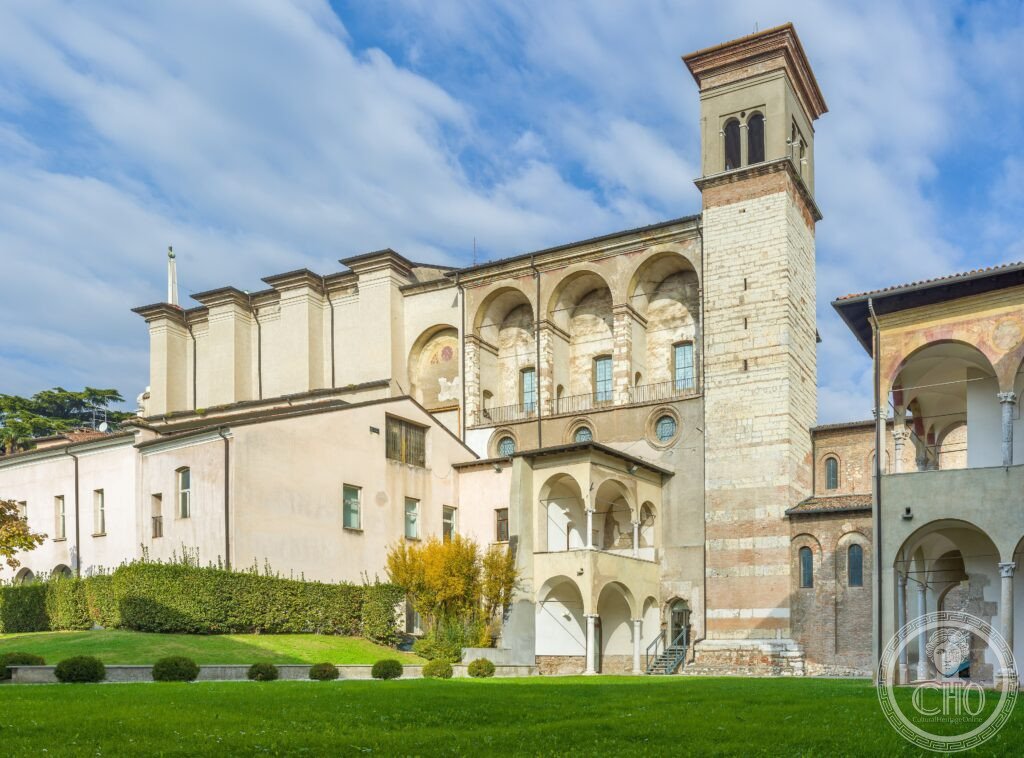
A Lombard royal monastery that became the city museum of Brescia. Under one roof stand a ninth-century basilica, a twelfth-century oratory frescoed in the Renaissance, two Roman houses left where they were found, and the jewelled cross that has carried the name of the last Lombard king for a thousand years.
At a glance
Santa Giulia stands on Via dei Musei, along the old Roman decumanus of Brescia, on ground that has been built on continuously since antiquity. The museum opened in 1998 and occupies about 14,000 square metres of the former monastery. It is two museums at once: one route follows the history of the monastic complex itself, the other runs through the history of the city from prehistory to the modern age. The buildings are not a container for the collection. They are the largest object in it.
Key facts
- Foundation: the monastery of San Salvatore was founded in 753 by Desiderius, then duke of Brescia and from 756 king of the Lombards, with his wife Ansa. Their daughter Anselperga was its first abbess.
- The churches: the basilica of San Salvatore, of around the ninth century; the oratory of Santa Maria in Solario, added in the twelfth; the church of Santa Giulia, finished in 1599.
- Cross of Desiderius: 158 by 100 by 7 centimetres, wood covered in metal lamina and set with 212 stones, about fifty of them classical cameos and gems. It is early ninth-century work, and the attribution to Desiderius is traditional rather than documented.
- Frescoes: Floriano Ferramola painted Santa Maria in Solario between 1513 and 1524, and worked with Paolo da Caylina the Younger and others on the nuns’ choir.
- Roman Brescia: the Domus dell’Ortaglia, two Roman houses excavated under the monastery garden, with finds of the second and third centuries AD.
- Museum: opened 1998; about 14,000 square metres of exhibition space.
- Recognition: UNESCO World Heritage since 2011, as a component of the serial property «Longobards in Italy: Places of the Power (568-774 AD)», reference 1318.
- GPS: 45.5393, 10.2291 — open in Google Maps.
History
In 753 Desiderius and his wife Ansa founded a monastery of Benedictine nuns in Brescia, dedicated to the Saviour, and installed their daughter Anselperga as its first abbess. Three years later Desiderius became king of the Lombards. His reign ended in 774, when Charlemagne took Pavia after a siege of eight months and sent him into exile at the abbey of Corbie, in northern France. The monastery outlived the kingdom that had made it: the relics of Saint Julia arrived later and gave the house the name it still carries.
The complex grew by addition rather than replacement, which is why so much of it survives. The basilica of San Salvatore, standing today, dates from around the ninth century. The oratory of Santa Maria in Solario was added in the twelfth, a small square building on two floors that became the treasury of the monastery. The nuns’ choir was built in the second half of the fifteenth century and frescoed in the first half of the sixteenth by Floriano Ferramola, Paolo da Caylina the Younger and others. The church of Santa Giulia was finished in 1599.
The monastery was suppressed under Napoleon and passed through military and civil uses before the city began to treat it as a monument. A museum of the Christian age was installed in 1882; restoration went on through the twentieth century, and the museum as it is now opened in 1998. In 2011 the complex was inscribed by UNESCO as one of seven Italian sites of the serial property on the places of Lombard power.
What you see
The route runs through the buildings in the order they were built, which means walking down through the floors of the city. Under the monastery garden lie the Domus dell’Ortaglia, two Roman houses with mosaic floors and painted walls, left in place and roofed over; the finds around them belong to the second and third centuries. Above, the basilica of San Salvatore keeps its columns and capitals of reused Roman and Byzantine work, and traces of Carolingian stucco and painting on the walls.
The set piece is Santa Maria in Solario. The lower chamber is dark, vaulted on a single central pillar; the upper one is covered from floor to vault with the frescoes Ferramola painted between 1513 and 1524, and holds the Cross of Desiderius. The cross is 158 centimetres high, wood faced with metal lamina, studded with 212 stones of which about fifty are classical cameos and engraved gems reused from Roman jewellery: no other object of the early Middle Ages carries so many. Among them is a gold-glass medallion of the third century with three portrait busts, long said to show Galla Placidia with her children, an identification scholars now reject without having found another.
Practical information
- Hours and tickets: Santa Giulia is a municipal museum with seasonal opening times and a combined ticket with the other city sites; check the official museum channels before visiting.
- Time needed: at least half a day. The two routes, monastery and city, are long, and the Roman houses are at the far end.
- The Winged Victory: the bronze that stood in Santa Giulia for years is no longer here. After restoration it was returned in 2020 to the Capitolium, the Roman temple a short walk away on the same street.
- Light: Santa Maria in Solario is artificially lit and legible at any hour; the Roman houses are best seen when the museum is quiet.
Getting there
Santa Giulia is on Via dei Musei in the old centre of Brescia, a short walk from Piazza del Foro and the Capitolium. Brescia station is served by regional and long-distance trains from Milan and Verona and is about twenty minutes on foot from the museum; the city metro line stops at Vittoria, from which the old centre is a few minutes away. For times and fares it is best to consult the Trenitalia site.
Nearby
- Capitolium and the Roman forum — on the same street, the temple of the Capitoline triad and the archaeological park, where the Winged Victory has stood again since 2020.
- Brescia — the city card, with the Palazzo Broletto, the Palazzo della Loggia and the two cathedrals.
- Castello di Brescia — the fortress on the Cidneo hill above the museum quarter.
Sources
- UNESCO World Heritage List, Longobards in Italy. Places of the Power (568-774 A.D.), reference 1318, inscribed 2011
- Museo di Santa Giulia, Brescia Musei (bresciamusei.com)
- Wikipedia, Museo di Santa Giulia; San Salvatore, Brescia; Croce di Desiderio; Desiderius, consulted September 2026
Find it on the map
See this place and what’s around it →📷 Become a Cultural Heritage Online photographer
Share your photos of places: they stay published under your name as the author. The more they're seen, the more you get noticed — and soon a contest will reward the most appreciated photos.
Log in or sign up free to add a photoIs this page about you?
This page is read by travellers and heritage enthusiasts who find it on Google. Tell us how you are connected to this place and we will take it from there.