
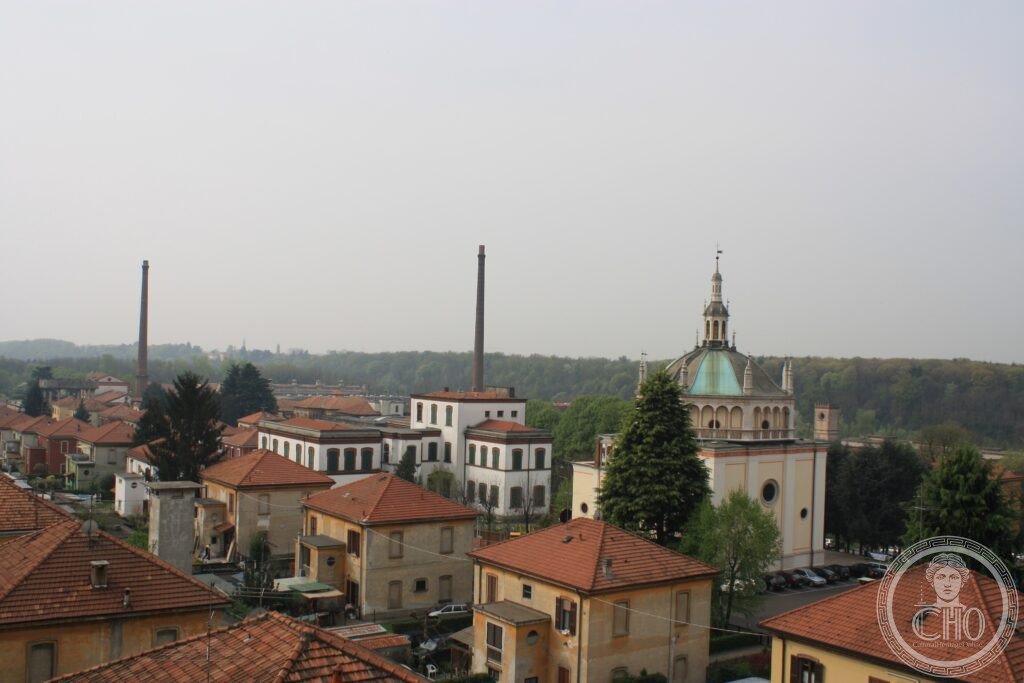
Crespi d’Adda
Crespi d’Adda (UNESCO 1995) è il villaggio operaio meglio conservato d’Italia e uno dei più integri del mondo — costruito tra il 1877 e il 1920 CE dall’imprenditore cotoniero Cristoforo Benigno Crespi lungo il fiume Adda per ospitare l’intera forza lavoro del suo cotonificio (2.200 persone), il villaggio ha una propria chiesa, scuola, ospedale, lavanderia, palestra, piscina e cimitero, ed è rimasto praticamente invariato nella sua struttura urbanistica e nel suo patrimonio edilizio dalla chiusura del cotonificio nel 2003 CE.
At a glance
Crespi d’Adda company town (the most precisely Crespi d’Adda zone Crespi d’Adda Lombardia Italy 45.6012 N 9.5311 E UNESCO WHS 1995 reference 730: the town plan (the total area: approximately 85 hectares; the street grid (a strict grid of 6 main streets + 4 transversal streets; the streets are named by numbers; the main axis (Via Cristoforo Crespi) runs 800 m from the mill gate (south) to the cemetery gate (north) on the banks of the Adda river): the buildings (9 typologies of housing (a hierarchical system: (1) director’s villa: a 2-floor Liberty-style villa with garden (one villa per department head; the most elaborately decorated; the facades have polychrome brick inserts); (2) foreman’s house: a 2-floor house with garden (smaller garden; less elaborate facade decoration); (3) worker’s house: a 1–2 floor building with a small courtyard garden shared by 2–4 families; the facade is uniform (red facing brick without applied decoration); (4)–(9): dormitories, single workers’ housing, apprentice housing, elderly workers’ housing, seasonal workers’ housing; the total number: 145 residential buildings housing c.2,200 people at peak (1910 CE)); the services (the complete set of social services provided free by the Crespi family: school (1881 CE; compulsory for workers’ children 6–14 years; the teacher was employed and paid by the Crespi firm); the church of Sant’Apollinare (1891–99 CE; Pietro Fenoglio; the Neo-Romanesque + Liberty facade; the interior: the pews are assigned by family and rank (the director’s family had fixed pews in the first row; the workers’ families had pews assigned by department)); the hospital (1880 CE; free treatment for workers and families; the hospital physician was employed full-time by the Crespi firm; it was one of the first employer-funded hospitals in Italy); the swimming pool (1922 CE; the first heated swimming pool available to workers in Lombardy; it functioned until 2001 CE); the theater (1892 CE; 300 seats; used for company events and recreational activities); the cemetery (1880 CE: the “cimitero monumentale” at the north end of the village on the river bank; the tombs are stratified by social rank: the Crespi family mausoleum (the largest structure; built 1878 CE; modeled on the Mausoleum of Halicarnassus (the frieze = the horses of Mausolos); Gaetano Moretti, 1878 CE) + the directors’ section + the workers’ section; even in death the social hierarchy of the company town was maintained in spatial form)).
Key facts
- Il sistema paternalistico Crespi: gratuità dei servizi vs controllo dei lavoratori — come funzionava il villaggio nella pratica: the Crespi paternalism system (the Crespi model of “welfare capitalism” (the specific Italian term: “paternalismo industriale”): the concept (the Crespi family owned everything in the village (the houses, the church, the school, the hospital, the theater, the pool): the workers paid no rent (the housing was provided as part of the employment contract); they paid no tuition (the school was free); they paid no medical fees (the hospital was free); they paid for food at the company store (the “spaccio aziendale”: a company-owned store where workers could buy food, clothing, and household goods; the prices were set by the Crespi firm; the wages were partly paid in “buoni” (vouchers) that could only be spent at the company store — a practice that effectively tied workers to the company system); the specific controls (the rules (the Crespi “regolamento” of 1904 CE (the firm’s internal regulation): workers must be at the mill gate by 5:50 AM (6 AM start; 5:50 AM roll call); workers caught sleeping during the shift lose half a day’s wage; workers who arrive drunk are dismissed immediately; workers who join a trade union are dismissed; workers’ children must attend the Crespi school until age 14; workers who are absent without notification lose the right to free housing until re-employed for 3 months); the outcome (the system created extreme loyalty among the long-term workforce (4th-generation families at Crespi d’Adda were documented in the 1990 CE oral history surveys) combined with total dependence (when the mill closed in 2003 CE, 600 workers lost both their jobs and their right to housing simultaneously; the Italian government had to intervene to allow workers to buy their houses at below-market prices))
- GPS (ingresso villaggio, Via Vittorio Veneto): 45.6012° N, 9.5311° E
History
Da Cristoforo Crespi al cotonificio al UNESCO 1995 alla chiusura 2003 CE (the most precisely Crespi d’Adda zone history: the foundation (Cristoforo Benigno Crespi (1833–1920 CE): the founder of Crespi d’Adda; a native of Busto Arsizio (the leading cotton textile town in Lombardy in the 19th century); Crespi bought the land on the Adda river in 1875 CE (the reason for the Adda location: water power (the Adda river generates 4 MW of hydraulic power at the Crespi mill site; the mill used water turbines before switching to steam in 1890 CE and to electricity in 1906 CE; the current turbine hall (visible on the mill tour) still contains the original 1906 CE Ganz turbines from Budapest)); the first mill construction began 1877 CE; the first workers’ housing was built simultaneously (the Crespi model was that housing and mill were built together — not an afterthought); the peak period (1900–1920 CE: the peak production (350,000 kg of cotton spun per day; the specific product: fine cotton yarn for weaving (count 40–80 Ne (the “Ne” or English Number count system: the number of 840-yard lengths per pound; the higher the number, the finer the yarn)); the main clients: the Milanese weaving industry (the cotton was woven into lightweight fabrics for the Italian and export markets)); the Crespi family decline (1920 CE: Cristoforo Benigno Crespi died; the firm passed to his son Silvio Crespi (1868–1944 CE); Silvio Crespi was a senator, a member of the Italian delegation to the Paris Peace Conference (1919 CE), and a supporter of Mussolini’s industrial policies; the mill was nationalized briefly during WWII and denationalized in 1945 CE; the firm changed ownership 3 times between 1945 and 1975 CE); the UNESCO inscription (1995 CE: reference 730; the UNESCO evaluation noted Crespi d’Adda as “the most complete and best-preserved example of a 19th-century company town in Europe”); the closure (2003 CE: the mill (then owned by the Legler Group of Bergamo) closed permanently in January 2003 CE; the closure was due to competition from Asian textile producers (the specific event: the end of the Multi-Fibre Arrangement quotas in 2002 CE removed the last trade protection for European cotton manufacturing)).
What you see
Le case operaie, il cotonificio, il cimitero monumentale, la chiesa di Pietro Fenoglio (the most precisely Crespi d’Adda zone visit (2 hours on foot): the visitor circuit (the village is free to walk; the mill and some buildings require a guided tour): (1) the entrance (Via Vittorio Veneto: the main gate of the workers’ village; the gate has been maintained since 1877 CE; the iron gate pillars are original); (2) the workers’ housing streets (the grid: walk the 6 main streets (400 m × 150 m area); the housing types are visually distinguishable: the directors’ villas (Liberty facades; irregular garden plans; individual) vs the workers’ houses (regular rows; identical facades; small shared gardens)); (3) the church of Sant’Apollinare (1891–99 CE; Pietro Fenoglio; open daily 9 AM–5 PM; the interior: the original Crespi family pews in the first row; the Fenoglio-designed polychrome tile floor; the bell tower: 46 m; open for visits on weekends); (4) the mill (the cotonificio: the eastern edge of the village; guided tours (weekends only; €7; book at the tourist office Via Vittorio Veneto 1); the 1906 CE turbine hall; the original spinning machinery (2 of the original 1877 CE Platt Brothers (Oldham, England) spinning frames are preserved as museum objects)); (5) the cemetery (the “cimitero monumentale”: the north edge of the village on the Adda riverbank; open daily; the Crespi mausoleum (Gaetano Moretti, 1878 CE; the Mausoleum of Halicarnassus frieze; the iron gates are the originals); the workers’ section: the 145-year-old headstones in uniform marble; the social stratification visible in stone (the plots nearest the mausoleum are the directors’; the furthest are the seasonal workers’)).
Practical information
- Come arrivare a Crespi d’Adda da Bergamo o Milano e quando visitare: il trasporto (Crespi d’Adda è a 30 km da Bergamo e 40 km da Milano; nessun treno diretto; le opzioni: (1) auto: A4 uscita Capriate San Gervasio (12 min da Bergamo); parcheggio gratuito all’ingresso del villaggio; (2) bus: Autoguidovie (linea Bergamo–Capriate; 50 min; €3.40; orari su autoguidovie.it; la fermata è a 5 min a piedi dall’ingresso del villaggio); (3) bici: il Parco Adda Nord ha una pista ciclopedonale 32 km Trezzo sull’Adda → Lecco che passa davanti all’ingresso di Crespi d’Adda (da Bergamo Città Alta in bici: 28 km; livello facile; il fondo è asfaltato)); la visita (il villaggio è abitato da 700 residenti che usano le case ex-operaie come abitazioni private; rispettare la privacy; fotografare strade e facciate OK, cortili privati NO; l’Ufficio Tourist è in Via Vittorio Veneto 1 (orario: dom 9–17, sab 10–17); la visita guidata al cotonificio (€7) è disponibile sab e dom; i bambini <12 anni non possono entrare nel cotonificio per ragioni di sicurezza))
Getting there
Auto: A4 uscita Capriate San Gervasio (30 km da Bergamo, 40 km da Milano), parcheggio gratuito. Bus Autoguidovie da Bergamo (50 min, €3.40). GPS ingresso villaggio: 45.6012, 9.5311.
Nearby
- Bergamo: Città Alta e Le Mura (UNESCO 2017) — 30 km nord (Le Mura veneziane; funicolare; Piazza Vecchia; Cappella Colleoni Amadeo 1476; la polenta taragna; Trenitalia da Milano 50 min €5.50)
- Milano: Navigli e Cenacolo Vinciano — 40 km ovest (Trenitalia da Bergamo 50 min €5.50; Ultima Cena Leonardo 1495–98 (prenotazione obbligatoria vivaticket.com €15; solo 25 visitatori/15min slot); Navigli canale 25 km; Pinacoteca Ambrosiana Codex Atlanticus)
Gallery


Sources
- Wikipedia, Crespi d’Adda; Cristoforo Benigno Crespi, accessed June 2026
- UNESCO, Crespi d’Adda, WHS reference 730, inscribed 1995
- Rumi, Giorgio. Crespi d’Adda: Villaggio Operaio. Bergamo: Lubrina Editore, 1996 (the primary historical study; based on the Crespi family archives)
Find it on the map
See this place and what’s around it →📷 Diventa un fotografo di Cultural Heritage Online
Condividi le tue foto dei luoghi: restano pubblicate con la tua firma come autore. Più vengono viste, più ti fai conoscere — e presto un concorso premierà le foto più apprezzate.
Accedi o registrati gratis per aggiungere una foto