
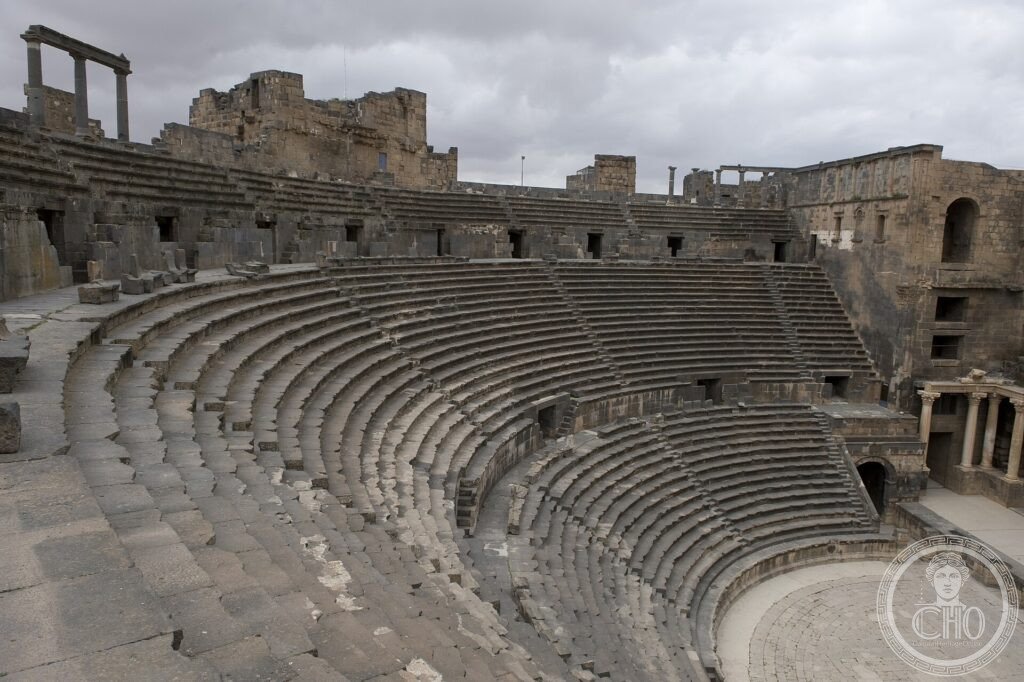
Built from the hard black volcanic stone of the Hauran, Bosra was capital of the Roman province of Arabia and a stop on the pilgrim road to Mecca. Its jewel is one of the best-preserved Roman theatres in the world, protected inside a citadel that has guarded its tiers for nearly two thousand years.
At a glance
Bosra, in southern Syria, was an important city for over a thousand years — Nabataean, then capital of the Roman province of Arabia, then a Byzantine bishopric and an early Islamic town on the pilgrimage road to Mecca. Built of the black basalt of the volcanic Hauran, it preserves an exceptional 2nd-century Roman theatre, one of the best-kept in the world, encased within a later fortress that protected it. The ancient city was inscribed by UNESCO in 1980.
Key facts
- UNESCO: World Heritage since 1980 (Ancient City of Bosra)
- Roman theatre: a magnificent 2nd-century theatre in black basalt
- Capital of Arabia: chief city of the Roman province
- Black stone: built of the volcanic basalt of the Hauran
- Many ages: Nabataean, Roman, Byzantine and early Islamic remains
- Pilgrim road: a station on the route to Mecca
History
Bosra was a Nabataean town that the Romans made the capital of their new province of Arabia in 106 AD, endowing it with the colonnaded streets, baths, arches and the great theatre of a provincial metropolis, all in the local black basalt. Under the Byzantines it became a bishopric with churches, and after the Muslim conquest a town on the road by which pilgrims travelled to Mecca.
In the Middle Ages the theatre was walled in and turned into a fortress, which ironically preserved it almost intact. The result is a layered city where Roman, Byzantine and Islamic monuments stand together, dominated by the dark mass of the theatre-citadel.
What you see
The Roman theatre is the marvel: a great semicircle of black basalt seats for thousands, rising in tiers before the stage wall, remarkably complete and enclosed within the medieval fortress that saved it. Around the town spread colonnaded streets, a triumphal arch, baths, the remains of churches and mosques, all in the same dark stone.
The contrast of black basalt against the sky gives Bosra a sombre grandeur.
Practical information
- Site: the theatre-citadel is the highlight; the town can be walked
- Time needed: half a day
- Note: check current travel advice for Syria before any visit
- Setting: in the Daraa region of southern Syria
Getting there
Bosra is in the Daraa governorate of southern Syria, near the border with Jordan, about 140 km south of Damascus. Access depends on the security situation. GPS: 32.518° N, 36.482° E.
Nearby
- Daraa — the regional town to the west
- Hauran — the black-stone volcanic plateau
- Damascus — the ancient capital to the north
Sources
- UNESCO World Heritage Centre — “Ancient City of Bosra” (ref. 22)
- Directorate-General of Antiquities and Museums of Syria — official body
- Encyclopaedia Britannica — Bosra
Find it on the map
See this place and what’s around it →📷 Become a Cultural Heritage Online photographer
Share your photos of places: they stay published under your name as the author. The more they're seen, the more you get noticed — and soon a contest will reward the most appreciated photos.
Log in or sign up free to add a photo