
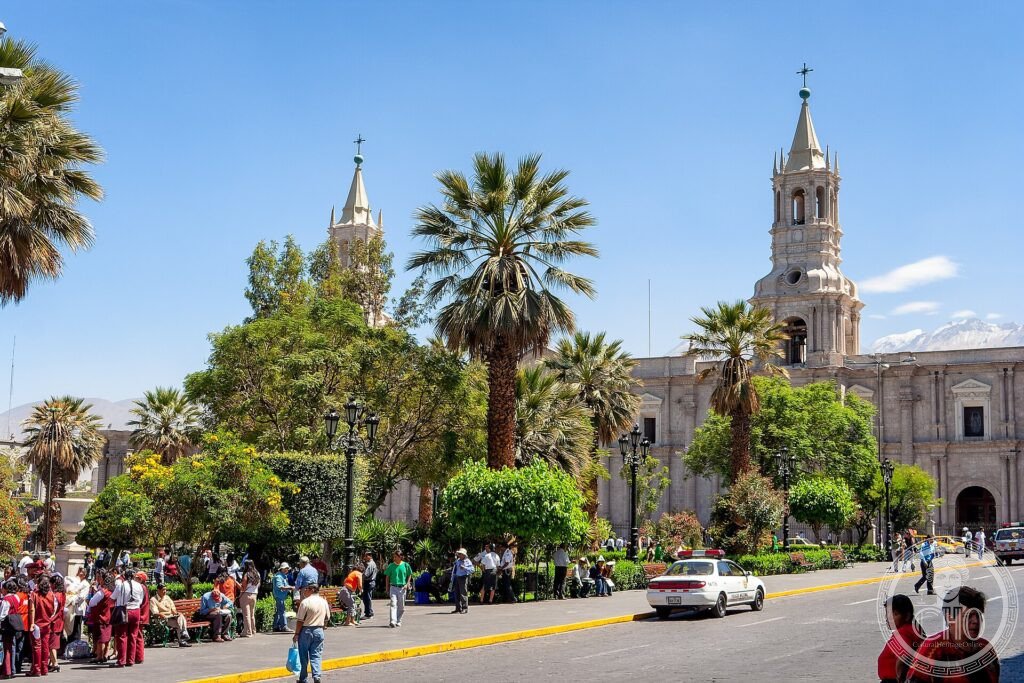
Built from sillar, the white volcanic stone of the volcanoes that surround it, Arequipa gleams in the Andean sun. In its baroque palaces and churches, Spanish and indigenous sculptors fused two worlds into an exuberant decoration. Above it watches the perfect cone of the Misti volcano.
At a glance
Arequipa, in the southern highlands of Peru, is known as the “White City” for the pale sillar — a white volcanic stone from the surrounding volcanoes — from which its historic centre is built. Founded by the Spanish in 1540, it developed a distinctive Baroque architecture in which European forms were enriched by indigenous craftsmen into an exuberant ornament called the mestizo or Andean Baroque. Set beneath the volcano El Misti, its historic centre was inscribed by UNESCO in 2000.
Key facts
- UNESCO: World Heritage since 2000 (Historical Centre of Arequipa)
- Sillar: built of white volcanic stone, hence the “White City”
- Founded: 1540 by the Spanish
- Andean Baroque: European forms enriched by indigenous carving
- El Misti: the volcano that overlooks the city
- Santa Catalina: a vast walled convent within the city
History
The Spanish founded Arequipa in 1540 in a fertile valley below the volcanoes, on a site long inhabited by Andean peoples. The settlers and their descendants built churches, mansions and convents from the abundant white sillar, which is easily carved, and over the 17th and 18th centuries local sculptors covered facades and portals in deep, intricate relief that blended Spanish Baroque motifs with native plants, animals and faces.
Repeated earthquakes shaped the architecture, encouraging thick walls, low vaults and buttresses. The result is a coherent colonial city of luminous white stone, an outstanding example of the fusion of European and indigenous traditions in the Americas.
What you see
On the Plaza de Armas, the white cathedral stretches the length of one side, arcades line the others, and palms shade the square, with El Misti rising beyond. The church and cloisters of La Compañía show the Andean Baroque at its richest, their portals carved like lace. Nearby, the great convent of Santa Catalina is a walled city-within-a-city of painted lanes and courtyards.
Mansions with carved sillar portals line the old streets, all glowing white in the strong highland light.
Practical information
- Old town: walkable; Santa Catalina convent and churches charge entry
- Time needed: one to two days
- Note: the gateway to the Colca Canyon
- Setting: at about 2,300 m in the Peruvian Andes
Getting there
Arequipa is in southern Peru, with an airport and road links from Lima and the south. The historic centre is the heart of the city. GPS: 16.3989° S, 71.537° W.
Nearby
- Colca Canyon — one of the world’s deepest canyons, with condors
- El Misti — the volcano above the city
- Santa Catalina Convent — the walled convent in the centre
Sources
- UNESCO World Heritage Centre — “Historical Centre of the City of Arequipa” (ref. 1016)
- Municipalidad de Arequipa — official authority
- Encyclopaedia Britannica — Arequipa
Find it on the map
See this place and what’s around it →📷 Become a Cultural Heritage Online photographer
Share your photos of places: they stay published under your name as the author. The more they're seen, the more you get noticed — and soon a contest will reward the most appreciated photos.
Log in or sign up free to add a photo