
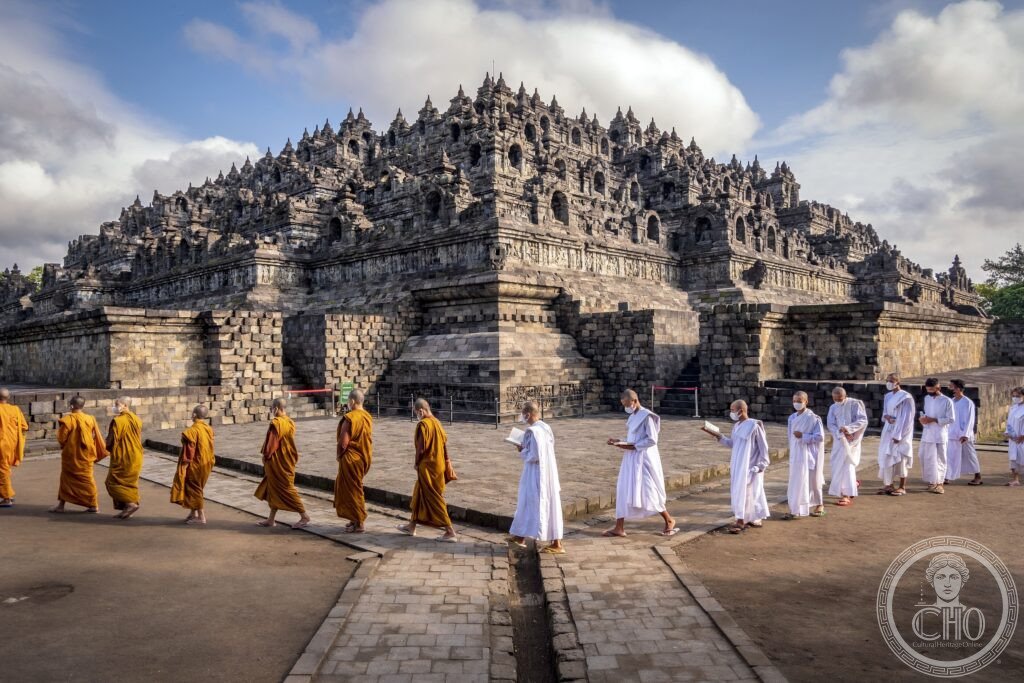
The largest Buddhist temple in the world and the most ambitious single stone monument ever built in South-East Asia — Borobudur, constructed on the Kedu Plain of Java by the Sailendra dynasty between 760 and 830 CE, is a stone mandala the size of a hill, its nine platforms of gallery and stupa rising through three realms of Buddhist cosmology toward the open sky and the silence of nirvana.
At a glance
Borobudur (UNESCO WHS 1991; the largest Buddhist monument in the world (more precisely: the largest Buddhist temple (the most frequently disputed architectural superlative in South-East Asian heritage; the Angkor Wat complex in Cambodia is larger in total area but is primarily Hindu with later Buddhist elements; Borobudur is the largest single-religion Buddhist temple structure); 55,000 m³ of andesite stone (the most volcanic stone used in any ancient monument in South-East Asia; andesite from the nearby Mount Merapi and surrounding highlands; the stone was cut to shape and fitted without mortar — the most precisely dry-stone-fitted construction in Java); the structure (a flat-topped artificial hill; 9 platforms; 6 lower square platforms of gallery corridors + 3 upper circular platforms of open stupas + 1 summit stupa; the geometry: the plan is a mandala (the sacred diagram of the Buddhist universe) when viewed from above — the most perfectly mandalic building plan of any Buddhist monument in the world; the base is 121 m square; the height from ground to summit stupa is 35 m)); the relief narrative (the most important single fact about Borobudur: the 4.5 km of stone relief panels that line the galleries of the six square platforms narrate the entire Mahayana Buddhist canon (the Lalitavistara sutra (life of the historical Buddha); the Jataka tales (stories of the Buddha’s previous lives); the Gandavyuha sutra (the pilgrim’s journey to enlightenment)); a worshipper walking the galleries clockwise from the base to the summit follows the Buddhist path to enlightenment in 2,672 relief panels — the most complete single stone narrative of a religious path in any monument in the world).
Key facts
- The cosmological structure: a three-dimensional diagram of the Buddhist universe — the three realms (the most important single idea for understanding Borobudur: the 9 platforms are divided into 3 zones that correspond to the 3 realms of Buddhist cosmology (the Kamadhatu (the world of desire; the hidden base platform with the “hidden foot” relief panels (160 panels of the Karmavibhangga sutra depicting the consequences of human desire — sinfull actions and their karmic punishment; these panels were covered with a stone casing shortly after the temple was completed, apparently for structural reasons — the most completely covered narrative sculpture in any ancient monument; fully uncovered only in 1885); the Rupadhatu (the world of form; the 6 square gallery platforms; the 2,672 narrative relief panels; the 432 Buddha statues in niches on the outer walls of the galleries — each in one of 5 mudras depending on the cardinal direction of the niche (the most precisely spatially coded assemblage of Buddha statues in any temple)); the Arupadhatu (the world of formlessness; the 3 circular platforms; the 72 lattice-work stupas each containing a seated Buddha; the summit stupa (the most debated element of Borobudur: the summit stupa is hollow and was found empty at excavation (the most frequently cited archaeological disappointment in Javanese history; the most argued: it may have contained a Buddha statue that was removed; it may always have been empty as a symbol of sunyata (emptiness, the void of Mahayana enlightenment — the most philosophically satisfying interpretation of the hollow stupa))
- The abandonment and rediscovery: the most dramatic reemergence of any ancient monument — the abandonment (Borobudur was abandoned c. 900–1000 CE; the cause: unknown for certain (the most debated abandonment in South-East Asian archaeology); the most likely reasons: the eruption of Mount Merapi (volcanic ash buried the temple and destroyed the agricultural surplus that supported the Sailendra court; the most consequential single volcanic event in Javanese cultural history); the shift of the Javanese Hindu-Buddhist kingdoms east (away from the Kedu Plain to the Brantas River valley and ultimately to Bali); the absorption of the Sailendra dynasty into the Hindu Mataram kingdom); the rediscovery (the most consequential single colonial administrative act in Indonesian heritage: Thomas Stamford Raffles, the British Lieutenant-Governor of Java (r. 1811–1816), heard rumours of a buried temple and sent the Dutch engineer H.C. Cornelius to investigate in 1814; Cornelius spent 2 months clearing jungle and volcanic ash with 200 workers and uncovered the main stupa; the most important temple discovery in 19th-century colonial South-East Asia); the restorations (the first restoration: 1907–1911 by Dutch engineer Theodore van Erp (the first systematic consolidation of the stone structure; the most important early-20th-century restoration in Java); the UNESCO mega-restoration: 1973–1983 (the most expensive and most technically complex UNESCO restoration project in the history of the World Heritage programme at that time: all 1,460 stones were dismantled, cleaned, treated for biological growth, and reassembled with improved drainage; the Indonesian government and UNESCO co-funded the project; total cost: USD 25 million))
- Merapi and Prambanan: the volcanic and Hindu context — Mount Merapi (8 km north-east of Borobudur; the most active and most dangerous volcano in Java; it has erupted more than 68 times since 1548 — the most reliably documented eruption sequence of any Indonesian volcano; the 2010 eruption (the largest since 1872; the most destructive modern Merapi eruption; 353 deaths; 350,000 people evacuated; the pyroclastic flows reached 15 km from the crater — the most rapid mass evacuation in Indonesian history); the eruption is visible from Borobudur on a clear day — the most geologically dramatic single view from a UNESCO monument in South-East Asia); the Hindu complement (Prambanan: described in Nearby)
- Heritage: UNESCO World Heritage Site, Borobudur Temple Compounds, inscribed 1991
- GPS: -7.6079° N, 110.2038° E
History
The Sailendra dynasty (c. 760–830 CE; the most important Buddhist dynasty in South-East Asian history; the Sailendra (meaning “Lords of the Mountain” — the most literally appropriate dynastic title in relation to their monument; the mountain they built is Borobudur) controlled the Kedu Plain of Central Java from approximately 750 to 850 CE; they were the first dynasty in the archipelago to build in large-scale permanent stone (the most significant architectural transition in the history of Indonesian civilisation: from wood and brick to stone); the patronage (the Sailendra were committed Mahayana Buddhists who maintained diplomatic relations with the Srivijaya Empire in Sumatra and with the Buddhist monasteries of Nalanda in India — the most important centre of Mahayana Buddhist learning in Asia; the Borobudur relief panels show a familiarity with Indian Buddhist iconography consistent with contacts at the highest scholarly level of the Nalanda tradition); the construction timeline (c. 760–830 CE; 70 years of building; the most sustained single monumental construction project in Javanese history; the later Islamic period (15th–16th centuries CE; as Islam spread through Java from the coastal trade cities, Borobudur fell deeper into obscurity; by the 17th century the temple was completely covered in jungle and volcanic ash and its very existence was forgotten by all but the nearest villages); UNESCO WHS 1991.
What you see
The Borobudur visit (the experience: enter from the east at the main gate; the first view is of the tiered profile from below — the monument appears modest at this angle; the revelation happens as you ascend; the galleries (walking the galleries clockwise: begin on the first east gallery and walk through the relief panels; the most effective approach: hire a knowledgeable local guide who can narrate the Jataka stories depicted; without context, the 2,672 panels blur into a continuous decorative frieze; with a guide, they become a complete illustrated mythology; allow 2h 30min for the galleries); the circular terraces (the moment of transition from the square gallery zone to the first circular terrace is the most memorable architectural experience at Borobudur: the narrative reliefs vanish; the enclosed corridor opens to the sky; the 72 lattice-work bell stupas surround you; through the diamond-shaped openings of each stupa you can see the seated Buddha inside; on clear days the summit gives a 360° panorama of the Kedu Plain and the surrounding volcanoes including Merapi directly east); the sunrise visit (the most popular and most recommended time: arrive at 4:30am for the supervised sunrise access; watch dawn break over Merapi and the Kedu Plain from the circular terraces — the most atmosphere-rich single moment in any Indonesian UNESCO visit).
Practical information
- Getting there: Yogyakarta International Airport (YIA; 40 km south-west of Borobudur; the main international gateway; direct flights from Singapore, Kuala Lumpur, Bali, Jakarta, Surabaya; from Singapore AirAsia (2h); from Bali (1h 30min); the drive from Yogyakarta city (Jl. Malioboro hotel area) to Borobudur: 45 km; 1h by car or organized tour; the most convenient base: Yogyakarta (the most culturally rich city in Java: Kraton palace; batik; wayang kulit shadow puppet theatre; the traditional Javanese arts capital of Indonesia)); the admission (the most frequently changing price in Indonesian UNESCO tourism: as of 2026, USD 25 for foreign tourists (the most commonly advertised online rate; verify current rate at Borobudur.id official site); the sunrise access ticket (USD 60; includes the central zone and circular terraces at dawn — the most heavily subscribed single timed access in Indonesian heritage tourism; book weeks in advance); the sarong (required at entry; provided free at the ticket gate — the most inclusive mandatory dress code provision at any Indonesian monument))
- Yogyakarta Kraton and Batik: the living Javanese court tradition — the Kraton (the Sultan’s Palace; the seat of the Yogyakarta Sultanate (the only surviving traditional sultanate in Indonesia with a formal place in the Indonesian state as a Special Region; the most constitutionally exceptional monarchy in Indonesia); the Kraton complex (the inner palace (the pendopo; the open pavilion with pillars; the most important single architectural space in Javanese court ceremony; batik gamelan concerts held here every morning); the batik workshops (Yogyakarta is the centre of Javanese batik — UNESCO Intangible Cultural Heritage 2009; the hand-drawn batik tulis (the finest and most time-consuming: a single sarong may take 3–6 months; the most prestigious form of Indonesian textile art; each pattern has a meaning and a ceremonial context); the Pasar Beringharjo market (the most important traditional batik market in Yogyakarta; the most price-negotiable textile market in Central Java))
- Bali and its temples: the Hindu-Buddhist culture that preserved the traditions Borobudur embodied — Bali (1h 30min flight from Yogyakarta; the most visited island in Indonesia (approximately 6 million international visitors per year); the Balinese Hindu-Buddhist culture (the direct descendent of the same culture that built Borobudur: when Islam converted Java in the 15th–16th centuries, the Majapahit court (the last great Hindu-Buddhist Javanese kingdom) retreated to Bali, bringing the full tradition of Javanese-Hindu art, dance, ritual, and literature (the most consequential cultural migration in Indonesian history); the result: Bali preserves the Mahayana-inflected Hindu tradition that mainland Java abandoned 500 years ago); the Pura Besakih (the most important temple in Bali: the “Mother Temple”; on the slopes of Gunung Agung (3,031 m; the most sacred mountain in Bali and the holiest volcano in Balinese Hinduism); the Pura Tirta Empul (the most important purification temple in Bali: the holy spring pool fed by a natural spring of the same name; Balinese men and women immerse themselves in the spring’s channels for ritual purification; the most actively used ritual bathing site in Indonesian Hinduism))
Getting there
Yogyakarta Airport (YIA) 40 km. Drive from Yogyakarta city 45 km / 1h. Entry approx. USD 25; sunrise ticket USD 60 (book in advance). Sarong provided free. Best: arrive 4:30am for sunrise. GPS: -7.6079, 110.2038.
Nearby
- Prambanan Hindu Temple Compound (UNESCO WHS 1991) — 40 km east of Borobudur (1h drive through Yogyakarta); the finest Hindu temple complex in South-East Asia and the architecturally perfect complement to Buddhist Borobudur — Prambanan (built c. 850 CE by the Mataram kingdom; the most dramatic example of the Hindu-Buddhist coexistence in Java (Prambanan was built contemporaneously with the final phase of Borobudur construction); the architecture (the central compound: 3 main candi (towers) for the Trimurti (Shiva 47 m; the tallest and most elaborate; Vishnu; Brahma) + 3 smaller candi for the vahanas (Nandi the bull; Garuda; Hamsa the goose); the inner reliefs (the Ramayana narrative panels on the inner balustrade of the Shiva candi — the most important Ramayana stone narrative outside India); the Prambanan Ballet (the Ramayana Ballet performed at the open-air Trimurti Theatre at Prambanan on full-moon evenings from May to October — the most atmospheric performing arts event in Indonesian heritage tourism; the backdrop is the illuminated Prambanan towers; the most cinematically staged traditional performance in Java))
- Mount Merapi and the volcanoes of Java — 28 km north-east of Borobudur; the most active and most dangerous volcano in Indonesia and the defining geological feature of the Borobudur landscape — Merapi (described in Key Facts; the lava tour (jeep tours to the hardened lava fields of the 2010 eruption at the mountain’s foot — the most viscerally geological tourist activity available in Central Java; the destroyed village of Kinahrejo (the village of the volcanic soothsayer Mbah Maridjan who refused to evacuate before the 2010 eruption and was killed by a pyroclastic surge — the most morally complex single story in Javanese volcano tourism)); the Observatory at Kaliurang (the most reliable live view of the active vent from a safe distance); Java’s other volcanoes (the Dieng Plateau (2,093 m; 2h north of Yogyakarta; the Hindu Arjuna temple complex on an active volcanic plateau — the oldest surviving Hindu temples in Java; the most atmospherically volcanic temple setting in the archipelago; the coloured acid lakes))
- Komodo National Park (UNESCO WHS 1991) — 2h flight from Yogyakarta (via Bali or Labuan Bajo); the only place on Earth where Komodo dragons live wild and the finest marine protected area in Indonesia — Komodo (the Komodo dragon (Varanus komodoensis; the most dangerous large lizard in the world; 3 m long; 70 kg; the most impressively large varanid in existence; the only large carnivorous lizard in the world that can kill large mammals (deer, pigs, goats) and has been documented attacking humans (the most frequently cited dangerous animal at any Indonesian UNESCO site); the largest animals are on Rinca Island (the most reliable viewing location: Rinca has the highest dragon density per km² in the island group); the manta rays (the Komodo archipelago waters are among the 3 richest manta ray aggregation sites in the world; the current season (March–May) produces the most frequent aggregations at the cleaning stations of Manta Point — the most predictable single large-marine-life viewing in Indonesian waters))
Sources
- Wikipedia, Borobudur; Sailendra dynasty; Prambanan, accessed June 2026
- UNESCO, Borobudur Temple Compounds, WHS reference 592, inscribed 1991
- Jan Fontein, The Pilgrimage of Sudhana: A Study of Gandavyuha Illustrations in China, Japan and Java, Mouton, 1967
Find it on the map
See this place and what’s around it →📷 Diventa un fotografo di Cultural Heritage Online
Condividi le tue foto dei luoghi: restano pubblicate con la tua firma come autore. Più vengono viste, più ti fai conoscere — e presto un concorso premierà le foto più apprezzate.
Accedi o registrati gratis per aggiungere una foto