
The Emperor Who Changed Buddhism
In 261 BC, Emperor Ashoka of the Mauryan dynasty watched the aftermath of the Battle of Kalinga. The region — roughly modern Odisha — had been conquered, but the cost was staggering: historians estimate 100,000 killed in battle, 150,000 deported, and many more dead from famine and disease. Ashoka, by his own account carved on rock edicts across the subcontinent, was horrified. He converted to Buddhism, renounced further conquest, and resolved to rule by dharma — moral law, compassion, non-violence. The great Buddhist complex at Sanchi, on a sandstone hill in what is now Madhya Pradesh, is the most tangible monument to that transformation.
Ashoka did not commission Sanchi for its own glory. He built it as a repository for Buddhist relics and a centre of religious practice in a region he was trying to integrate into his empire. The site he chose — a 91-metre sandstone hill above the Betwa River plain — had no particular prior significance. It became one of the most important Buddhist centres in the ancient world, and remains one of the best-preserved Buddhist monuments on earth, a UNESCO World Heritage Site since 1989.
The Great Stupa — Architecture of the Cosmos
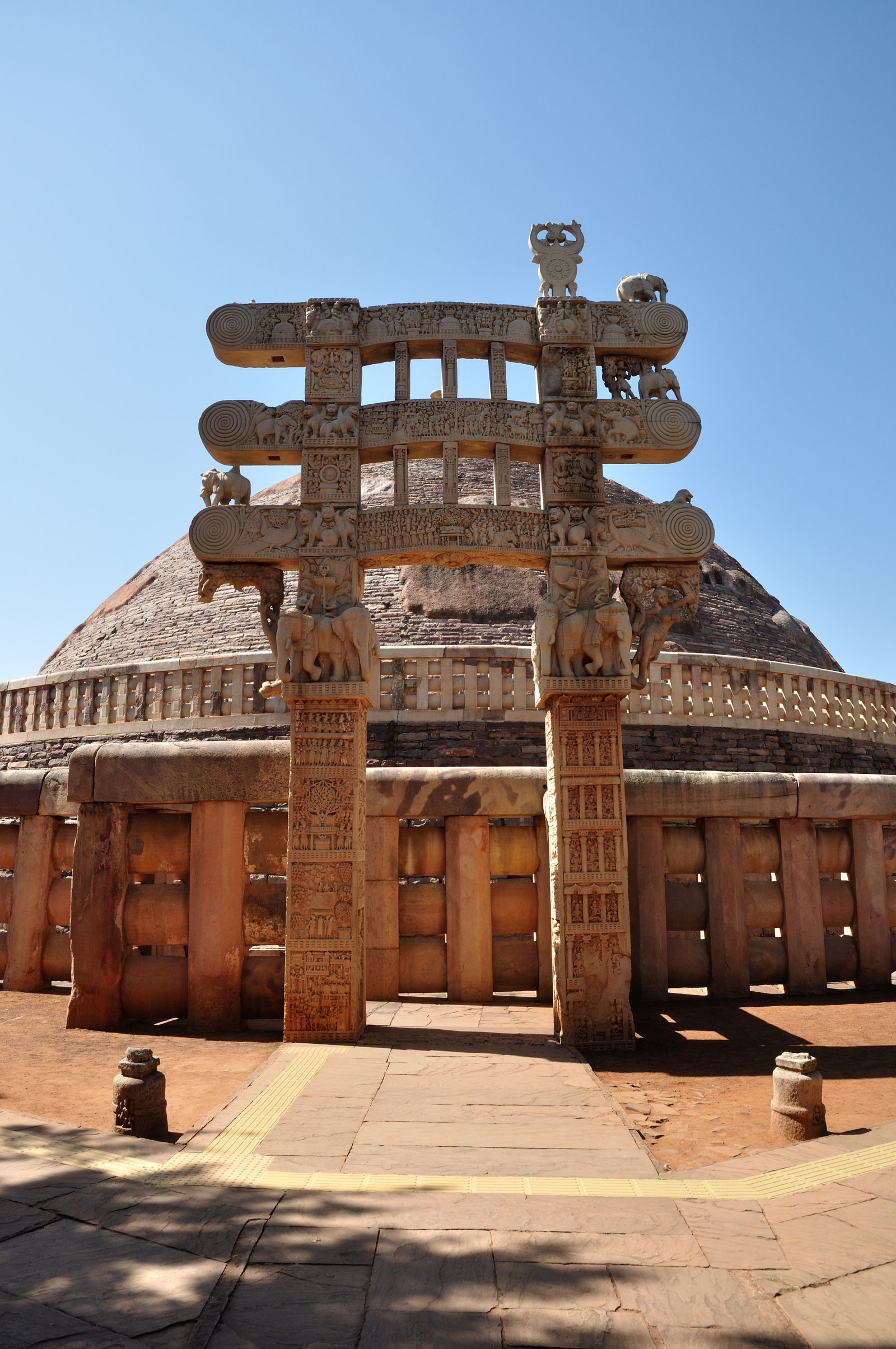
The Great Stupa (Stupa No. 1) at Sanchi is one of the oldest stone structures in India. Ashoka built the original as a simple hemispherical brick mound, approximately 36 metres in diameter and 16 metres in height, enclosing a relic chamber. It was later enlarged — doubled in diameter — and faced with stone by the Shunga dynasty in the 2nd century BC. A stone balustrade (vedika) was added around the perimeter, with four elaborate stone gateways (toranas) positioned at the cardinal directions.
The form of the stupa is cosmological: the hemispherical dome (anda) represents the world-mountain or the sky vault over the flat earth disc; the square railing at its summit (harmika) represents the sacred enclosure of the gods; the vertical mast (yashti) rising from the centre represents the cosmic axis. Walking clockwise around the stupa (pradakshina) is the primary act of veneration — circumambulation replicating the movement of the cosmos around its axis. Visitors still perform pradakshina at Sanchi today, following a path worn by 2,000 years of pilgrims.
The Toranas — A Library in Stone
The four gateways of the Great Stupa are masterpieces. Carved in the 1st century BC — more than a century after Ashoka — by ivory and wood craftsmen working in stone for the first time, each torana consists of two square pillars topped by three curved architraves. Every surface is covered in relief carvings depicting the Jataka tales (stories of the previous lives of the Buddha), episodes from the life of Gautama Siddhartha, and the symbolic language of early Buddhism. The carvings are dense, sophisticated, and deliberately narrative: they read like sequential panels, with scenes unfolding from one register to the next.
One of the most studied features of the early Buddhist art at Sanchi is the deliberate absence of the human figure of the Buddha. In the carvings, the presence of Gautama Siddhartha is indicated only through symbols: the Bodhi tree (his enlightenment), the wheel (the Dharma he set in motion), an empty throne, a pair of footprints, a parasol (royal authority), or a horse with no rider (his great renunciation, when he left his father's palace). Art historians call this the “aniconic” convention — representing the ineffable through absence rather than image. It was only in the 1st to 2nd century AD, at Gandhara and Mathura, that the human image of the Buddha became standard.
Ashoka Pillars and Royal Patronage
Ashoka erected a polished sandstone pillar at Sanchi as part of his broader empire-wide programme of inscribed edicts and marker pillars. The Sanchi pillar originally stood at the south gate; it has partially survived and is displayed in the site museum. Its capital — four lions seated back-to-back on an abacus decorated with dharma wheels and animals — is one of the finest examples of Mauryan sculptural art. The lion capital design from Sarnath (where the Buddha first preached) became the national emblem of the Republic of India; the Sanchi capital demonstrates the same tradition.
Royal patronage continued after Ashoka. Inscriptions at Sanchi record donations from merchants, monks, officials, and members of the royal court across several centuries. Some of the most interesting are inscribed on the vedika posts by individual donors who paid for specific sections of the stone railing — an early example of named patronage in Indian monumental architecture.
Stupas 2 and 3, and the Monastic Complex
The hilltop at Sanchi contains three major stupas and the remains of several monasteries, temples, and subsidiary shrines spanning from the 3rd century BC to the 12th century AD. Stupa No. 3 — smaller than the Great Stupa but with a single torana — contained relics of two of the Buddha's direct disciples: Sariputta and Maudgalyayana. These relics, excavated by Alexander Cunningham in 1851, were taken to England; they were returned to India in 1949 and are now enshrined in the newly built temple at the foot of the hill.
The monastic cells, visible as stone foundations across the hilltop, represent a community of monks that occupied the site continuously from the Mauryan period through the Gupta era (4th to 6th centuries AD), when Sanchi experienced its final major phase of construction. Temple 17, a small flat-roofed structure with a colonnaded porch, is one of the earliest surviving free-standing stone temples in India.
Discovery, Excavation, and Restoration
Sanchi was abandoned following the decline of Buddhism in India after the 12th century and was gradually swallowed by jungle on its isolated hill. It was rediscovered in 1818 by British general Henry Taylor, who noted “a circular mound of some magnitude” in his report. Early European visitors caused damage: Henry Maddock excavated the Great Stupa in 1822 to find relics, leaving it partially dismantled. Various officers removed architectural elements as souvenirs or decoration for their residences.
Systematic documentation began with Alexander Cunningham, who surveyed the site in the 1850s and published the first comprehensive account. Careful restoration was finally undertaken by John Marshall, Director-General of the Archaeological Survey of India, between 1912 and 1919. Marshall's work — meticulous, scholarly, and conservation-minded by the standards of his era — stabilised the structures and produced the definitive publication that established Sanchi's place in world art history.
Visiting Sanchi Today
Sanchi is in Raisen district, Madhya Pradesh, approximately 46 kilometres northeast of Bhopal. It is served by its own railway station (Sanchi station, on the Bhopal-Vidisha line) and is easily accessible by train or road from Bhopal. The site is managed by the Archaeological Survey of India and is open daily except Fridays.
The hilltop complex takes approximately 2 hours to walk thoroughly. The site museum at the foot of the hill — one of the ASI's finest — displays the Ashokan pillar capital, original gateway fragments, and finds from the excavations. Combine with a visit to the temples and cave inscriptions at nearby Udayagiri, 13 kilometres away, for a full day in the Malwa plateau's extraordinary concentration of early Indian monuments.
Essential Facts
- UNESCO WHS
- Inscribed 1989 — Buddhist Monuments at Sanchi
- Period
- c. 268 BC to 12th century AD
- Founded by
- Emperor Ashoka, Mauryan dynasty (273-232 BC)
- Location
- Raisen district, Madhya Pradesh, India, 46km northeast of Bhopal
- GPS
- 23.4793 N, 77.7397 E
- Managed by
- Archaeological Survey of India
- Getting there
- Sanchi railway station (Bhopal-Vidisha line); 46km by road from Bhopal
Find it on the map
See this place and what’s around it →📷 Become a Cultural Heritage Online photographer
Share your photos of places: they stay published under your name as the author. The more they're seen, the more you get noticed — and soon a contest will reward the most appreciated photos.
Log in or sign up free to add a photo