
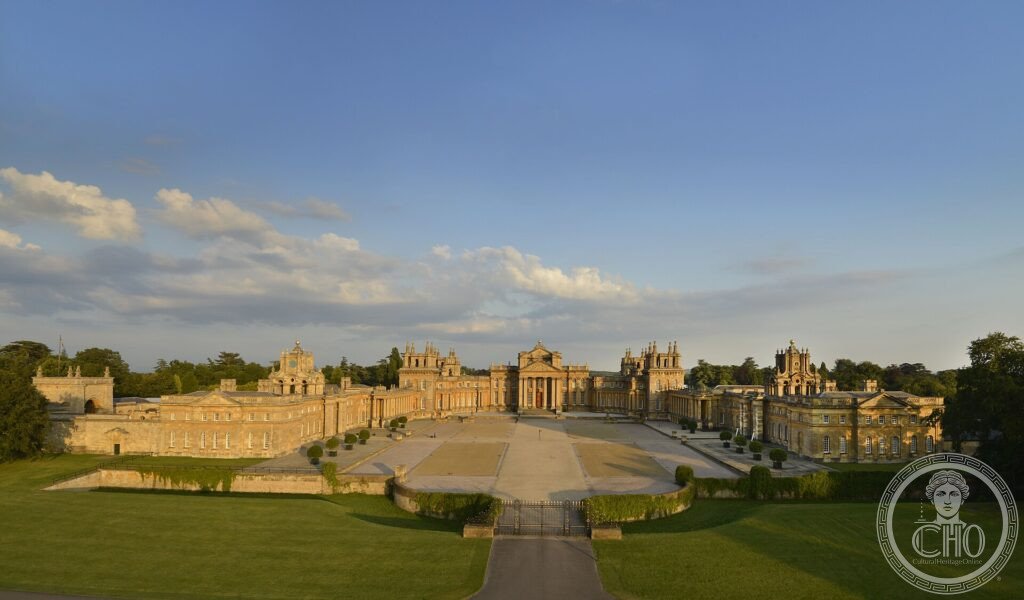
Dono della nazione al duca di Marlborough per la vittoria di Blenheim del 1704, questo palazzo è l’unica residenza non reale e non vescovile d’Inghilterra a fregiarsi del titolo di “palace”. Capolavoro del barocco inglese di Vanbrugh, immerso nel parco di Capability Brown, qui nel 1874 nacque Winston Churchill.
At a glance
Blenheim Palace is the masterpiece of English Baroque architecture, built between 1705 and 1722 to the design of Sir John Vanbrugh. It was a gift from Queen Anne and the nation to John Churchill, first Duke of Marlborough, in gratitude for his victory over the French at the Battle of Blenheim in 1704. The only country house in England to hold the title of “palace”, it stands in a vast landscaped park later remodelled by Capability Brown. In 1874 it was the birthplace of Winston Churchill. It was inscribed by UNESCO in 1987.
Key facts
- UNESCO: World Heritage since 1987 (Blenheim Palace)
- Built: 1705–1722, in the English Baroque style
- Architect: Sir John Vanbrugh, assisted by Nicholas Hawksmoor
- A national gift: awarded to the 1st Duke of Marlborough for the victory of Blenheim (1704)
- Birthplace of Churchill: Sir Winston Churchill was born here in 1874
- Park: the landscape was remodelled by Lancelot “Capability” Brown
History
In 1704 John Churchill, Duke of Marlborough, led the allied armies to a decisive victory over the French and Bavarians at Blindheim (Blenheim) in Bavaria. A grateful Queen Anne and Parliament granted him the royal manor of Woodstock and funds to build a palace in his honour. The architect Sir John Vanbrugh, with Nicholas Hawksmoor, conceived a theatrical Baroque composition as much monument as residence.
The building was dogged by cost overruns and quarrels with the duchess, but emerged as the grandest private house in England. In the 18th century Capability Brown swept away the formal gardens for a naturalistic park and lake. The palace remains the seat of the Dukes of Marlborough, and is celebrated as the birthplace, in 1874, of Sir Winston Churchill.
What you see
The palace presents a vast Baroque front of colonnades, towers and finials around a great court, designed for dramatic effect. Inside, the Great Hall, the Long Library and the state rooms display tapestries of Marlborough’s campaigns, while an exhibition marks Churchill’s birth. The painted Saloon and the chapel complete the state sequence.
Outside, Capability Brown’s park rolls away to the lake spanned by Vanbrugh’s Grand Bridge, with formal gardens near the house.
Practical information
- Entry: admission charged; tickets cover palace, park and gardens
- Park: the landscaped grounds reward a long walk to the lake and bridge
- Time needed: a full day for the state rooms and park
- Note: the palace is a family seat and may close for events
Getting there
Blenheim Palace lies at Woodstock in Oxfordshire, about 13 km north-west of Oxford. Oxford has fast trains from London (about an hour); buses run from Oxford to Woodstock. By car it is just off the A44. GPS: 51.8413° N, 1.3613° W.
Nearby
- Oxford — the university city of colleges and museums, about 13 km south-east
- The Cotswolds — the rolling country of golden-stone villages, to the west
- Bladon — the village churchyard where Winston Churchill is buried, near the park
Sources
- UNESCO World Heritage Centre — “Blenheim Palace” (ref. 425)
- Blenheim Palace — official estate site
- Encyclopaedia Britannica — Blenheim Palace; John Churchill, 1st Duke of Marlborough
Find it on the map
See this place and what’s around it →📷 Become a Cultural Heritage Online photographer
Share your photos of places: they stay published under your name as the author. The more they're seen, the more you get noticed — and soon a contest will reward the most appreciated photos.
Log in or sign up free to add a photoIs this page about you?
This page is read by travellers and heritage enthusiasts who find it on Google. Tell us how you are connected to this place and we will take it from there.