
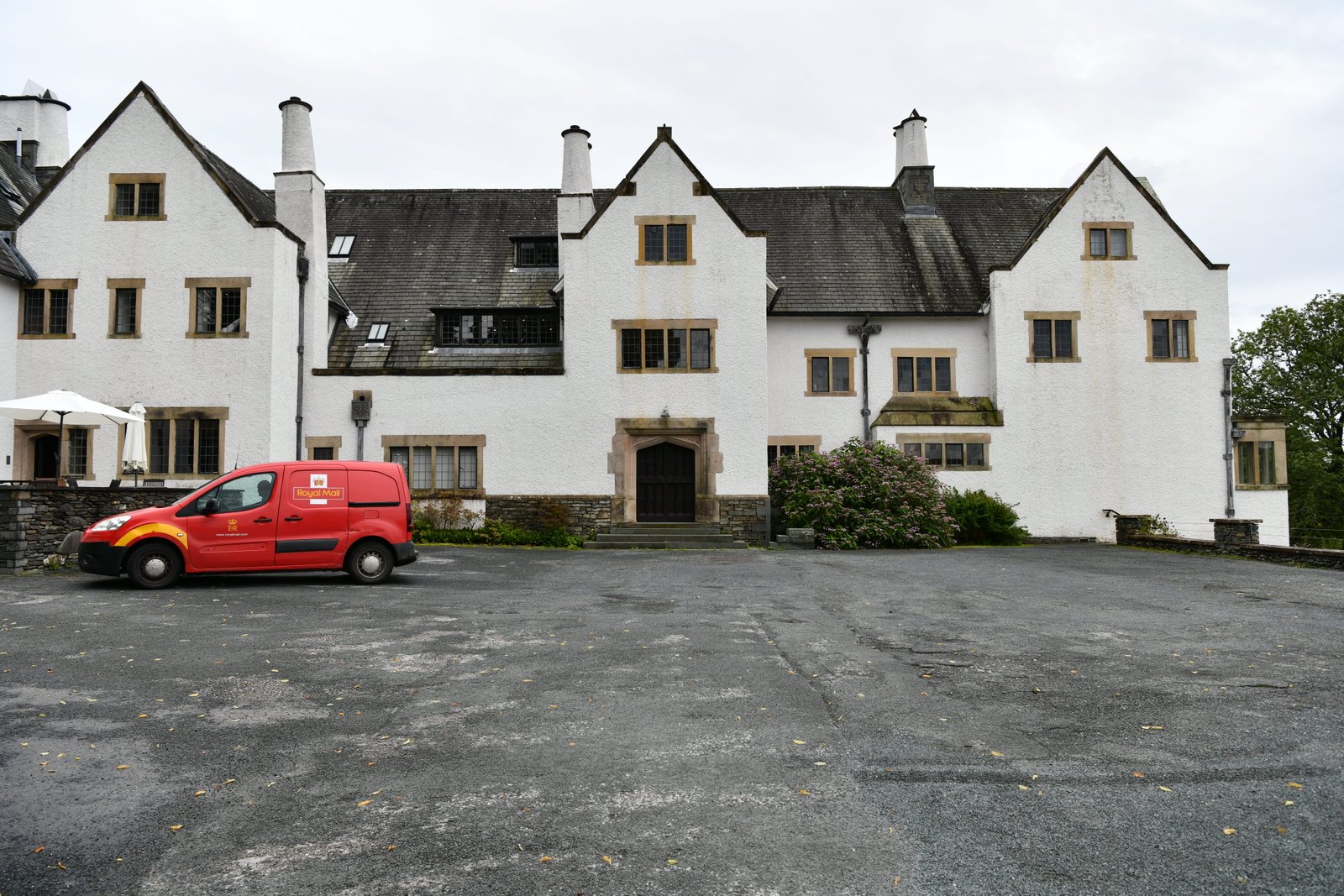

The finest surviving Arts and Crafts house open to the public in England, built for a Manchester brewer above the waters of Lake Windermere and virtually unchanged since 1900.
At a glance
Mackay Hugh Baillie Scott designed Blackwell in 1898 as a holiday retreat, and the result stands today as one of the most coherent demonstrations of Arts and Crafts ideals in domestic architecture. The whitewashed roughcast exterior, with its steeply pitched roofs and generously proportioned bay windows, gives little hint of the richness inside. The Great Hall inglenook, the White Drawing Room with its celebrated peacock frieze, the hand-carved panelling by Simpsons of Kendal, the metalwork by W.A.S. Benson — each room is a considered whole, not a showroom. Grade I listed and managed by Lakeland Arts since 2001, Blackwell sits above Lake Windermere with open views south toward the Coniston Fells.
Key facts
- Architect: Mackay Hugh Baillie Scott (1865–1945)
- Built: 1898–1900
- Client: Sir Edward Holt, Manchester brewer
- Style: Arts and Crafts
- Address: B5360, Bowness-on-Windermere, Cumbria LA23 3JT, England
- GPS: 54.3431, −2.9236 — Google Maps
- Designation: Grade I Listed Building (listing no. 1124680, designated 12 November 1969)
- Management: Lakeland Arts
- Open to public since: 2001
History
Sir Edward Holt, a wealthy Manchester brewer, commissioned the house in 1898 as a summer holiday retreat for his family. He chose Baillie Scott, then working from the Isle of Man and already gaining recognition through the pages of The Studio, for the project. Construction was completed in 1900, and the house served the Holt family through the Edwardian period exactly as intended — a place to escape the city and enjoy the Lake District landscape from a position of refined comfort.
The twentieth century brought changes of use. The house passed through various tenants and at one point served as a school for Lake District pupils during wartime. The decorative integrity that made it exceptional was, fortunately, never stripped out. A serious restoration programme began in the mid-1990s, led by a conservation team that uncovered and stabilised the original plasterwork, stained glass, and carved timber elements. Lakeland Arts opened Blackwell to the public in 2001, and the house quickly attracted attention as a rare example of an Arts and Crafts interior preserved in something close to its original state.
The gardens were laid out by Thomas Mawson, a Lakeland landscape architect who also worked at nearby Holker Hall. His terraced scheme of York stone paving, flower beds, and lawn edges toward the lake retains its essential structure today.
What you see
From the approach road the house reads as a long, whitewashed volume beneath a steeply pitched slate roof, its gables and bay windows projecting and receding in a rhythm characteristic of Baillie Scott’s mature domestic manner. The entrance is quieter than the lake-facing elevation, which opens in wide bays framing the water and the fells beyond. The roughcast render, textured and slightly warm in bright light, contrasts with the dark timber of the window surrounds — a deliberately understated exterior that does not prepare the visitor for what lies inside.
The Great Hall is the heart of the house. Its inglenook fireplace is large enough to sit inside; the carved woodwork and plasterwork above it carry stylised plant and berry motifs. The White Drawing Room on the first floor is the most celebrated space: a frieze of peacocks and berries runs at cornice height, rendered in low relief, while the light from lake-facing windows catches the pale surfaces throughout the day. Elsewhere, the rare Hessian wall-hanging in the dining room, the leaf-shaped door handles, and the distinctive window catches are exactly as Baillie Scott detailed them — evidence of a Gesamtkunstwerk approach in which every designed surface was held to the same standard as the architecture itself. Metalwork by W.A.S. Benson, ceramics from Pilkingtons and Ruskin Pottery, and furniture associated with Morris & Co. complete the picture.
Mackay Hugh Baillie Scott
Baillie Scott was born at Broadstairs, Kent, in 1865 and trained first at the Royal Agricultural College, Cirencester, before turning to architecture. He spent twelve formative years on the Isle of Man — initially at Douglas, then at Red House on Victoria Road, a building he designed himself — where he developed his version of Arts and Crafts domesticity in close contact with the designer Archibald Knox. His work in The Studio from 1894 onwards reached a wide professional audience, and by 1898, when Holt approached him, he was among the most distinctive voices in British domestic architecture.
Baillie Scott’s philosophy was straightforward: the house should be a unified work in which form, material, and decoration were resolved together from the first sketch. He distrusted applied ornament and preferred to derive decorative elements from the structure itself — carved beams, plastered ceilings with relief motifs, tiles integrated into fireplaces. In nearly 300 buildings over a long career (he died in Brighton in 1945), Blackwell remains the work that best demonstrates the ideal at full scale and in uncompromised condition.
Visiting
- Summer hours (1 Apr – 31 Oct): Monday – Saturday, 10am – 5pm
- Winter hours (1 Nov – 31 Mar): Monday – Saturday, 10am – 4pm
- Closed: Christmas Day and Boxing Day
- Admission: Adults £12 — Students £9 — Children (5–15) £6 — Under-4s free — Family (2 adults + up to 3 children) £30
- Art Fund: Members and Art Fund card holders enter free
- Tea room: Seasonal lunches, sandwiches, and cakes; hot food served until 3pm
- Gift shop: Books, ceramics, and Arts and Crafts-inspired objects
- Parking: Free car park on site, including blue badge spaces
- Allow: 1.5 – 2 hours for house and garden
Getting there
Blackwell sits on the B5360 approximately 1.5 miles south of Bowness-on-Windermere village. By rail, the nearest station is Windermere (served by Avanti West Coast and Northern from Oxenholme); from there the house is roughly 3 miles by taxi or local bus. Cyclists and walkers from Bowness can follow a footpath along the western shore of the lake; the journey on foot takes around 30 minutes. Free parking is available at the house for those arriving by car.
The Lake District setting
Blackwell stands within the Lake District, inscribed as a UNESCO World Heritage Site in 2017 for its outstanding cultural landscape shaped by centuries of farming, literary association, and conservation movement. The Victorian and Edwardian period saw a wave of substantial holiday houses built along the shores of Windermere, of which Blackwell is the finest surviving example open to visitors. Abbot Hall Art Gallery in Kendal, also managed by Lakeland Arts, holds a strong collection of British art and is 9 miles to the south-east. Hill Top, Beatrix Potter’s farmhouse at Near Sawrey, is 3 miles across the lake by ferry.
Sources
- Historic England, List Entry 1124680 — historicengland.org.uk
- Lakeland Arts — lakelandarts.org.uk/blackwell
- Wikipedia, “Baillie Scott” — en.wikipedia.org
- Wikipedia, “Blackwell (historic house)” — en.wikipedia.org
- UNESCO World Heritage, “The English Lake District” — whc.unesco.org
Find it on the map
See this place and what’s around it →📷 Become a Cultural Heritage Online photographer
Share your photos of places: they stay published under your name as the author. The more they're seen, the more you get noticed — and soon a contest will reward the most appreciated photos.
Log in or sign up free to add a photoIs this page about you?
This page is read by travellers and heritage enthusiasts who find it on Google. Tell us how you are connected to this place and we will take it from there.