
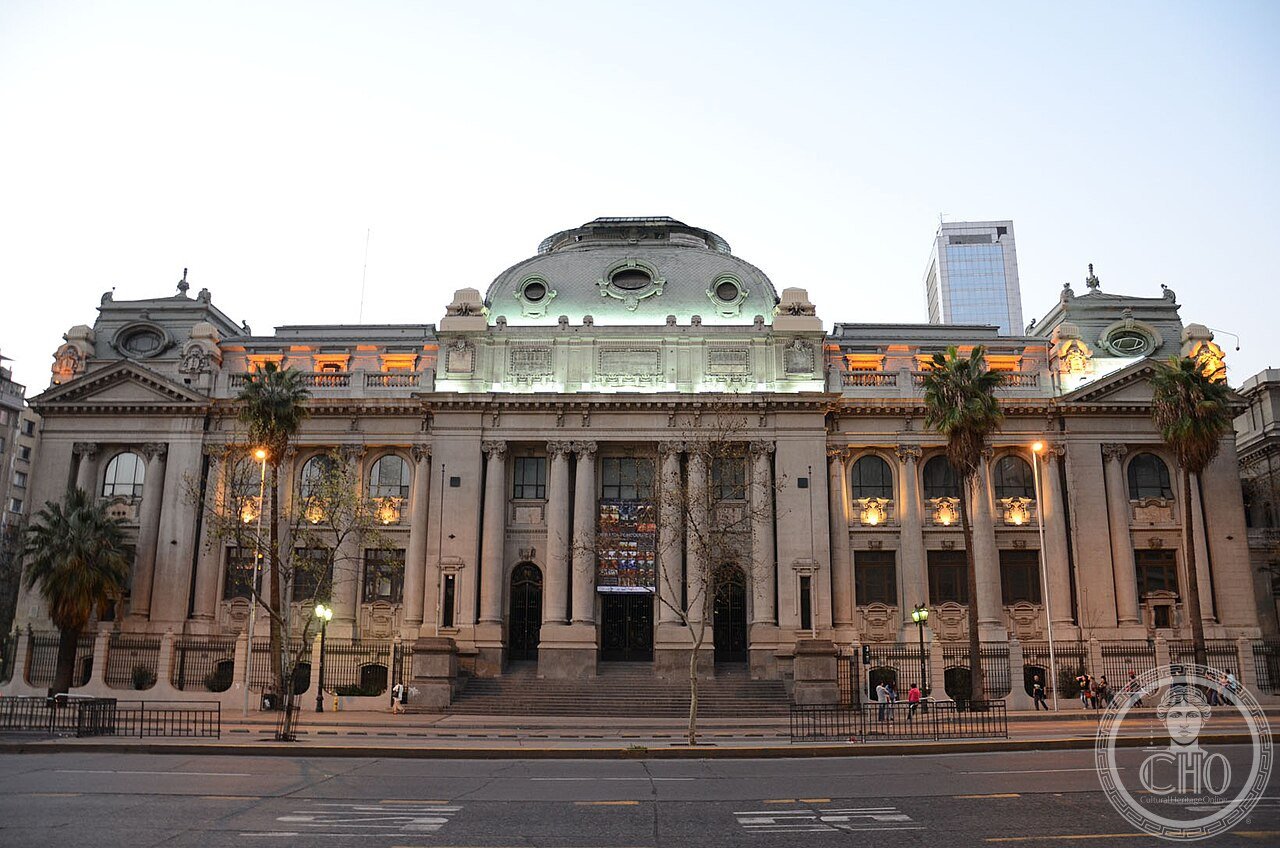
Rising above Avenida Libertador General Bernardo O’Higgins in central Santiago, the Biblioteca Nacional de Chile is Latin America’s largest and oldest national library. Its commanding French Neoclassical facade — a rhythmic procession of columns, arches, and sculpted stone — has anchored the intellectual life of the Chilean capital since its inauguration in 1925. Founded in the earliest years of the republic, the library weathered political upheaval, relocation, and war to become a living monument to the nation’s collective memory. Inside, marble staircases rise past murals by Chilean masters, and reading rooms hold over a million catalogued items spanning five centuries. For anyone who believes that great buildings house great ideas, this is Santiago’s secular cathedral — a place where the architecture itself is an argument for the enduring power of knowledge.
At a glance
- Type
- National Library
- Period
- Construction 1913–1925; institution founded 1813
- Style
- French Neoclassical
- Location
- Avenida Libertador General Bernardo O’Higgins 651, Santiago, Chile
- Coordinates
- 33.4421° S, 70.6457° W
- Architect(s)
- Émile Jecquier (attributed)
- Heritage Status
- National Monument of Chile
Overview
The Biblioteca Nacional de Chile is the oldest and largest national library in Latin America, holding more than 1.1 million registered items including manuscripts, maps, photographs, and rare printed works spanning five centuries of Chilean and South American history. Located in the heart of Santiago on the city’s main boulevard, the building is both a working research institution and a National Monument, recognized for the cultural and architectural significance it lends to the surrounding historic district. It shares its premises with the National Archive, making it a singular locus for scholarly inquiry into Chile’s past.
History
The library’s origins reach back to 19 August 1813, when it was established during Chile’s struggle for independence. In those turbulent early decades it suffered closures and disruptions as rival factions contested control of the young republic. Government patronage secured its survival, and in 1852 the institution gained autonomy from university supervision, cementing its role as a state organ of public enlightenment. By the late nineteenth century its collections had outgrown their premises, prompting a decision to commission an entirely new building. Construction on the current structure began in 1913 and continued for twelve years, producing the monumental French Neoclassical edifice that opened in 1925 and has served readers ever since.
Architecture & Design
The building presents an imposing street facade organized around a classical vocabulary of columns, arches, and rusticated stone that draws directly on the French Beaux-Arts tradition. Two main stories above a raised basement give the composition the gravitas appropriate to a national institution. Marble staircases inside ascend through luminous halls decorated with paintings and sculptures by Chilean artists, most notably Alfredo Helsby, whose landscapes and allegories line the principal reading rooms. The measured grandeur of the interiors — high ceilings, generous fenestration, coffered vaults — reflects the Positivist confidence of the era that reason and learning were themselves civilizational achievements worthy of monumental celebration.
Cultural significance
As custodian of Chile’s written heritage, the Biblioteca Nacional has preserved the personal archives of presidents, poets, scientists, and statesmen, making it an irreplaceable resource for scholars worldwide. It has served as a partner institution in the World Digital Library, extending access to its rarest holdings to researchers across the globe. The building itself embodies a pivotal chapter in Chilean urbanism — the ambition to align the young republic’s public architecture with the prestige of European neoclassicism — and remains one of Santiago’s most photographed and beloved landmarks.
Visiting today
The library is open to the public for research and general visits, free of charge. Reading rooms are available to anyone who registers on-site with valid identification. Temporary exhibitions drawn from the permanent collections are mounted regularly in the public galleries and require no prior booking. Photography for personal use is generally permitted in the entrance halls and exhibition spaces; prior authorization is required for work in restricted archive areas.
Getting there
The Biblioteca Nacional sits on Avenida Libertador General Bernardo O’Higgins, the principal east-west artery of central Santiago. The nearest Metro station is Santa Lucía (Line 1), a one-minute walk from the main entrance. Multiple bus routes serve the boulevard directly. By foot, the library is ten minutes from Plaza de Armas and five minutes from Cerro Santa Lucía, making it easy to combine with other landmarks in a single afternoon itinerary through the historic centre.
Sources & resources
Find it on the map
See this place and what’s around it →📷 Diventa un fotografo di Cultural Heritage Online
Condividi le tue foto dei luoghi: restano pubblicate con la tua firma come autore. Più vengono viste, più ti fai conoscere — e presto un concorso premierà le foto più apprezzate.
Accedi o registrati gratis per aggiungere una fotoDo you manage this place?
This page is read by travellers and heritage enthusiasts who find it on Google. Keep it accurate — and make it work for you. Free for non-profit heritage institutions.