
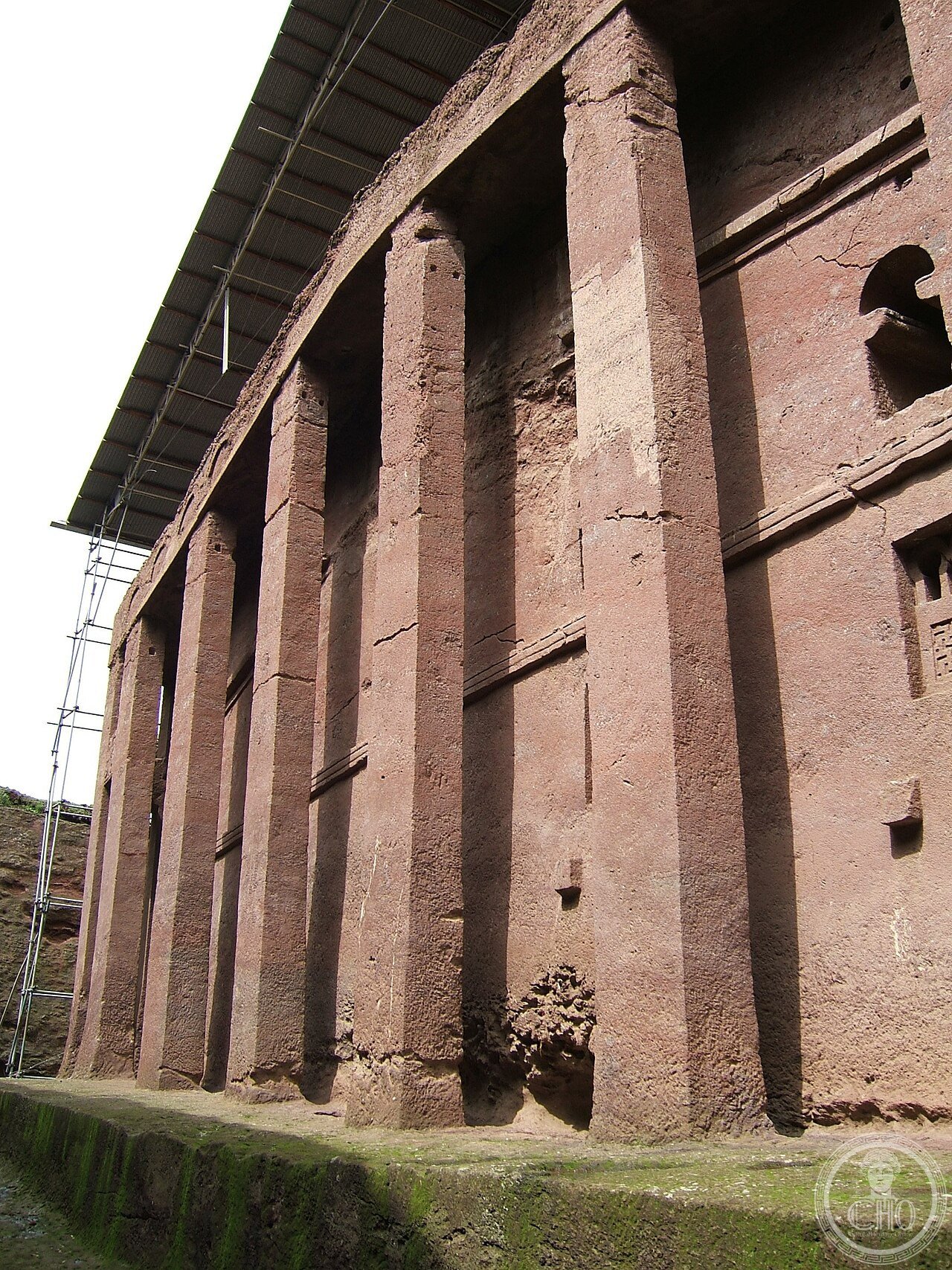
In Lalibela, Ethiopia, the church of Bete Medhane Alem (House of the Saviour of the World) was carved from a single block of volcanic rock. It is attributed to the reign of King Gebre Mesqel Lalibela of the Zagwe dynasty, whose reign is dated approximately between 1181 and 1221. The complex likely evolved, however, through several successive phases of excavation and alteration.
According to tradition — widely repeated in travel guides but not confirmed by primary academic sources — the church was modelled on the ancient Church of Saint Mary of Zion in Axum.
Measuring roughly 33.5-34 metres long, 23.5-24 metres wide, and about 11-11.5 metres high, it is surrounded by thirty-four rectangular pillars, three joined at each corner to symbolise the Trinity. It is commonly regarded as the largest monolithic church in the world.
Inside, tradition holds that three empty graves stand symbolically prepared for the biblical patriarchs Abraham, Isaac and Jacob. The church also houses the Lalibela Cross, a large gold processional cross stolen in 1997 and later recovered from Belgium.
Bete Medhane Alem belongs to the northwestern cluster of Lalibela’s churches, connected to its neighbours by rock-cut trenches and tunnels. It remains an active place of Ethiopian Orthodox Tewahedo worship today, hosting daily prayers and major festivals including Timkat and Genna.
Since 1978, it has formed part of the UNESCO World Heritage Site “Rock-Hewn Churches, Lalibela.”
About Bete Medhane Alem
Bete Medhane Alem, the Church of the Saviour of the World, in Lalibela, Ethiopia, was carved from a single block of volcanic rock, attributed to the reign of King Gebre Mesqel Lalibela of the Zagwe dynasty, dated approximately 1181 to 1221, though the complex likely evolved through several successive phases of excavation and alteration. According to tradition, widely repeated in travel literature though not confirmed by primary academic sources, the church was modelled on the ancient Church of Saint Mary of Zion in Axum. Measuring roughly 33.5 to 34 metres long, 23.5 to 24 metres wide, and about 11 to 11.5 metres high, surrounded by thirty-four rectangular pillars — three joined at each corner, said to symbolise the Trinity — it is commonly regarded as the largest monolithic rock-hewn church in the world. Inside, tradition holds that three empty graves stand symbolically prepared for the biblical patriarchs Abraham, Isaac and Jacob; the church also houses the Lalibela Cross, a large gold processional cross stolen in 1997 and later recovered from Belgium. Bete Medhane Alem belongs to the northwestern cluster of Lalibela’s churches, connected to its neighbours by rock-cut trenches and tunnels, and remains today an active place of Ethiopian Orthodox Tewahedo worship, hosting daily prayers and major festivals including Timkat and Genna. Since 1978, it has formed part of the UNESCO World Heritage Site “Rock-Hewn Churches, Lalibela.”
Key facts
- c. 1181-1221: attributed to the reign of King Gebre Mesqel Lalibela.
- ~33.5-34 x 23.5-24 x 11-11.5 metres, believed to be the largest monolithic rock-hewn church in the world.
- 34 rectangular pillars surround the church, three joined at each corner.
- Three empty graves, traditionally prepared for Abraham, Isaac and Jacob.
- The Lalibela Cross, a gold processional cross stolen in 1997 and later recovered from Belgium.
- 1978: becomes part of the UNESCO World Heritage Site “Rock-Hewn Churches, Lalibela”
History
Bete Medhane Alem’s scale, unmatched by any other monolithic church known anywhere in the world, reflects the extraordinary ambition of King Lalibela’s rock-hewn building programme, an undertaking that transformed a highland Ethiopian town into one of the most remarkable concentrations of medieval religious architecture on earth. The theft and eventual recovery of the Lalibela Cross underscores the ongoing vulnerability of Ethiopia’s sacred heritage even in the modern era, and the continued importance of its recovery to the church’s living community.
What you see
The church’s massive rock-cut form rises within a sunken courtyard, its exterior ringed by thirty-four rectangular pillars and its interior divided into multiple naves separated by further columns. Visitors move between Bete Medhane Alem and its neighbouring churches in the northwestern cluster via a network of trenches and tunnels carved directly into the surrounding rock.
Practical information
- Opening hours: generally open daily with seasonal variation; admission fee applies; check current hours before visiting.
- Address: Lalibela, Amhara Region, Ethiopia.
Getting there
Bete Medhane Alem stands within the northwestern cluster of Lalibela’s rock-hewn churches, reachable on foot within the town. GPS: 12.0337° N, 39.0436° E.
Nearby
- Bete Maryam — another of the eleven Lalibela churches, connected by tunnel.
- Bete Giyorgis — the cross-shaped Church of Saint George, a short walk away.
- Lalibela town — the surrounding highland town, source of the church complex’s name.
Sources
- Wikipedia — “Bete Medhane Alem” (en.wikipedia.org).
- Wikipedia — “Rock-Hewn Churches, Lalibela” (en.wikipedia.org).
- UNESCO World Heritage Centre — “Rock-Hewn Churches, Lalibela” (whc.unesco.org).
Find it on the map
See this place and what’s around it →📷 Become a Cultural Heritage Online photographer
Share your photos of places: they stay published under your name as the author. The more they're seen, the more you get noticed — and soon a contest will reward the most appreciated photos.
Log in or sign up free to add a photo